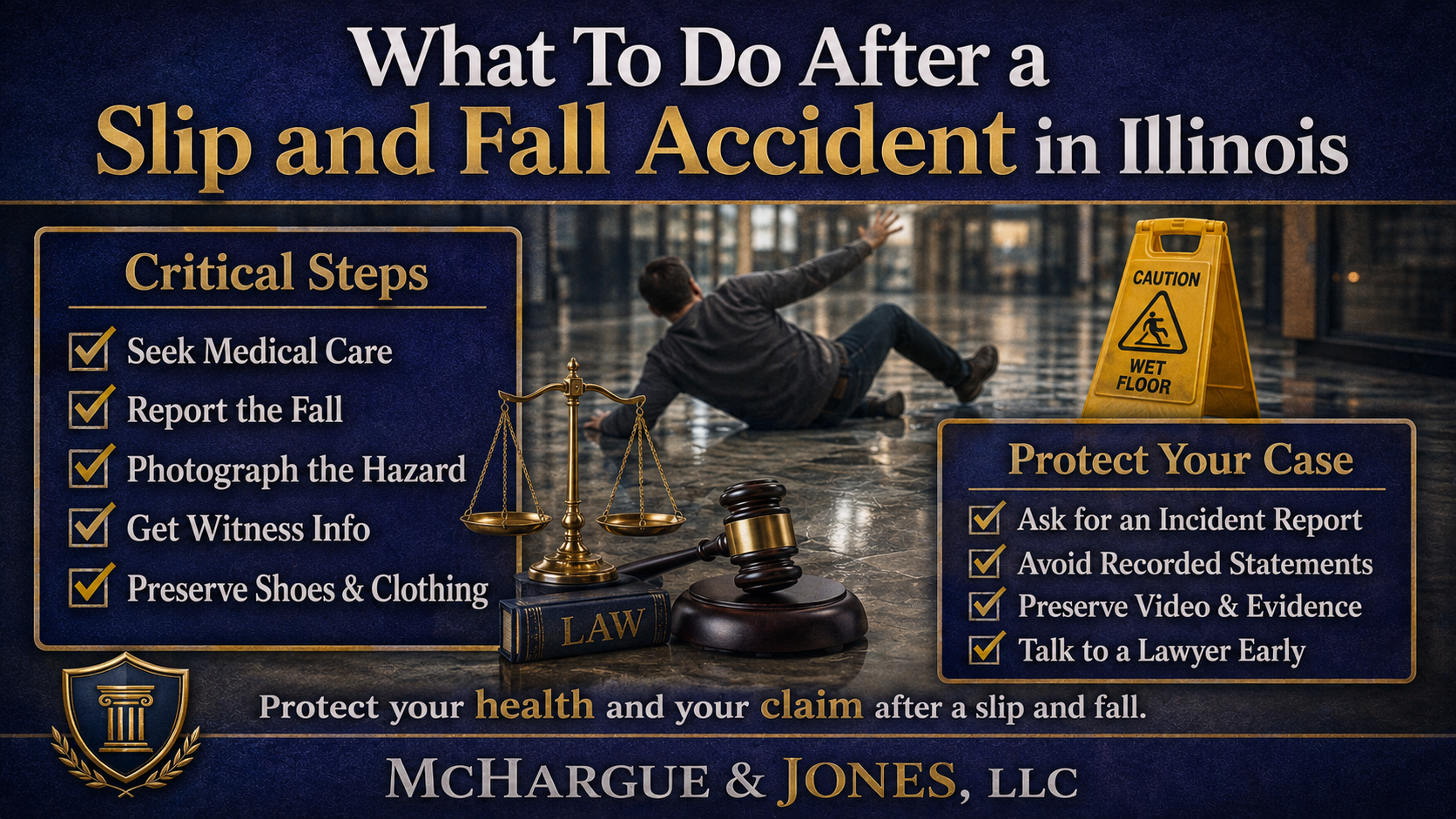


What To Do After a Slip and Fall Accident in Illinois
If you slipped and fell at a store, apartment building, restaurant, parking lot, sidewalk, workplace, or other property in Illinois, what you do next can affect both your health and your injury claim.
Slip and fall cases are often won or lost based on evidence. The dangerous condition may be cleaned up. Surveillance video may be erased. Witnesses may leave. The property owner may create an incident report that does not tell the full story. Later, the insurance company may argue there was no notice, the hazard was open and obvious, or you caused your own fall.
The short answer is this: after a slip and fall accident, get medical care, report the fall, photograph the hazard, ask for an incident report, preserve your shoes and clothing, get witness information, avoid recorded statements, and speak with a lawyer before accepting a quick settlement.
McHargue & Jones helps injured people with Chicago slip and fall lawyer and premises liability claims, including falls at stores, apartments, restaurants, parking lots, sidewalks, workplaces, and other unsafe properties.
[/vc_column_text][/vc_column][/vc_row]
Quick Answer: What Should You Do After a Slip and Fall in Illinois?
After a slip and fall accident in Illinois, you should get medical care, report the fall, photograph the hazard, ask for an incident report, get witness information, preserve your shoes and clothing, avoid recorded statements, and speak with a lawyer before accepting a settlement.
These steps matter because slip and fall cases often depend on proof of the dangerous condition, notice to the property owner, surveillance video, cleaning logs, inspection records, witness statements, and medical documentation.
Injured in a slip and fall accident?
Before you give a recorded statement or accept a quick offer, get advice about what evidence needs to be preserved and what your case may be worth.
Slip and Fall Checklist: What To Do Right Away
If you are physically able, take these steps after a slip and fall accident:
- Get medical care, even if the injury seems manageable at first.
- Report the fall to the store, landlord, manager, supervisor, or property owner.
- Ask for an incident report and request a copy or photo if possible.
- Photograph the hazard before it is cleaned, repaired, salted, blocked off, or changed.
- Photograph the surrounding area, including lighting, warning signs, cameras, stairs, mats, water, ice, snow, flooring, or debris.
- Get witness names and contact information before people leave.
- Preserve your shoes and clothing in the same condition they were in at the time of the fall.
- Do not admit fault or say you are fine if you are hurt.
- Do not give a recorded statement to the insurance company before understanding your rights.
- Contact a slip and fall lawyer quickly so video, reports, cleaning logs, inspection records, and other evidence can be preserved.
For a broader overview of these claims, visit our main page for a Chicago slip and fall lawyer. If you want to understand the evidence side, see our guide on how to prove a slip and fall case in Illinois.
Step 1: Get Medical Care Right Away
Your health comes first. After a fall, pain can get worse over the next several hours or days. Some injuries are obvious right away, but others may not fully show up until later.
Common slip and fall injuries include:
- Broken wrists, arms, ankles, or hips
- Knee injuries
- Shoulder injuries
- Back and neck injuries
- Disc injuries
- Concussions and head injuries
- Sprains, strains, and soft-tissue injuries
- Scarring or permanent limitations
Seeing a doctor quickly helps protect your health and creates a medical record connecting your injuries to the fall. If you wait too long, the insurance company may argue that you were not really hurt, that something else caused the injury, or that your condition is not as serious as you claim.
Step 2: Report the Slip and Fall Accident
Report the fall as soon as possible to the person or business responsible for the property. Depending on where the fall happened, that may be a store manager, landlord, building owner, restaurant employee, property manager, supervisor, security guard, or maintenance office.
When reporting the incident:
- Stick to the facts
- Identify where you fell
- Describe what caused you to fall if you know
- Ask whether an incident report will be created
- Request a copy or photo of the report
- Do not guess, apologize, or say you were careless
Be careful with casual statements. Saying “I am okay” or “I should have been watching” may later be used against you, even if you were just embarrassed, in pain, or trying to be polite.
Step 3: Photograph the Hazard Before It Changes
Photographs can be some of the most important evidence in a slip and fall case. Dangerous conditions are often temporary. A spill may be wiped up. Ice may melt. Snow may be shoveled. A broken mat may be removed. A warning sign may be placed after the fall.
If you can safely do so, photograph:
- The exact hazard that caused the fall
- Water, liquid, ice, snow, grease, food, debris, or uneven flooring
- Broken stairs, missing handrails, loose rugs, mats, or uneven pavement
- The surrounding area from multiple angles
- Lighting conditions
- Missing or poorly placed warning signs
- Your shoes and clothing
- Your visible injuries
- Nearby cameras, entrances, aisles, stairs, or exits
Take both close-up photos and wider photos showing where the hazard was located. The goal is to show not only what caused the fall, but also why a reasonable property owner should have discovered, repaired, cleaned, blocked off, or warned about the danger.
Step 4: Get Witness Information Before People Leave
Witnesses can be extremely important. A witness may have seen you fall, noticed the hazard before you fell, heard an employee talk about the danger, or seen similar problems in the same area before.
Try to get:
- Names
- Phone numbers
- Email addresses
- Short notes about what each person saw
Do not assume the store, landlord, property manager, or business will keep witness information for you. If a witness leaves and is never identified, important proof may be lost.
Step 5: Preserve Your Shoes and Clothing
Your shoes and clothing may matter more than you think. Insurance companies sometimes argue that the injured person fell because of the wrong footwear, worn soles, or carelessness.
After a fall, save the shoes you were wearing. Do not throw them away. Do not keep wearing them. Do not clean them. Take photos of the soles, sides, and condition of the shoes.
You should also save clothing if it was wet, torn, stained, dirty, or damaged in the fall. The condition of your clothing may help support what happened and what you landed on.
Step 6: Ask About Surveillance Video and Incident Reports
Many stores, apartment buildings, restaurants, parking lots, and commercial properties have cameras. Video can show the fall, the dangerous condition, how long the hazard existed, whether employees walked by it, and whether warning signs were present.
But video may not be saved for long. Some systems overwrite footage quickly. Incident reports, cleaning logs, and inspection records may also become harder to obtain with time.
A lawyer can send a preservation request asking the property owner, business, landlord, management company, maintenance company, snow removal company, or security company to preserve relevant video, incident reports, inspection logs, maintenance records, cleaning logs, and other evidence.
This is especially important if the property owner is already denying responsibility or claiming there is “no video.”
Step 7: Do Not Give a Recorded Statement Too Early
The property owner’s insurance company may contact you quickly. They may sound friendly. They may say they only need your side of the story. They may ask for a recorded statement.
Be careful.
Recorded statements can be used to argue that you did not know what caused the fall, that you were not seriously hurt, that the hazard was obvious, or that your injuries developed later for some other reason.
Before giving a recorded statement, signing anything, or accepting money, make sure you understand the legal issues in your case. Slip and fall claims often involve notice, causation, comparative fault, surveillance video, incident reports, and medical proof.
What Evidence Matters Most in an Illinois Slip and Fall Case?
Slip and fall cases often turn on proof. The insurance company may not dispute that you fell. The fight is usually over why you fell, how long the hazard existed, whether the property owner should have fixed it, and how badly you were hurt.
Important evidence may include:
- Photos and videos of the hazard
- Surveillance footage
- Incident reports
- Cleaning logs
- Inspection records
- Maintenance records
- Prior complaints or prior incidents
- Witness statements
- Medical records
- Photos of shoes and clothing
- Weather records in ice or snow cases
Our page on proving a slip and fall case in Illinois explains these evidence issues in more detail.
What If the Property Owner Says the Danger Was Open and Obvious?
Property owners and insurers often argue that a hazard was “open and obvious.” In plain English, they are arguing that you should have seen the danger and avoided it.
That defense can make a case harder, but it does not always end the claim. The facts matter. Lighting, distraction, layout, warning signs, employee conduct, necessity of using the area, and other circumstances may all affect the analysis.
If the property owner or insurance adjuster is blaming you for the fall, review our article on open and obvious dangers and the distraction exception in Illinois premises liability cases.
What If You Slipped and Fell While Working?
If you slipped and fell while working, your case may involve more than one claim.
For example, delivery drivers, healthcare workers, construction workers, maintenance workers, cleaners, contractors, warehouse workers, and service employees may be injured on property controlled by someone other than their employer.
In that situation, you may have:
- A workers’ compensation claim through your employer
- A third-party premises liability claim against the property owner
- A claim against a maintenance contractor, snow removal company, security company, or another negligent party
This matters because workers’ compensation may cover medical care and temporary disability benefits, while a third-party claim may allow recovery for pain and suffering and other damages. For more, see our guide on workers’ compensation vs. third-party claims in Illinois and our article on whether you can sue if you were hurt at work in Illinois.
Where Do Slip and Fall Accidents Happen?
Slip and fall accidents can happen anywhere people are expected to walk safely. Common locations include:
- Grocery stores
- Restaurants and bars
- Retail stores
- Apartment buildings
- Office buildings
- Hospitals and medical buildings
- Parking lots
- Sidewalks
- Stairs and stairwells
- Worksites
- Hotels
- Swimming pool areas
Different locations can involve different evidence. A store may have cleaning logs and aisle video. An apartment building may have maintenance records. A parking lot fall may involve snow removal contracts or lighting issues. A workplace fall may involve both workers’ compensation and third-party liability.
For a broader overview of these claims, visit our page on slip and fall accidents in Illinois.
What Not To Do After a Slip and Fall Accident
Some mistakes can make a slip and fall claim harder to prove. After a fall, try to avoid these problems:
- Do not leave without reporting the fall if you are physically able to report it.
- Do not assume the property owner will save video.
- Do not throw away your shoes or clothing.
- Do not post details about the fall or your injuries on social media.
- Do not say you are fine if you are in pain.
- Do not give a recorded statement before understanding your rights.
- Do not accept a quick settlement before the full medical picture is clear.
Once evidence disappears or a settlement is signed, it can be difficult or impossible to undo the damage.
How Long Do You Have to File a Slip and Fall Claim in Illinois?
In many Illinois personal injury cases, the deadline to file a lawsuit is generally two years from the date of injury. But there are important exceptions. Claims involving government property, public sidewalks, public buildings, schools, municipalities, or other public entities may involve shorter deadlines and special rules.
Do not wait until the deadline is close. In slip and fall cases, the practical evidence deadline may be much shorter because video can be overwritten, witnesses can disappear, and the dangerous condition may be repaired or cleaned up.
When Should You Call a Slip and Fall Lawyer?
You should consider legal help if:
- You needed emergency medical care
- You are still treating
- You missed work
- You suffered a fracture, head injury, back injury, knee injury, shoulder injury, or surgery-level injury
- The property owner is denying responsibility
- The hazard was fixed or cleaned quickly after the fall
- The insurance company is blaming you
- You were hurt while working on someone else’s property
- You are being pressured to give a recorded statement or accept a quick settlement
A lawyer can help preserve evidence, identify the responsible parties, obtain video and records, document your injuries, and evaluate whether the settlement offer reflects the real value of the case.
FAQ: What To Do After a Slip and Fall Accident in Illinois
What is the first thing I should do after a slip and fall?
Get medical care and report the fall. Your health comes first, and the incident report can help document when and where the fall happened.
Should I take pictures after a slip and fall?
Yes. If you can safely do so, photograph the hazard, surrounding area, warning signs, lighting, floor condition, shoes, clothing, and visible injuries before anything changes.
Do I need an incident report?
An incident report can be helpful because it creates a record with the property owner or business. Ask for a copy or take a photo of the report if possible.
Should I talk to the insurance company after a slip and fall?
Be careful. You should avoid recorded statements, broad medical authorizations, or quick settlement agreements before understanding your rights and the full extent of your injuries.
What if I do not know exactly what caused me to fall?
That can make the case harder, but it does not always mean there is no claim. Photos, video, witnesses, incident reports, and maintenance records may help identify the dangerous condition.
What if I slipped and fell at work?
You may have a workers’ compensation claim and, depending on the facts, a separate third-party premises liability claim against someone other than your employer.
How long do I have to file a slip and fall lawsuit in Illinois?
In many Illinois personal injury cases, the deadline is generally two years from the date of injury, but some claims have shorter deadlines or special rules. You should speak with a lawyer quickly so evidence and deadlines are protected.
Talk to a Chicago slip and fall lawyer before evidence disappears
McHargue & Jones helps people injured in slip and fall and premises liability cases throughout Chicago and Illinois. We can review what happened, explain your options, and help preserve the evidence needed to prove your case.