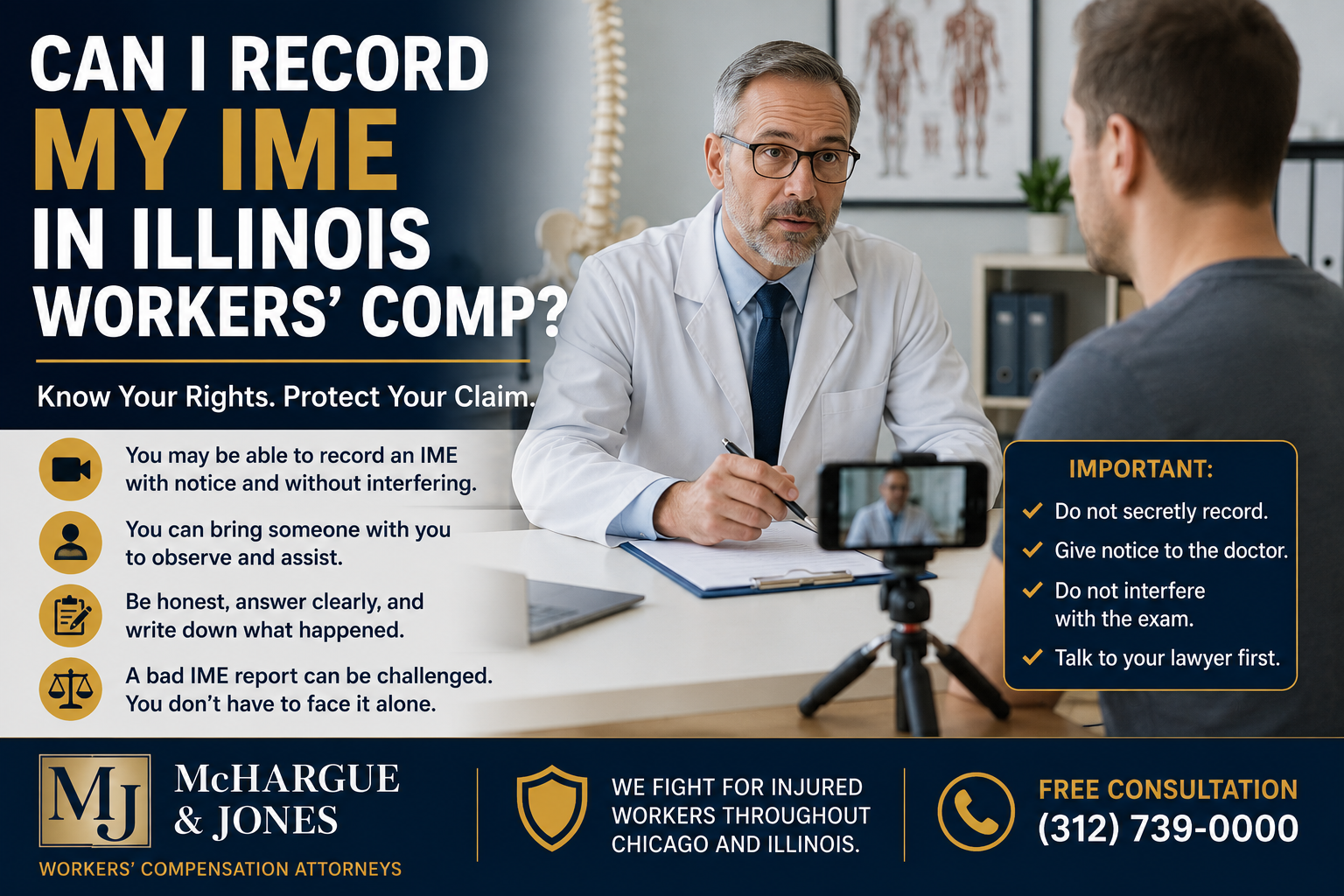


Can You Record an IME in an Illinois Workers’ Compensation Case?
Quick answer: In many Illinois workers’ compensation cases, you may be able to record an IME if it is done properly, with notice, and without interfering with the examination. You should not secretly record the IME doctor. You also should not assume that recording the exam will win your case. In my experience handling Illinois workers’ compensation cases for nearly 20 years, I have never seen an IME recording become the key evidence that changed the result.
I understand why injured workers want to record an IME. They are nervous. They are worried the IME doctor will lie, leave things out, twist what they said, or write a one-sided report. Those fears are not crazy. IMEs are a big deal. A bad IME report can lead to denied surgery, stopped workers’ comp checks, light-duty pressure, or a fight over whether your injury is work-related.
But recording is usually not the most important part of the fight.
What matters more is being honest, consistent, prepared, and careful. If the IME doctor writes a bad report, we usually fight it with medical records, treating doctor opinions, cross-examination, deposition testimony, bias evidence, job-duty evidence, and trial proof — not with an audio or video recording.
If the insurance company scheduled you for an IME, start with our full guide to IMEs in Illinois workers’ compensation. If your benefits have already been denied, stopped, or delayed, talk to a Chicago workers’ compensation lawyer before the IME report becomes the centerpiece of the insurance company’s defense.
Quick Answer: Can You Record an IME in Illinois Workers’ Comp?
Generally, yes, you may be able to record an IME in Illinois if it is done properly. But that does not mean you should secretly record the doctor, surprise the doctor, or make the recording the main focus of the exam.
If you want to record the IME, talk to your attorney before the appointment. Your lawyer can decide whether it makes sense, whether notice should be given, whether the request should be made in writing, and whether recording will help or hurt the overall strategy.
The safer rule is:
Do not secretly record the IME. Talk to your lawyer first. If recording is going to happen, handle it openly, calmly, and properly.
Most of the time, I do not think recording the IME is the best use of energy. The better approach is:
- show up on time;
- bring identification;
- be honest;
- do not exaggerate;
- do not minimize;
- describe your symptoms clearly;
- explain how the injury happened;
- do not guess about medical issues;
- write down what happened immediately after the exam;
- call your lawyer if something unusual happened.
That usually helps more than trying to create a recording that may make the exam more tense and may not matter much later.
What Is an IME in an Illinois Workers’ Compensation Case?
An IME is an independent medical examination requested by the employer or workers’ comp insurance company. The word “independent” can be misleading. The IME doctor is not your treating doctor. The doctor is usually hired and paid by the insurance side to examine you, review records, and give opinions about the claim.
The IME doctor may give opinions on:
- whether your injury is work-related;
- whether your current symptoms are related to the accident;
- whether you need more medical treatment;
- whether surgery is reasonable and necessary;
- whether you have reached maximum medical improvement;
- whether you can return to work;
- whether your work restrictions are appropriate;
- whether your condition is due to a pre-existing problem;
- whether workers’ comp checks should continue.
That is why IMEs are such a big deal. A bad IME report can lead to denied medical care, denied surgery, stopped TTD checks, light-duty pressure, settlement pressure, or a disputed hearing.
If you want a broader explanation of how IMEs work, read our guide: IMEs in Illinois workers’ compensation: what injured workers need to know.
Why Injured Workers Want to Record IMEs
I understand why injured workers want to record an IME.
People are worried that:
- the IME doctor will not listen;
- the doctor will twist what they said;
- the report will leave out important symptoms;
- the doctor will say the exam was normal when it was not;
- the doctor will claim the worker exaggerated pain;
- the doctor will spend five minutes with them and write a long report;
- the report will be used to deny surgery or stop checks;
- the insurance company will believe the IME doctor over the treating doctor.
Those fears are not crazy. IMEs often mark the start of a major fight in an Illinois workers’ comp case.
But recording the exam is usually not the answer. A recording usually does not prove the doctor misunderstood the medical records, ignored the job duties, cherry-picked facts, relied on the wrong assumptions, or gave an opinion the insurance company wanted. Those issues are usually attacked through medical proof, deposition questions, and cross-examination.
For more on how these disputes play out, read our article on IME doctor vs. treating doctor: who does workers’ comp believe?
Can You Audio or Video Record an IME?
In many Illinois IME situations, an injured person may have the ability to record the exam if it is done properly. But the practical question is not only “Can I record it?” The better question is:
Will recording the IME actually help my workers’ compensation case?
Often, my answer is no.
If you are going to ask to record, you should not do it casually or secretly. Talk to your lawyer first. Your lawyer may want to notify the insurance company, defense attorney, or IME doctor ahead of time. If recording is allowed, it should be unobtrusive and should not interfere with the medical exam.
You also need to think about the downside. If a video exists, the defense may try to use it too. If the video shows you moving a certain way, reacting poorly, arguing, appearing frustrated, or doing something that can be taken out of context, the insurance company may try to use that against you.
That is one reason I usually do not recommend making recording the centerpiece of the IME strategy.
Can You Secretly Record an IME?
No. Do not secretly record the IME doctor.
An IME is usually a private medical examination in a doctor’s office. If you want to record it, you should assume that notice and permission matter. Secret recording can create legal, evidentiary, and strategic problems.
Even if you think the recording would help, you should ask your lawyer first. Your attorney can evaluate:
- whether recording is legally allowed in your situation;
- whether notice should be given before the exam;
- whether the IME doctor will object;
- whether the insurance company will object;
- whether asking to record will escalate the situation;
- whether recording could create side issues that distract from the real case;
- whether a written post-IME summary would be better.
The last thing you want is to turn the IME into a fight about the recording instead of focusing on the actual injury, medical care, restrictions, and temporary total disability benefits (TTD).
Can You Bring Someone With You to an IME?
In many situations, injured workers may be able to have someone present at the IME. That person may be there for comfort, assistance, or to observe what happens. But you should talk to your lawyer before bringing someone into the exam room.
If someone comes with you, that person should not:
- answer questions for you;
- argue with the doctor;
- coach your answers;
- interrupt the exam;
- make the appointment more confrontational;
- turn the visit into a scene.
At most, that person may be able to observe how long the exam lasted, what the doctor did, what body parts were examined, and whether anything unusual happened.
Do not bring someone just to “fight” the IME doctor. That will usually hurt more than help.
Does Recording an IME Actually Help?
In my experience, usually no.
I have handled Illinois workers’ compensation cases for nearly 20 years, and I have not seen a recording of an IME become the game-changer at trial or in the deposition of the IME doctor. That does not mean IME reports are always fair. It means recordings usually do not address the real issues that decide the case.
The biggest IME fights usually involve questions like:
- Did the IME doctor have all the medical records?
- Did the doctor understand the actual job duties?
- Did the doctor understand how the injury happened?
- Did the doctor ignore the treating surgeon’s opinion?
- Did the doctor rely too much on old medical records?
- Did the doctor minimize objective findings?
- Did the doctor give opinions outside his or her specialty?
- How much money does the doctor make from IMEs?
- How often does the doctor work for insurance companies?
- How many IMEs does the doctor perform each year?
Those issues are usually not solved by audio or video. They are solved by preparation, records, treating doctor opinions, depositions, and hearings.
What Should You Do Instead of Focusing on Recording the IME?
If recording usually does not move the needle, what should you do?
Before the IME
- Review the date, time, and location.
- Make sure your lawyer has the notice.
- Know which body parts are part of the claim.
- Think through how the accident happened.
- Review your current symptoms and restrictions.
- Do not memorize a script.
- Do not exaggerate.
- Do not minimize.
If a nurse case manager is also involved in your case, read our guide on whether you have to talk to the workers’ comp nurse case manager in Illinois.
During the IME
- Be polite.
- Answer the question asked.
- Do not guess.
- Do not argue with the doctor.
- Do not try to convince the doctor by overacting.
- Only say something hurts if it really hurts.
- Explain symptoms clearly but briefly.
- Be honest about prior injuries or prior treatment.
Think of it like a recorded statement in one respect: what you say can matter later. If you have not read it yet, see our article on whether you should give a recorded statement to the workers’ comp insurance adjuster.
After the IME
As soon as you leave, write down what happened.
Include:
- what time you arrived;
- what time you were called back;
- how long the doctor actually examined you;
- what questions were asked;
- what body parts were examined;
- whether any body parts were ignored;
- what movements or tests were performed;
- whether the doctor reviewed any records;
- whether the doctor made any unusual comments;
- whether anything important was left out.
This kind of written summary can be useful if the IME report later says something that does not match what happened.
What Not to Say at a Workers’ Comp IME
You do not need to convince the IME doctor that you are more hurt than you are. That can backfire.
Do Not Exaggerate
If every movement causes “10 out of 10” pain, the IME doctor may claim symptom magnification. Be honest. If something hurts badly, say so. If it does not hurt, do not say it does.
Do Not Minimize
Do not say “I’m fine” if you are not fine. Some people minimize because they are embarrassed or trying to be polite. That can hurt the case too.
Do Not Guess
If you do not remember a date, say you do not remember. If you do not know a medical diagnosis, say you do not know. Do not guess about medical causation.
Do Not Hide Prior Medical Problems
If you had prior treatment, be honest. A prior condition does not automatically kill a workers’ comp case. Work can aggravate a pre-existing condition. But if you hide old treatment and the IME doctor finds it in the records, the insurance company will attack your credibility.
If medical records or authorizations are becoming an issue, read our guide on whether workers’ comp can see your medical records in Illinois.
Do Not Treat the IME Doctor Like Your Treating Doctor
The IME doctor is not there to treat you. The doctor is not there to give you medical advice, order treatment, manage your recovery, or be your advocate. The doctor is there to evaluate you for the insurance side.
Do Not Argue
If the doctor is rude, short, dismissive, or seems biased, do not argue. Make a note afterward and tell your lawyer.
Waddell Signs and “Symptom Magnification” in IME Reports
IME doctors sometimes talk about Waddell signs, non-organic findings, symptom magnification, or inconsistent exam findings. These are often presented in the report as though they prove the injured worker is exaggerating or faking.
Do not panic if you see this in an IME report.
These findings can be attacked. Many IME doctors will admit that positive Waddell signs are not the only factor, do not automatically prove someone is lying, and must be interpreted in context. An IME is adversarial. Injured workers are nervous. They know the exam can affect their checks, medical care, and settlement. That stress can affect how they respond during the exam.
The best thing you can do during the IME is simple:
Only say it hurts if it really hurts. Do not perform for the doctor. Do not try to prove pain by exaggerating.
If the IME doctor uses Waddell signs or symptom magnification to deny treatment, your lawyer can challenge that opinion through deposition, treating doctor evidence, and trial testimony.
What the IME Doctor Is Usually Looking For
The IME doctor may be looking for things the insurance company can use to deny or limit the claim.
Common issues include:
- prior medical treatment;
- inconsistent histories;
- missing early complaints;
- delayed reporting;
- normal exam findings;
- positive Waddell signs;
- gaps in treatment;
- surveillance issues;
- job-duty misunderstandings;
- reasons to say the injury is not work-related;
- reasons to say no more treatment is needed;
- reasons to say you can return to work.
This is why consistency matters. What you tell the IME doctor should be consistent with what you told your employer, your treating doctors, the insurance adjuster, and your medical records. That does not mean memorizing exact words. It means telling the truth clearly every time.
What If the IME Report Is Wrong?
IME reports are often disputed.
Sometimes the report says the doctor spent more time with the injured worker than actually happened. Sometimes the report leaves out symptoms. Sometimes the doctor describes a normal exam when the worker believes the exam was painful. Sometimes the report says the worker can return to work even though the treating doctor disagrees.
If the IME report is wrong, do not assume the case is over.
Workers’ comp lawyers attack IME reports by looking at:
- whether the doctor reviewed all records;
- whether the doctor had the correct job description;
- whether the doctor understood how the injury happened;
- whether the doctor ignored objective imaging;
- whether the doctor mischaracterized the treating doctor’s records;
- whether the doctor performs mostly defense IMEs;
- how much the doctor is paid for IME work;
- how many IMEs the doctor performs each year;
- how often the doctor gives opinions for injured workers versus insurance companies.
Some IME doctors make hundreds of thousands of dollars a year doing IMEs. That matters. It can show bias, financial motivation, and a pattern of working for the insurance side.
That is usually more important than whether the exam was recorded.
My IME Doctor Said I Was Hurt — Does That Mean I Won?
Not necessarily.
Clients sometimes leave an IME and say:
“The IME doctor agreed I’m hurt.”
That may be true in a limited way. The doctor may agree that you have pain, a diagnosis, or an abnormal MRI. But that does not mean the doctor agrees the condition is work-related. It also does not mean the doctor agrees you need surgery, should remain off work, or should receive more benefits.
There is a big difference between:
- “You are hurt,” and
- “Your work accident caused the condition and workers’ comp should pay for treatment.”
Often, the real fight is causation. The IME doctor may nod along during the exam, but the written report later says the condition is degenerative, pre-existing, unrelated, resolved, or not severe enough to require more treatment.
That is why the written IME report matters more than the vibe you got during the appointment.
Can Workers’ Comp Stop My Checks or Deny Surgery After an IME?
Yes. This is one of the main reasons IMEs matter.
After a defense IME, the insurance company may claim:
- you can return to full duty;
- you can perform light duty;
- you reached maximum medical improvement;
- your current condition is not work-related;
- you do not need more treatment;
- you do not need surgery;
- your symptoms are from a pre-existing condition.
If that happens, the insurance company may stop TTD checks, deny surgery, refuse therapy, deny injections, or push the case toward settlement.
If your checks were stopped after an IME, read: Can workers’ comp stop my checks in Illinois?
If surgery was denied after an IME, read: Workers’ comp denied my surgery in Illinois: what to do next
If the entire claim was denied, read: Denied workers’ comp in Illinois: what to do next
How Lawyers Fight Bad IME Reports
A bad IME report is not the end of the case. It is often the beginning of the real fight.
At McHargue & Jones, we fight IME reports by building the record around the evidence that actually matters:
- treating doctor opinions;
- operative recommendations;
- MRI and diagnostic findings;
- work restrictions;
- job-duty evidence;
- witness testimony;
- medical histories;
- doctor depositions;
- cross-examination of the IME doctor;
- evidence of IME doctor bias;
- trial testimony before the Illinois Workers’ Compensation Commission.
If the insurance company refuses to approve treatment, the case may need to be tried. Read our Illinois workers’ comp hearing and trial guide to understand what happens when disputed cases go before an arbitrator.
This is where hiring a lawyer can matter. The IME doctor may be experienced at writing reports for insurance companies. The insurance company may rely on the same doctors repeatedly. An injured worker should not have to fight that alone.
For more on how legal representation helps, read our guide on the benefits of hiring a workers’ comp attorney in Illinois.
Bottom Line: Recording an IME Usually Is Not the Winning Move
Injured workers are not wrong to be suspicious of IMEs. IMEs are a big deal. They can lead to denied treatment, stopped checks, light-duty disputes, surgery denials, and settlement pressure.
But recording the IME usually is not what wins the case.
In my experience, the better strategy is:
- do not secretly record;
- talk to your lawyer before asking to record;
- be honest during the exam;
- do not exaggerate;
- do not minimize;
- do not guess;
- write down what happened right after the exam;
- let your lawyer attack the IME report with records, depositions, bias evidence, treating doctor opinions, and trial proof.
If the IME doctor agrees with your treating doctor, great. If not, then the fight becomes about evidence, credibility, medicine, job duties, and legal proof — not whether you caught the exam on audio or video.
FAQ: Recording an IME in Illinois Workers’ Comp
Can I record my IME in an Illinois workers’ comp case?
Generally, you may be able to record an IME if it is done properly, with notice, and without interfering with the examination. You should talk to your workers’ comp lawyer before asking to record.
Can I secretly audio record the IME doctor?
No. Do not secretly record an IME doctor. Secret recording can create legal and strategic problems. If recording is going to happen, it should be handled openly and properly.
Can I video record a workers’ comp IME?
You may be able to video record an IME in Illinois, but that does not mean it is always a good idea. Talk to your lawyer first so the request is handled correctly and does not hurt your case.
Do I have to tell the IME doctor I am recording?
Yes, you should assume notice is required. Do not surprise or secretly record the doctor. Ask your lawyer how to handle notice before the appointment.
Can I bring someone with me to an IME?
In many situations, an injured worker may be able to bring someone to observe or assist. That person should not interrupt, answer for you, argue with the doctor, or interfere with the exam. Talk to your lawyer first.
Should I record my IME?
Usually, I do not think recording is the most important thing. It can make the exam more tense and may not help later. The better focus is preparation, honesty, consistency, and documenting what happened after the exam.
Can the defense use my IME video against me?
Potentially, yes. If a recording exists, the defense may try to use parts of it against you. That is one reason recording should be discussed with your lawyer before the exam.
What should I do if I cannot record the IME?
Be honest, answer questions clearly, do not exaggerate, and write down what happened immediately after the exam. Note how long the exam lasted, what the doctor asked, what body parts were examined, and anything unusual.
What should I not say at a workers’ comp IME?
Do not guess, exaggerate, minimize, hide prior medical treatment, argue with the doctor, or try to convince the doctor you are more hurt than you are. Tell the truth and keep your answers clear.
What if the IME doctor lies in the report?
Tell your lawyer immediately. A bad or inaccurate IME report can be challenged through medical records, treating doctor opinions, deposition questions, cross-examination, job-duty evidence, and hearing testimony.
What are Waddell signs in an IME report?
Waddell signs are sometimes used by IME doctors to suggest symptom magnification or non-organic findings. They do not automatically prove that an injured worker is lying. These opinions can often be challenged in deposition or at trial.
Can workers’ comp stop my checks after an IME?
Yes. If the IME doctor says you can return to work, reached maximum medical improvement, or no longer need treatment, the insurance company may try to stop TTD checks. That does not mean the stoppage is valid or final.
Can workers’ comp deny surgery after an IME?
Yes. Insurance companies often use IME reports to deny surgery recommended by a treating doctor. If that happens, the case may need medical evidence, doctor depositions, and a hearing before the Illinois Workers’ Compensation Commission.
Does the IME doctor have to agree with my treating doctor?
No. IME doctors often disagree with treating doctors. When that happens, the dispute may come down to which doctor the arbitrator finds more persuasive and whether the treating doctor’s opinions are supported by records, imaging, symptoms, restrictions, and testimony.
Is recording the IME the best way to protect myself?
Usually, no. In most cases, the better approach is to prepare properly, be honest during the exam, document what happened afterward, and let your lawyer attack any unfair IME report with evidence and cross-examination.
Talk to McHargue & Jones Before Your Workers’ Comp IME
If the insurance company scheduled you for an IME, do not panic and do not try to outsmart the doctor by secretly recording the exam. McHargue & Jones can explain what to expect, protect your treating doctor’s opinions, and fight back if the IME is used to stop checks or deny treatment.
We represent injured workers in Chicago, Cook County, and throughout Illinois. You do not pay unless we recover for you. Call (312) 739-0000 or contact us for a free consultation.