

Illinois Workers’ Comp 3-Day Waiting Period: When Do TTD Checks Start?
If you were hurt at work in Illinois and your doctor has you off work, one of the first questions is usually simple: when do I get paid from workers’ comp?
The short answer is that Illinois workers’ compensation has a short waiting period before wage benefits are owed. If you miss only a few days, you may not be paid for the first three days. But if you are off work long enough, those first three days may become payable too.
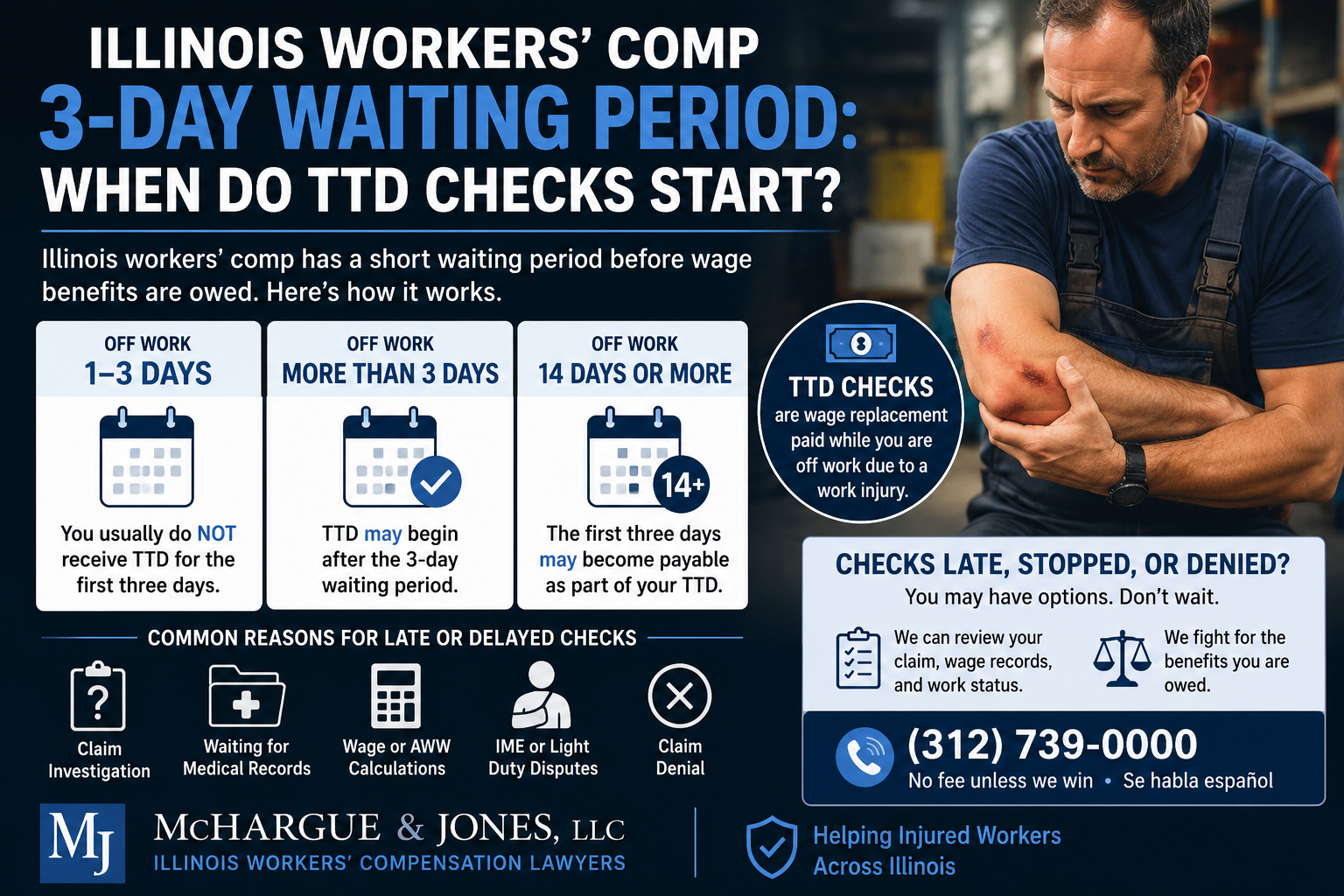
Quick answer: in Illinois, TTD benefits generally are not paid for the first three days you are off work unless your disability continues for at least 14 days. If you are off work for at least 14 days, the first three days may be paid back as part of your TTD benefits.
This issue matters because many injured workers expect a check right away. In real life, insurance companies may delay, investigate, dispute the claim, calculate the wage rate incorrectly, or stop checks after an IME or light-duty dispute.
For a broader overview of Illinois workers’ compensation, read our Illinois workers’ compensation guide or visit our main Illinois workers’ compensation page.
Are Your Workers’ Comp Checks Late?
If you were taken off work after a job injury and your TTD checks are late, stopped, denied, or lower than expected, McHargue & Jones can review your claim and explain your options.
Or call (312) 739-0000 • No fee unless we win • Se habla español
Quick Answer: What Is the Illinois Workers’ Comp 3-Day Waiting Period?
The Illinois workers’ comp waiting period is the short period at the start of a lost-time claim where TTD benefits generally are not owed for the first three days off work.
Here is the practical rule:
- Off work 1 to 3 days: you usually do not receive TTD for those first three days.
- Off work more than 3 days: TTD may begin after the waiting period if your doctor has you off work because of the work injury.
- Off work 14 days or more: the first three days may become payable too.
This is one reason workers get confused. You may be unable to work immediately after the accident, but the first few days are treated differently from a longer disability period.
What Are TTD Checks?
TTD stands for temporary total disability. These are wage-replacement checks paid while you are temporarily unable to work because of a job injury.
TTD may be owed when your doctor takes you completely off work. TTD may also be owed when your doctor gives work restrictions and your employer cannot provide a job within those restrictions.
TTD is separate from medical benefits. Workers’ compensation may also pay for reasonable and necessary medical treatment related to the work injury, including doctor visits, therapy, imaging, injections, surgery, medication, and follow-up care.
For a full breakdown of wage benefits and medical benefits, read our guide to Illinois workers’ compensation benefits.
How Much Does Workers’ Comp Pay While You Are Off Work?
TTD is usually based on your average weekly wage, often called AWW. In many Illinois workers’ compensation cases, TTD is paid at two-thirds of the worker’s average weekly wage, subject to legal minimums and maximums.
But calculating the correct rate is not always simple. Overtime, second jobs, bonuses, irregular schedules, seasonal work, union work, temporary staffing work, and wage records can all affect the calculation.
If your check seems too low, the issue may not be the waiting period. It may be that the insurance company used the wrong average weekly wage.
For the deeper wage-benefit explanation, read our guide: How much does workers’ comp pay in Illinois? TTD, TPD, maintenance, and AWW explained.
When Should the First Workers’ Comp Check Arrive?
In an accepted claim, the first TTD check should usually be sent within the required payment timeline after the employer and insurance company have notice of the injury and medical information showing that you are off work because of the work injury.
In real life, checks are often delayed because the insurance company says it is investigating, waiting for medical records, confirming wage information, reviewing work status, or deciding whether it accepts the claim.
Some delay may be caused by missing paperwork or unclear medical records. But if your doctor has clearly taken you off work because of a job injury, and the insurance company has no valid basis to dispute the claim, late checks can become a serious problem.
Do You Get Paid for the First Three Days?
Sometimes. The first three days are the waiting period. If you return to work quickly, those first three days may not be paid as TTD.
But if your disability continues for at least 14 days, those first three days may become payable. In other words, a worker who is off work for a longer period may eventually receive TTD for the waiting-period days too.
This distinction matters because a short absence and a longer disability period are treated differently. If you miss only a few days, the insurance company may not owe TTD for the first three days. If your doctor keeps you off work for two weeks or longer, the first three days should be reviewed again.
What If You Are on Light Duty?
The waiting-period issue usually comes up when the doctor takes the worker off work completely. But TTD disputes can also happen with light duty.
If your doctor gives restrictions and your employer has work available within those restrictions, the insurance company may argue you are not entitled to TTD because work is available.
But the job has to actually fit your restrictions. Problems arise when the employer claims light duty is available, but the job still requires lifting, bending, reaching, standing, driving, repetitive use of an injured body part, or other tasks beyond what your doctor allowed.
If there is a dispute, get the light-duty job description in writing and make sure your doctor reviews it. A vague statement that “light duty is available” is not the same as a real job offer that fits your medical restrictions.
What If the Insurance Company Denies the Claim?
If the insurance company denies the whole claim, it may refuse to pay TTD checks at all. That does not mean the denial is correct.
Workers’ comp claims are often denied because the insurance company disputes how the injury happened, whether it happened at work, whether notice was given, whether the condition is related to work, or whether the off-work note is supported by the medical records.
A denial can create major financial pressure because the worker may be off work and treating, but not receiving wage checks. In some cases, the claim needs to be pushed forward quickly through the Illinois Workers’ Compensation Commission.
If your claim is denied, read our guide: Workers’ comp denied my case or medical treatment in Illinois: what to do next.
What If Your Checks Are Late, Stopped, or Too Low?
Late, stopped, or short TTD checks are one of the most common problems in Illinois workers’ compensation cases.
Checks may be late because of wage calculation problems, missing work-status notes, an IME, a light-duty dispute, a claim denial, or insurance-company delay. Sometimes the insurance company pays benefits but uses the wrong average weekly wage, which makes every check too low.
If your checks stop or never start, do not assume the insurance company is right. Save your work-status notes, pay stubs, claim letters, emails, texts, and any communication from the adjuster.
For more detail, read Workers’ comp stopped my checks in Illinois: what to do next.
Can You Get Penalties or Fees for Late Workers’ Comp Checks?
In some Illinois workers’ compensation cases, late or unreasonable nonpayment may raise penalty or attorney-fee issues. Whether penalties or fees are available depends on the facts, the reason for the delay, the evidence the insurance company had, and whether the delay was reasonable or unreasonable.
Not every late check automatically means penalties are owed. But if the insurance company had clear notice, clear medical records, and no good reason to delay TTD, the issue should be reviewed.
This is one reason it is important to save documentation. Work-status notes, emails, adjuster letters, wage records, and payment history can matter if the dispute later becomes about unreasonable delay or nonpayment.
When Should You Talk to a Workers’ Comp Lawyer?
You do not need a lawyer for every minor injury. But if you are missing work and your checks are late, denied, short, or stopped, it is worth getting legal advice quickly.
A lawyer can help determine whether TTD is owed, whether the insurance company calculated your average weekly wage correctly, whether the waiting period was applied correctly, whether light duty is valid, and whether a hearing or emergency petition may be needed to push the case forward.
Legal help is especially important if your doctor has you off work and no checks are coming, the insurance company is still “investigating,” your claim was denied, your employer says light duty is available but the job violates your restrictions, your checks stopped after an IME, or your checks are lower than expected.
For more on when legal help matters, read Do I need an Illinois workers’ compensation attorney?
The Bottom Line
The Illinois workers’ comp 3-day waiting period can be confusing, but the basic rule is straightforward: short absences may not trigger payment for the first three days, while longer disability periods may make those days payable. If your doctor has you off work and TTD checks are late, stopped, denied, or too low, you should not wait indefinitely for the insurance company to “look into it.”
McHargue & Jones helps injured workers across Illinois with late TTD checks, denied claims, stopped benefits, wrong wage calculations, light-duty disputes, IMEs, and hearings before the Illinois Workers’ Compensation Commission.
Questions About Late TTD Checks?
If you are off work after a job injury and workers’ comp has not paid, McHargue & Jones can review your claim, wage records, work-status notes, and options for getting benefits moving.
Call (312) 739-0000 • No fee unless we win • Se habla español
Frequently Asked Questions About the Illinois Workers’ Comp Waiting Period
What is the 3-day waiting period for Illinois workers’ comp?
The 3-day waiting period means TTD benefits generally are not owed for the first three days you are off work unless your disability continues long enough. If you are off work for at least 14 days, those first three days may become payable.
When do workers’ comp checks start in Illinois?
In an accepted claim, TTD checks should usually begin within the required payment timeline after your employer and insurance company have notice of the injury and medical documentation showing that you are off work because of the work injury.
Do I get paid for the first three days I miss from work?
Not always. If you miss only a short period, the first three days may not be paid. If you are off work for at least 14 days, those first three days may become payable.
What are TTD checks?
TTD stands for temporary total disability. These are wage-replacement checks paid when your doctor takes you off work because of a job injury, or when you have restrictions your employer cannot accommodate.
How much does workers’ comp pay in Illinois while I am off work?
TTD is usually based on the injured worker’s average weekly wage. In many Illinois workers’ compensation cases, TTD is paid at two-thirds of the worker’s average weekly wage, subject to legal minimums and maximums.
What if my workers’ comp checks are late?
Save your medical work-status notes, wage records, emails, texts, and claim paperwork. If the insurance company has no valid basis to delay payment, a workers’ compensation lawyer may be able to push the case forward and review whether penalties or fees may apply.
What if workers’ comp denied my whole case?
If the claim is denied, the insurance company may refuse to pay TTD checks. That does not mean the denial is correct. A lawyer can review whether the injury, notice, medical records, and work status support benefits.
Can workers’ comp stop my checks after they start?
Yes, checks may be stopped if the insurance company claims you can return to work, an IME releases you, light duty is available, or the claim is disputed. Whether stopping checks is proper depends on the facts and medical evidence.
Should I talk to a lawyer if my TTD checks are late?
Yes, especially if you are missing work, your doctor has you off work, and checks are late, denied, short, or stopped. Late TTD checks can create serious financial pressure and may need prompt legal action.