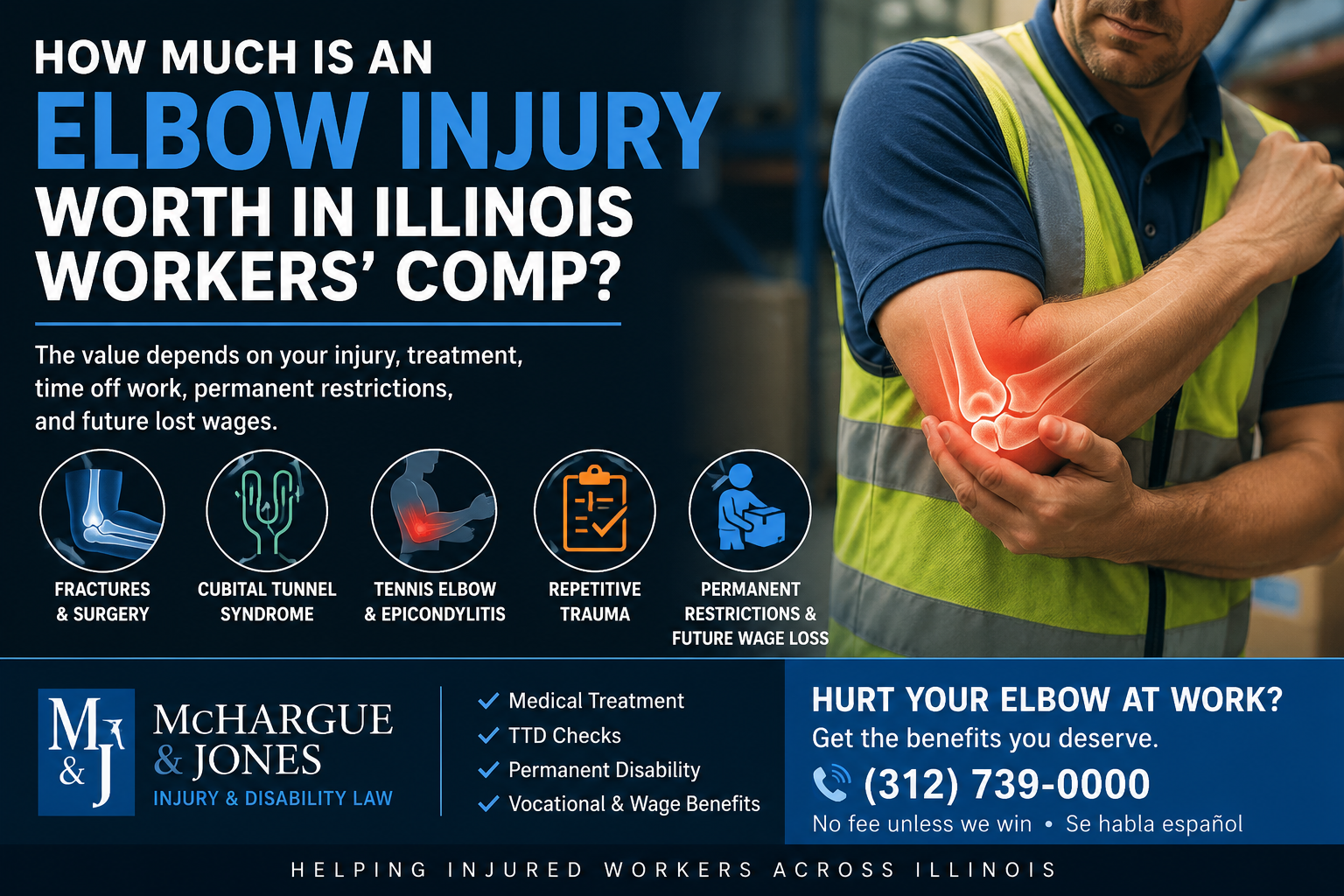


How Much Is an Elbow Injury Worth in Illinois Workers’ Comp?
Quick answer: an Illinois workers’ comp elbow injury case is usually worth more when the injury requires surgery, causes permanent restrictions, keeps you off work, prevents you from returning to your old job, involves repetitive trauma, or causes long-term weakness, numbness, tingling, loss of motion, or reduced earning capacity.
Elbow injury cases can involve construction workers, factory workers, warehouse workers, Amazon workers, UPS drivers and package handlers, FedEx workers, delivery drivers, mechanics, electricians, healthcare workers, machine operators, and anyone whose job depends on lifting, gripping, carrying, pushing, pulling, driving, scanning, sorting, or using tools.
At McHargue & Jones, we represent injured workers across Chicago, Cook County, and Illinois in elbow injury claims involving fractures, cubital tunnel syndrome, ulnar nerve problems, tennis elbow, epicondylitis, repetitive trauma, surgery disputes, TTD checks, permanent restrictions, settlement value, and trials before the Illinois Workers’ Compensation Commission.
For a broader overview of claim rights and benefits, visit our main Illinois workers’ compensation page.
Hurt Your Elbow at Work in Illinois?
If you have an elbow fracture, cubital tunnel syndrome, tennis elbow, epicondylitis, nerve symptoms, a surgery recommendation, denied treatment, stopped checks, or permanent restrictions, McHargue & Jones can review your workers’ comp case.
Or call (312) 739-0000 • No fee unless we win • Se habla español
What Determines the Value of an Elbow Injury Case?
There is no single “average” elbow injury settlement that applies to every Illinois workers’ compensation case. The value depends on the full picture: how the injury happened, what the medical records show, whether the claim is accepted or disputed, whether surgery is needed, how long you are off work, and whether the injury affects your ability to return to the same job.
The most important value factors usually include:
- The exact diagnosis, such as fracture, cubital tunnel syndrome, tennis elbow, lateral epicondylitis, medial epicondylitis, tendon injury, or nerve compression;
- Whether the injury happened suddenly or developed over time through repetitive trauma;
- Whether the insurance company accepts the case or disputes causation;
- Whether you need therapy, injections, EMG testing, nerve testing, or surgery;
- How long you are off work and whether TTD checks are paid correctly;
- Whether you return to full duty, light duty, or cannot return at all;
- Whether you are released with permanent restrictions;
- Your average weekly wage;
- Whether future medical care may be needed; and
- Whether the injury causes future wage loss.
For a broader case-value overview, read What is my Illinois workers’ comp case worth? and our Illinois workers’ comp settlement chart.
Common Work-Related Elbow Injuries
Elbow injuries usually fall into two categories: traumatic injuries and repetitive trauma injuries.
Traumatic elbow injuries
Traumatic elbow injuries happen from a specific accident. A worker may slip and fall, land directly on the elbow, fall from a ladder or truck, get struck by an object, suffer a crush injury, or injure the elbow while lifting or catching something heavy.
These cases may involve elbow fractures, dislocations, tendon tears, biceps tendon injuries, crush injuries, or direct blows to the elbow. We often see traumatic elbow injuries after falls on wet floors, ice, stairs, loading docks, uneven pavement, parking lots, warehouse floors, and construction sites.
If your elbow injury happened in a fall at work, read our related guide on slipping and falling on ice in a work parking lot in Illinois.
Repetitive trauma elbow injuries
Many elbow injuries do not happen from one dramatic accident. They develop over weeks, months, or years from repeated job duties. These cases can be harder because the insurance company may argue there was no accident, or that the condition is age-related, degenerative, recreational, or unrelated to work.
Repetitive trauma elbow claims often involve cubital tunnel syndrome, ulnar nerve compression, lateral epicondylitis, medial epicondylitis, tennis elbow, golfer’s elbow, tendonitis, or bursitis. These conditions may come from repeated gripping, lifting, scanning, sorting, pulling, pushing, driving, tool use, vibration exposure, assembly-line work, or package handling.
In Illinois, repetitive trauma can qualify for workers’ compensation if the job duties caused, aggravated, or accelerated the condition. For more detail, read our guide on how to prove a repetitive trauma injury in Illinois workers’ comp.
Cubital Tunnel Syndrome, Tennis Elbow, and Epicondylitis
Some of the most common elbow-related workers’ compensation claims involve cubital tunnel syndrome and epicondylitis.
Cubital tunnel syndrome
Cubital tunnel syndrome involves irritation or compression of the ulnar nerve near the inside of the elbow. Workers often describe numbness, tingling, burning, weakness, or pain that travels into the ring finger and pinky finger.
Symptoms may start slowly. A worker may first notice that the hand falls asleep, grip strength is weaker, tools are harder to use, or objects are harder to hold. Over time, the symptoms can become more constant and may require EMG testing, nerve conduction studies, injections, restrictions, or surgery.
Jobs that may contribute to cubital tunnel syndrome include factory work, assembly work, warehouse work, Amazon work, UPS and FedEx package handling, delivery driving, construction work, electrical work, mechanic work, machine operation, forklift operation, long periods of elbow bending, leaning on hard surfaces, or using vibrating tools.
Carpal tunnel, cubital tunnel, shoulder problems, and a cervical nerve-root injury can overlap. What may seem like an elbow injury could actually be a spinal injury. See our guide to cervical radiculopathy that is initially mistaken for a hand, arm, elbow, or shoulder problem after a work injury.
Tennis elbow and epicondylitis
“Tennis elbow” is the common name for lateral epicondylitis. Despite the name, most workers’ compensation cases involving tennis elbow have nothing to do with tennis. They often involve repeated gripping, lifting, pulling, twisting, scanning, tool use, package handling, driving, assembly work, or production work.
Medial epicondylitis affects the inside of the elbow and is sometimes called golfer’s elbow. Lateral epicondylitis usually affects the outside of the elbow. Both can be painful and limiting, especially for workers who rely on their hands and arms all day.
Epicondylitis cases may involve elbow pain with gripping, pain lifting even light objects, weakness, pain with wrist motion, difficulty using tools, therapy, bracing, injections, work restrictions, and in more serious cases, surgery.
We have handled elbow injury cases involving lateral epicondylitis, surgery, and permanent restrictions. Prior results do not guarantee a similar outcome, but these cases can have real value when the condition affects the worker’s ability to lift, grip, carry, drive, use tools, or return to the old job.
Elbow Injuries for Factory, Warehouse, Amazon, UPS, and Delivery Workers
Elbow injuries are common in jobs that require repeated lifting, scanning, gripping, sorting, loading, pulling, pushing, driving, or tool use. A job title alone rarely tells the whole story. A strong workers’ compensation case explains what the worker actually did with the arm throughout the day.
For Amazon workers, elbow injuries may come from repetitive scanning, lifting, packing, sorting, reaching, pushing carts, conveyor work, and delivery activity. Read more about workers’ compensation claims for Amazon warehouse and delivery workers in Illinois.
For UPS workers and other delivery workers, elbow injuries may involve package handling, steering, shifting, climbing in and out of vehicles, repetitive gripping, lifting, and carrying. If you work for UPS, read more about UPS workers’ compensation claims in Illinois.
One example is a UPS feeder driver repetitive trauma case involving carpal tunnel, cubital tunnel, and disputed nerve symptoms from years of job duties. Read about our UPS feeder driver carpal tunnel and cubital tunnel trial win.
How Do You Prove a Repetitive Trauma Elbow Injury?
Repetitive trauma elbow cases often require more proof than a simple fall or fracture case. If you fall at work and land on your elbow, the accident is usually easy to identify. But cubital tunnel syndrome, tennis elbow, lateral epicondylitis, medial epicondylitis, and ulnar nerve problems often develop over time.
The insurance company may argue that the condition is degenerative, age-related, recreational, caused by hobbies, or caused by ordinary daily activity. The answer is not just to say, “my job hurt my elbow.” The better approach is to prove the actual physical demands of the job and connect those duties to the medical diagnosis.
Important evidence may include a detailed job-duty description, testimony about how often the worker lifted or gripped, the weight of boxes or tools, the amount of force required, whether the elbow was repeatedly bent, whether vibrating tools were used, whether symptoms worsened during work, and whether medical records connect the symptoms to work activity.
Medical evidence is critical. In cubital tunnel cases, EMG or nerve conduction testing may help confirm ulnar nerve involvement. In epicondylitis cases, the treating orthopedic doctor or hand specialist may need to explain how repetitive gripping, lifting, pulling, tool use, or other job duties caused or aggravated the condition.
These cases are often won or lost on detail. “Warehouse worker,” “driver,” “factory worker,” or “package handler” is not enough. The stronger case explains what the worker actually did with the elbow, wrist, hand, and arm throughout the workday.
Trial Strategy in Repetitive Trauma Elbow Cases
Repetitive trauma elbow cases can be difficult because there may be no single accident date that obviously explains the injury. The insurance company may focus on that point. The injured worker’s lawyer needs to focus on the cumulative effect of the job duties and the medical evidence connecting those duties to the elbow condition.
Trial preparation may include developing a clear timeline of symptoms, identifying when the condition became serious enough to require treatment, obtaining medical records that document pain, numbness, tingling, weakness, or loss of grip, and preparing the worker to explain the job duties in a specific and credible way.
Medical opinion evidence is especially important. In many repetitive trauma elbow cases, the treating orthopedic doctor, hand specialist, or surgeon must explain whether the work duties caused, aggravated, or accelerated the condition. If the insurance company relies on an IME, the treating doctor’s opinion can be critical in pushing back.
If the insurance company schedules an IME, read IMEs in Illinois workers’ compensation: what injured workers need to know. If the case must be tried, read our guide to an Illinois workers’ comp hearing or trial.
What Benefits Can You Receive for an Elbow Injury?
If your elbow injury is covered under Illinois workers’ compensation, benefits may include medical treatment, wage benefits, permanent disability benefits, and in some cases vocational or wage differential benefits. For a full explanation, see our guide to types of Illinois workers’ compensation benefits.
Medical treatment
Workers’ comp may pay for reasonable and necessary medical treatment related to the elbow injury. Depending on the case, that may include doctor visits, orthopedic care, hand specialist care, X-rays, MRI testing, EMG or nerve conduction studies, physical therapy, bracing, injections, medication, surgery, and post-surgical rehabilitation.
TTD checks
If your doctor takes you off work because of the elbow injury, or if you have restrictions that your employer cannot accommodate, you may be entitled to temporary total disability benefits, commonly called TTD checks.
TTD disputes are common in elbow injury cases. The insurance company may argue you can work light duty, that restrictions are unrelated to the work injury, or that an IME doctor released you back to work. If your checks have been stopped or delayed, read Workers’ comp stopped my checks in Illinois: what to do next.
Permanent partial disability
After you reach maximum medical improvement, your case may be evaluated for permanent partial disability, often called PPD. Elbow injury permanency may depend on pain, loss of motion, weakness, nerve symptoms, surgery, restrictions, and whether the injury affects the arm as a whole.
An impairment rating may be part of the evidence, but it is not automatically the value of the case. The value depends on the whole picture, including your job, wage loss, treatment, restrictions, and how the injury affects your ability to work.
No Surgery, Surgery, Permanent Restrictions, and Future Wage Loss
Elbow injury value can range from a relatively modest claim to a major workers’ compensation case. The difference often comes down to treatment, recovery, restrictions, and whether the worker can return to the same job.
Elbow injury with no surgery
A no-surgery elbow case may still have value, especially if the worker missed time, needed significant treatment, had documented pain or nerve symptoms, or was released with restrictions. But generally, a case that resolves with conservative care and a full-duty return is worth less than a case involving surgery or permanent work limitations.
That said, surgery is not required for a serious workers’ comp case. A non-surgical case with permanent restrictions, nerve symptoms, or loss of earning capacity may be worth more than a surgical case where the worker fully recovers and returns to regular duty.
Elbow injury with surgery
Surgery usually increases the value of an Illinois workers’ comp elbow case, but not automatically. Surgery may involve fracture repair, tendon repair, cubital tunnel release, ulnar nerve transposition, or surgery for severe epicondylitis.
Surgery can increase value because it may show the injury was serious, often creates a longer recovery period, may involve more TTD, and can leave permanent symptoms or restrictions. But the real value question is what happens after surgery: did the worker recover, or did the worker still have pain, weakness, nerve symptoms, loss of motion, or restrictions?
For a deeper explanation, read Does surgery increase the value of my workers’ comp case in Illinois?. If workers’ comp denies surgery, read our guide on what to do when workers’ comp denies surgery in Illinois.
Elbow injury with permanent restrictions
Permanent restrictions can change the entire value of the case. A worker who returns to full duty after elbow treatment may have a straightforward permanency claim. But a worker who can no longer lift, grip, carry, drive, use tools, perform assembly work, handle packages, or return to construction or factory work may have a much more significant claim.
Permanent restrictions may raise issues involving job accommodation, vocational rehabilitation, wage differential benefits, future lost wages, or settlement value. This is especially important for factory workers, Amazon workers, UPS workers, FedEx workers, construction workers, mechanics, electricians, machine operators, and delivery drivers.
For more on this issue, read what happens after permanent work restrictions in Illinois workers’ comp.
Future wage loss
The most serious elbow injury cases may involve future wage loss. This can happen when a worker cannot return to the old job and has to take a lower-paying position because of permanent restrictions. In some cases, that can create wage differential exposure or make the settlement value significantly higher.
That is why elbow injuries should not be dismissed as minor. A fractured elbow, cubital tunnel surgery, ulnar nerve injury, or severe epicondylitis can become a major workers’ comp case if it affects the worker’s ability to earn a living.
What If the Insurance Company Says It Is Just Tennis Elbow or Aging?
Insurance companies frequently argue that elbow conditions are not work-related. They may say the injury is degenerative, age-related, recreational, or caused by activities outside work.
That does not end the case. Illinois workers’ compensation can apply when work aggravates or accelerates a condition, not just when work is the only cause. The key is whether the job contributed to the condition or made it worse.
For repetitive trauma cases, it is important to tell your doctor what you actually do all day. Do not assume the doctor understands the physical demands of your job from your job title alone.
What Should You Do After an Elbow Injury at Work?
If you hurt your elbow at work or develop elbow symptoms from repetitive work, report the injury or symptoms to your employer as soon as possible. Be specific about whether it was a fall, blow, lifting injury, or repetitive trauma. Tell your doctor the injury or symptoms are work-related and describe your actual job duties in detail.
You should also save work notes, restrictions, emails, texts, schedules, and claim paperwork. Do not ignore numbness, tingling, weakness, or hand symptoms. If nerve symptoms continue, ask whether EMG testing is needed. If your employer offers light duty, get the job offer in writing and make sure it fits your medical restrictions.
If you are unsure whether you need legal help, read Do I need an Illinois workers’ compensation attorney?
Elbow Injury Settlement Examples
Prior results do not guarantee a similar outcome. Every case depends on the facts, medical evidence, wages, treatment, restrictions, disputed issues, and Illinois workers’ compensation law.
Examples of elbow-related workers’ compensation results handled by McHargue & Jones include:
- $300,000 settlement for a construction worker who suffered a career-ending elbow injury after falling from a roof at work. The injury required surgery and resulted in permanent restrictions.
- $130,000 settlement for a FedEx worker who suffered lateral epicondylitis requiring surgery and permanent restrictions.
These examples show why elbow injury cases should not be dismissed as minor. When an elbow injury affects a worker’s ability to lift, grip, carry, drive, use tools, or return to the same job, the case may involve much more than a small permanency award.
For more examples by injury type, visit our Illinois workers’ compensation settlements, awards, and trial wins.
Talk to an Illinois Workers’ Comp Lawyer About Your Elbow Injury
Elbow injury cases can become complicated quickly. A fracture case may involve surgery and permanent restrictions. A cubital tunnel or epicondylitis case may involve repetitive trauma, nerve testing, disputed causation, and an IME. A delivery driver, factory worker, Amazon worker, UPS worker, FedEx worker, or construction worker may not be able to return to the same job if the elbow does not heal fully.
McHargue & Jones helps injured workers across Illinois with elbow injury claims, denied treatment, unpaid TTD checks, repetitive trauma disputes, surgery denials, permanent restrictions, settlement value, and hearings before the Illinois Workers’ Compensation Commission.
Free Consultation for Illinois Elbow Injury Workers’ Comp Claims
If you hurt your elbow at work or developed cubital tunnel, tennis elbow, epicondylitis, numbness, tingling, or weakness from repetitive job duties, we can review your case and explain your options.
Call (312) 739-0000 • No fee unless we win • Se habla español
Frequently Asked Questions About Elbow Injuries and Illinois Workers’ Comp
Can I get workers’ comp for an elbow injury in Illinois?
Yes. If your elbow injury arose out of and in the course of your employment, you may qualify for Illinois workers’ compensation benefits. This can include sudden injuries from falls or blows to the elbow, as well as repetitive trauma injuries that develop over time.
Is cubital tunnel syndrome covered by workers’ comp?
Cubital tunnel syndrome may be covered if work duties caused, aggravated, or accelerated the condition. These cases often involve repeated elbow bending, gripping, tool use, vibration, driving, factory work, warehouse work, or other repetitive arm activity.
Is tennis elbow covered by workers’ comp?
Tennis elbow, also called lateral epicondylitis, may be covered by Illinois workers’ compensation if it is related to repetitive work duties or a specific work accident. The name does not mean the condition must come from playing tennis.
What makes an elbow injury case worth more?
Elbow injury value may increase when the worker needs surgery, misses significant time from work, has permanent restrictions, cannot return to the same job, has nerve symptoms, or needs future medical treatment.
Does elbow surgery automatically increase workers’ comp value?
No. Surgery does not automatically increase workers’ comp value. It may increase value if it shows the injury is serious, leads to a longer recovery, causes permanent restrictions, or affects the worker’s ability to earn wages.
Can an elbow case be valuable without surgery?
Yes. A non-surgical elbow case can still have value if the worker has lasting pain, nerve symptoms, permanent restrictions, significant treatment, time off work, or reduced ability to perform the job.
Can repetitive work cause an elbow injury?
Yes. Repetitive gripping, lifting, scanning, pulling, pushing, tool use, vibration, assembly work, warehouse work, driving, or package handling can contribute to elbow conditions such as cubital tunnel syndrome or epicondylitis.
What if the insurance company says my elbow injury is not work-related?
The insurance company may dispute causation, especially in repetitive trauma cases. That does not end the claim. Medical records, job-duty evidence, witness testimony, and treating doctor opinions can help prove the connection to work.
Can I receive TTD checks for an elbow injury?
Yes, if your doctor takes you off work or gives restrictions your employer cannot accommodate, you may be entitled to TTD benefits. If the insurance company stops paying, you should speak with a workers’ compensation lawyer.
Can I settle an Illinois workers’ comp elbow injury case?
Many elbow injury cases eventually settle, but settlement value depends on the diagnosis, treatment, surgery, wages, restrictions, future medical needs, disputed issues, and whether you can return to your old job.
Should I talk to a lawyer about an elbow injury at work?
You should consider speaking with a lawyer if the insurance company denies the claim, delays treatment, stops TTD checks, schedules an IME, disputes surgery, offers light duty outside your restrictions, or makes a low settlement offer.