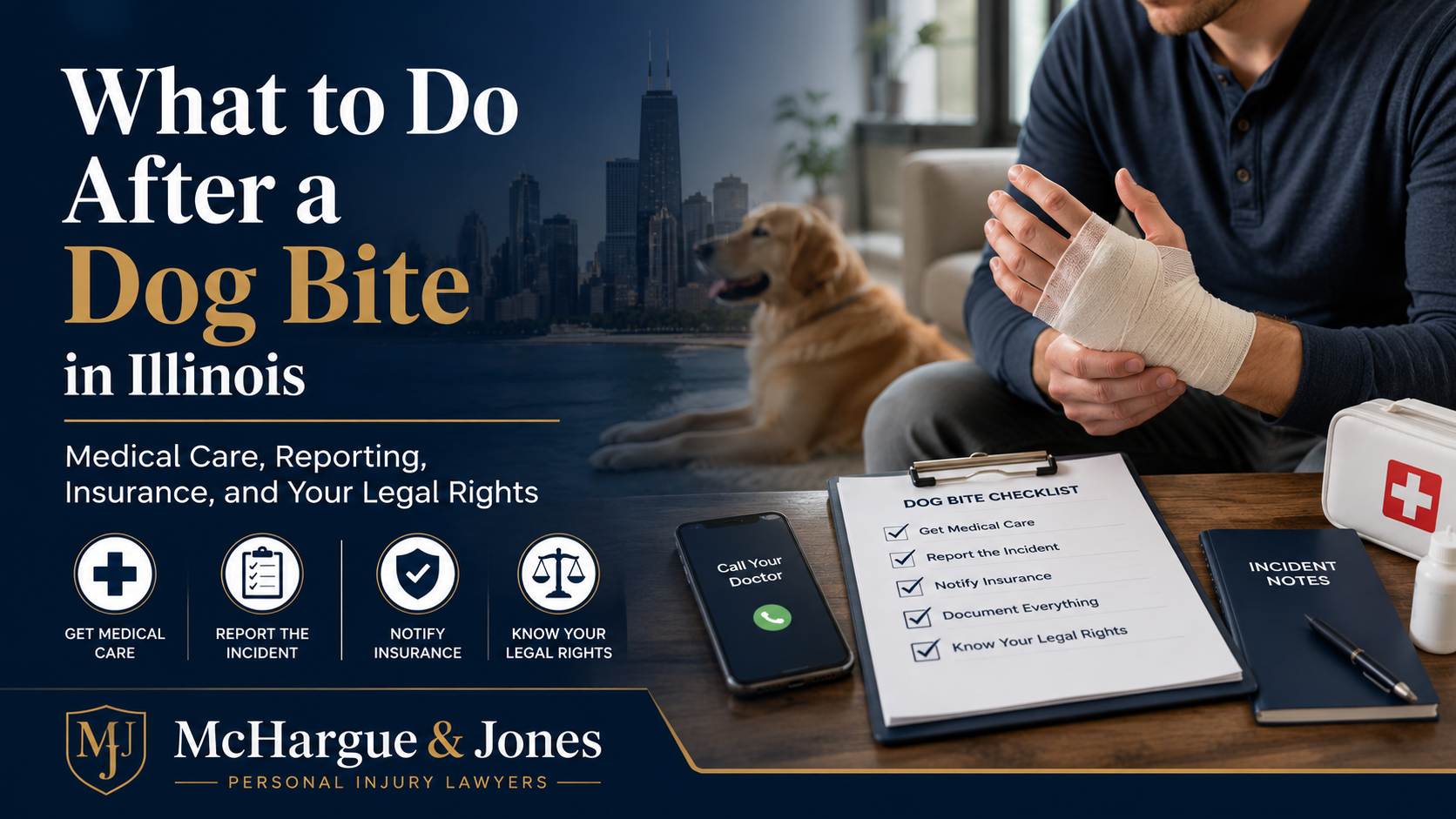


What to Do After a Dog Bite in Illinois
Illinois Dog Bite Injury Guide
After a dog bite in Illinois, get to safety, wash the wound if you can, seek medical care, report the bite, identify the dog and owner, take photos, gather witness information, and avoid signing anything from the insurance company before you understand the full injury.
These steps matter because a dog bite can create medical risks, an animal control investigation, an insurance claim, and in some cases both a personal injury claim and a workers’ compensation claim.
If you were bitten in Chicago or anywhere in Illinois, our Chicago dog bite lawyers can help you understand your rights, the insurance issues, and whether your case may involve both personal injury compensation and workers’ compensation benefits.
Quick Checklist: What to Do After a Dog Bite in Illinois
- Get away from the dog and call 911 if the dog is loose, aggressive, or still a danger.
- Wash the wound with soap and water if you can safely do so.
- Get same-day medical care, especially if the bite broke the skin.
- Report the dog bite to the proper local authority.
- Get the dog owner’s name, address, phone number, and insurance information.
- Ask for the dog’s vaccination information.
- Take photos of the wound, the dog, the location, and any torn clothing.
- Get names and phone numbers for witnesses.
- Save clothing, shoes, work equipment, and other damaged items.
- Do not give a recorded statement or sign a release before understanding your rights.
- If you were bitten while working, report it to your employer and ask whether you have a workers’ compensation claim.
- Talk to an Illinois dog bite lawyer if the injury is serious, the victim is a child, there is scarring, or insurance is already involved.
1. Get to Safety First
Your first priority is safety. Move away from the dog. If the dog is loose, aggressive, or still nearby, call 911 or local authorities. Do not try to catch, restrain, or confront the dog yourself.
If a child was bitten, move the child to a safe place and check for injuries beyond the obvious bite wound. Children may be in shock, crying, or unable to explain all of their symptoms.
2. Wash the Wound and Get Medical Care
Dog bites can cause infection, nerve damage, tendon damage, scarring, crush injuries, and deep tissue injuries. Even a puncture wound that looks small on the surface can be more serious underneath.
If you can safely do so, wash the wound with soap and water. Then get medical care as soon as possible.
Seek medical attention right away if:
- the bite broke the skin;
- the wound is deep;
- there is heavy bleeding;
- the bite is on the face, hand, wrist, arm, leg, or near a joint;
- there is numbness, tingling, or trouble moving the area;
- the dog’s vaccination status is unknown;
- the victim is a child;
- the victim is elderly, diabetic, or immunocompromised;
- there are signs of infection, including redness, warmth, swelling, drainage, or fever.
Medical treatment protects your health and creates a record of the injury. That record may become important if the dog owner’s insurance company later disputes what happened or argues that the injuries are not serious.
For general first-aid information, the Mayo Clinic’s animal bite first-aid guidance explains basic wound cleaning and when medical attention may be needed. Your own doctor or emergency provider should decide what treatment is appropriate for your specific injury.
3. Report the Dog Bite
A dog bite should be reported. Reporting creates an official record and may trigger the animal observation process for rabies concerns.
Under 510 ILCS 5/13, Illinois law addresses dog and animal bite reporting and observation. In Cook County, bites to humans and companion animals must be reported to local police or, in unincorporated areas, to the Cook County Sheriff’s Office. Cook County also instructs people to contact the local police department within 24 hours after a bite or scratch.
If the bite happened in Chicago, Chicago Animal Care and Control says the first step is to make a report by calling 311 Non-Emergency or stopping into your police district to make a report.
Do not rely only on the dog owner saying, “The dog has had its shots.” Ask for proof and let the proper authorities handle the reporting and observation process.
4. Identify the Dog and the Owner
Get as much information as you can about the dog and the person responsible for the dog.
Important information includes:
- dog owner’s name;
- dog owner’s address;
- dog owner’s phone number;
- location where the dog lives;
- description of the dog;
- dog’s name, breed, color, and size;
- vaccination information;
- homeowners insurance or renters insurance information.
In many dog bite cases, the most important issue is not whether the bite happened. The important questions are who is legally responsible and what insurance policy may cover the injury.
5. Take Photos and Videos
Photos are extremely important in dog bite cases. Take pictures of:
- the bite wound;
- bleeding, bruising, swelling, stitches, bandages, and scarring;
- the location of the attack;
- the dog, if safe;
- broken gates, open doors, fences, leashes, or warning signs;
- torn or bloody clothing;
- damaged shoes, glasses, phones, tools, or work equipment.
Do not take only one photo. Dog bite injuries change over time. Take pictures the day of the bite, the next day, several days later, and throughout the healing process. If scarring develops, continue documenting it.
6. Get Witness Information
Witnesses can be very important, especially if the dog owner later claims you provoked the dog or were not allowed to be where the attack happened.
Witnesses may include:
- neighbors;
- people walking nearby;
- delivery coworkers;
- family members;
- park visitors;
- store employees;
- contractors or other workers at the residence;
- anyone who heard the dog owner make statements after the attack.
Useful witness statements may include:
- “The dog has gotten out before.”
- “That dog always barks or lunges.”
- “The owner knew the gate was broken.”
- “The dog was loose.”
- “The victim did not provoke the dog.”
- “The owner told the worker the dog was friendly.”
Get names, phone numbers, email addresses, and short notes about what each person saw or heard.
7. Save Clothing and Physical Evidence
Do not throw away or wash torn or bloody clothing.
Save:
- torn pants, shirts, jackets, or uniforms;
- bloody clothing;
- damaged shoes;
- broken eyeglasses;
- delivery equipment;
- work tools or PPE;
- photos of damaged items.
In serious cases, physical evidence can help show the force of the attack and the nature of the injuries.
8. Be Careful With the Insurance Company
The dog owner’s homeowners insurance or renters insurance company may call quickly. The adjuster may sound friendly and may say they only need your side of the story.
Be careful. Insurance companies often use recorded statements to look for defenses. They may ask questions designed to suggest that you provoked the dog, ignored a warning, entered an area without permission, or were not badly hurt.
You are allowed to get legal advice before giving a recorded statement.
9. Do Not Settle Before You Know the Full Injury
Dog bite injuries can change over time. A wound that looks manageable at first may later involve:
- infection;
- nerve damage;
- numbness;
- limited motion;
- plastic surgery;
- scar revision;
- permanent disfigurement;
- anxiety or PTSD;
- fear of dogs;
- lost time from work.
Once you sign a release, the case is usually over. You generally cannot come back later for more money if the scar worsens, the infection spreads, or the emotional trauma becomes more serious.
This is especially important in cases involving children, facial injuries, hand injuries, visible scarring, or psychological trauma.
10. Find Out What Insurance Coverage Exists
Dog bite cases are usually handled through homeowners insurance or renters insurance. In a serious case, insurance coverage can be one of the most important issues.
A case may be worth more than the available policy limits. For example, a severe dog attack involving permanent injury, scarring, and PTSD may be a very high-value case. But if the dog owner has only a limited homeowners policy and limited personal assets, the practical recovery may be limited.
A lawyer should look for:
- homeowners insurance;
- renters insurance;
- umbrella coverage;
- landlord or property coverage;
- business coverage, if the attack happened during work or on business property;
- possible additional responsible parties.
11. If You Were Bitten While Working, Report It to Your Employer
If you were bitten while working, tell your employer right away. This may apply if you are a:
- delivery driver;
- Amazon, UPS, FedEx, USPS, or courier worker;
- in-home nurse or home health worker;
- caregiver;
- housekeeper;
- plumber;
- electrician;
- cable worker;
- HVAC technician;
- contractor;
- maintenance worker;
- home health aide.
A work-related dog bite may involve both:
- a workers’ compensation claim; and
- a third-party dog bite personal injury claim against the dog owner or another responsible party.
Workers’ compensation may cover medical care and part of your lost wages. A third-party personal injury claim may allow recovery for pain and suffering, scarring, disfigurement, PTSD, and other damages not covered by workers’ compensation.
These cases need to be coordinated carefully because workers’ compensation liens can affect the final recovery.
12. Keep Track of Medical Treatment, Symptoms, and Expenses
Save and organize:
- ER records;
- urgent care records;
- primary care records;
- photos of the wound;
- prescriptions;
- referrals to specialists;
- physical therapy records;
- plastic surgery opinions;
- mental health treatment records;
- work restriction notes;
- missed work dates;
- mileage to medical appointments;
- out-of-pocket expenses.
Also keep a simple timeline of symptoms. Note pain, numbness, nightmares, fear of dogs, sleep problems, difficulty working, visible scarring, and limitations with daily activities.
13. Understand the Basic Illinois Dog Bite Law
Illinois dog bite law is favorable to many victims. In many cases, the injured person does not need to prove that the dog had bitten someone before.
Under Illinois dog bite law, the main questions are often whether the animal attacked or injured the person, whether the person was lawfully where they were, whether the person was acting peaceably, and whether the animal was provoked.
For a deeper explanation, read our companion guide: Understanding Illinois Dog Bite Law: Strict Liability, the One-Bite Rule, Insurance, and Work Injuries.
14. Talk to a Lawyer Before the Insurance Company Controls the Case
Not every minor dog bite requires a lawyer. But you should strongly consider talking to a lawyer if:
- the bite broke the skin;
- the injury required stitches;
- the injury involved the face, hand, arm, leg, or a joint;
- there is scarring;
- there is infection;
- the victim is a child;
- you missed work;
- you were bitten while working;
- the dog owner blames you;
- the insurance company wants a recorded statement;
- the insurer offers money quickly;
- you do not know what insurance coverage exists.
A lawyer can investigate liability, identify insurance coverage, coordinate workers’ compensation issues, document scarring and long-term effects, and protect you from settling before the full injury is known.
Attorney Insight From McHargue & Jones
We have handled dog bite cases involving neighborhood pedestrians, children, delivery drivers, housekeepers, in-home nurses, and tradespeople injured at private homes. In serious cases, the legal issue is often only part of the fight. The practical issue is whether there is enough insurance or collectible assets to pay for the full harm.
That is why we investigate homeowners insurance, renters insurance, umbrella coverage, possible work injury claims, scarring, PTSD, medical treatment, and workers’ compensation liens early.
This article was written or reviewed by Matthew C. Jones, a Chicago workers’ compensation and personal injury attorney at McHargue & Jones.
Talk to a Chicago Dog Bite Lawyer
If you were bitten by a dog in Chicago or anywhere in Illinois, McHargue & Jones can help you understand your rights, the insurance issues, and whether you may have both a personal injury and workers’ compensation claim.
Contact our Chicago dog bite lawyers for a free consultation.
FAQs About What to Do After a Dog Bite in Illinois
Should I go to the doctor after a dog bite?
Yes, especially if the bite broke the skin, is deep, involves the face or hand, or the dog’s vaccination status is unknown. Dog bites can become infected and may cause damage beneath the surface.
Do I have to report a dog bite in Illinois?
Dog bites should be reported to the proper local authority. Reporting creates an official record and may trigger the animal observation process.
How do I report a dog bite in Chicago?
Chicago Animal Care and Control says the first step after a bite in Chicago is to make a report by calling 311 Non-Emergency or stopping into your police district to make a report.
What information should I get from the dog owner?
Get the owner’s name, address, phone number, insurance information, dog vaccination information, and a description of the dog.
Should I talk to the homeowners insurance adjuster?
Be careful. You should not give a recorded statement or sign a release before understanding your rights and the full extent of your injury.
What if I was bitten while delivering a package or working at someone’s home?
You may have both a workers’ compensation claim and a third-party personal injury claim against the dog owner. This can apply to delivery drivers, in-home nurses, housekeepers, caregivers, contractors, and tradespeople.
What if the dog owner has no insurance?
The case may be more difficult. A lawyer can investigate whether there is homeowners insurance, renters insurance, umbrella coverage, landlord coverage, business coverage, or other collectible assets.
“`