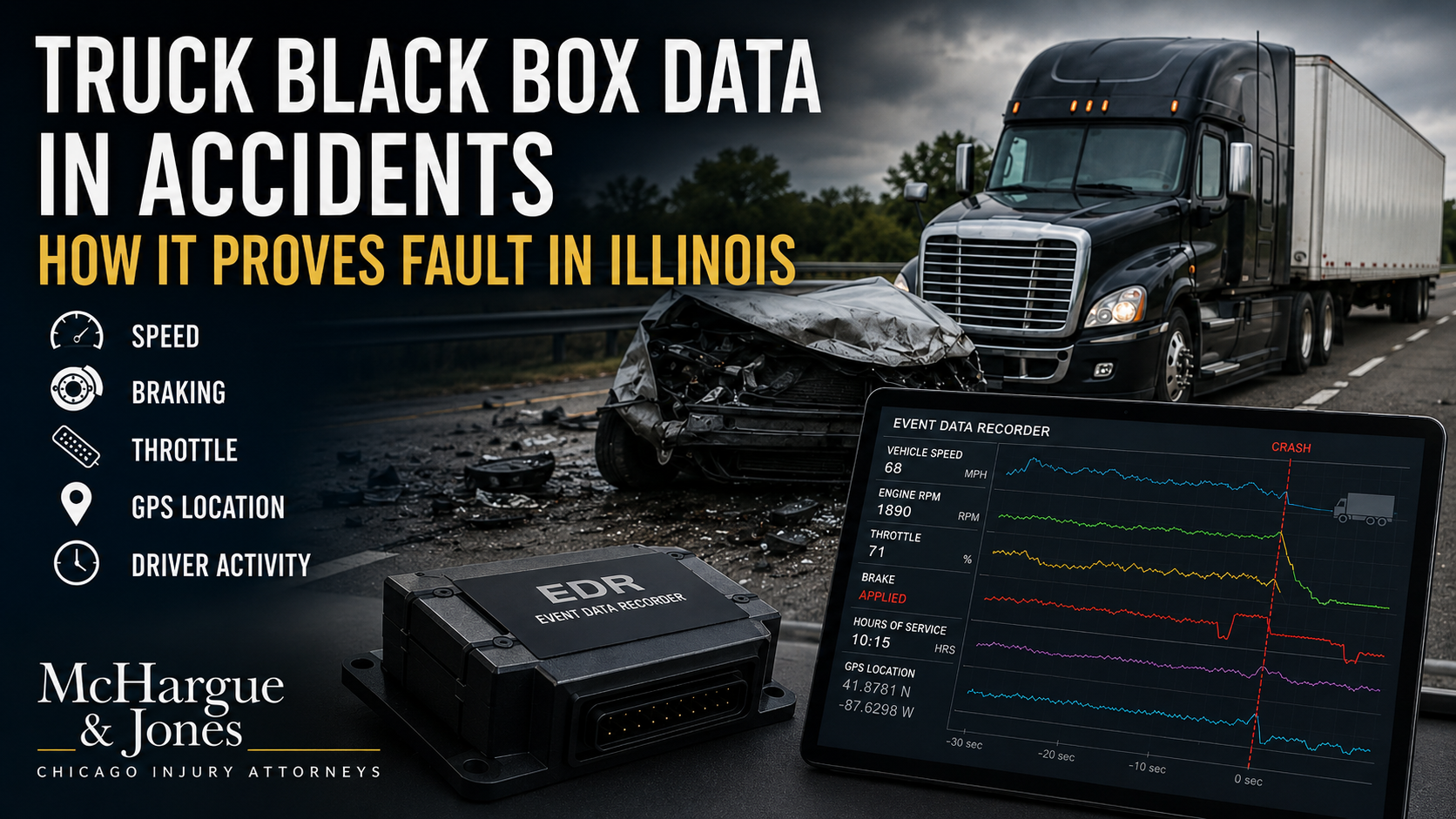


Truck Black Box Data in Accidents: How It Proves Fault in Illinois
Update May 2026
Key takeaway: Truck black box data can help prove fault in an Illinois truck accident case by showing how the truck was being operated before impact. Depending on the truck and system involved, the data may show speed, braking, throttle use, sudden deceleration, engine activity, hours-of-service information, GPS movement, and whether the driver reacted before the crash.
Commercial trucks often contain electronic data systems that can help show what happened before a collision. People commonly call this evidence “black box data,” but the information may come from several different sources, including the truck’s electronic control module, event data recorder, electronic logging device, GPS system, dash camera, or fleet-management platform.
In serious truck accident cases, this evidence can be critical. It may confirm or contradict the truck driver’s statement, the trucking company’s version of events, the police report, witness statements, and physical evidence from the crash scene.
If you were injured in a crash involving a semi-truck, tractor-trailer, 18-wheeler, box truck, delivery truck, garbage truck, dump truck, or other commercial vehicle, early investigation matters. For a broader overview of your rights, visit our Chicago truck accident lawyer page or our personal injury guide.
What Is a Truck Black Box?
A truck “black box” is a general term for electronic systems that record information about how a commercial vehicle was operating. In many cases, this refers to the truck’s electronic control module, or ECM. Depending on the vehicle and technology involved, useful data may also come from an event data recorder, electronic logging device, GPS system, dash camera, collision-avoidance system, or fleet telematics system.
This information can be used by attorneys, insurance companies, trucking companies, and accident reconstruction experts to understand what happened before and during a crash.
What Information Can Truck Black Box Data Show?
Truck black box data may help answer some of the most important questions in a truck accident case, including:
- How fast was the truck traveling before impact?
- Did the truck driver brake before the crash?
- How hard did the driver brake?
- Was the driver accelerating or using the throttle?
- Did the truck experience sudden deceleration?
- Were there engine fault codes or mechanical issues?
- Did the driver react too late?
- Does the electronic data match the driver’s story?
- Was the truck moving in a way that suggests fatigue, distraction, speeding, or loss of control?
Not every truck records the same information. The available data depends on the truck, manufacturer, model year, installed equipment, software, fleet systems, and whether the information was preserved before it was lost or overwritten.
How Black Box Data Proves Fault in a Truck Accident
Black box data can help prove negligence by showing how the truck was actually being operated in the seconds or minutes before the crash. This matters because trucking companies and insurance carriers may dispute fault, blame another driver, argue the crash was unavoidable, or claim there is not enough evidence to prove what happened.
For example, black box evidence may show that:
- The truck was speeding for the road, weather, or traffic conditions.
- The driver failed to brake before impact.
- The driver braked too late to avoid the collision.
- The truck was following too closely.
- The truck accelerated instead of slowing down.
- The driver’s account does not match the electronic data.
- A mechanical issue, such as a brake or engine problem, may have contributed to the crash.
- The crash may be connected to fatigue, unsafe scheduling, poor maintenance, or trucking company practices.
This type of evidence is especially important when fault is disputed. Unlike memory-based testimony, electronic data can provide an objective record that can be compared with photos, videos, skid marks, vehicle damage, witness statements, the police report, and expert analysis.
To understand how fault affects recovery in Illinois injury claims, see our related guide on what a truck accident case may be worth in Illinois.
ECM, EDR, ELD, GPS, and Dash Camera Data Are Not All the Same
The phrase “black box” is often used broadly, but several different types of electronic evidence may matter after a commercial truck crash.
Electronic Control Module Data
The ECM may record engine and vehicle-operation data. Depending on the truck, this can include speed, RPM, throttle position, braking activity, fault codes, cruise-control activity, and sudden deceleration events.
Event Data Recorder Data
An event data recorder, or EDR, may capture crash-event information when a triggering event occurs. Federal rules address vehicles equipped with EDRs and the collection, storage, and retrievability of crash event data. Not every commercial truck will have the same type of EDR data, so the specific vehicle must be investigated.
For official background, see the federal event data recorder regulations.
Electronic Logging Device Data
An ELD is different from an ECM or EDR. ELD data usually relates to the truck driver’s hours of service, duty status, and driving time. This can be important when fatigue, illegal driving hours, inaccurate logs, or unsafe delivery schedules are issues in the case.
Federal rules require motor carriers to maintain records of duty status and supporting documents for a period of six months, and ELD rules also address six-month backup retention of ELD records. For official background, see 49 CFR 395.8 and 49 CFR 395.22.
GPS, Telematics, and Dash Camera Evidence
Many trucking companies also use GPS tracking, fleet-management software, forward-facing cameras, driver-facing cameras, collision-warning systems, lane-departure systems, and other technology. This evidence can help show speed, route, location, traffic behavior, driver attention, braking, and how the crash developed.
How Do You Get Truck Black Box Data After a Crash?
Truck black box data usually has to be preserved and requested quickly. In many cases, the trucking company, motor carrier, maintenance provider, leasing company, fleet-management vendor, or insurance company may control some or all of the relevant evidence.
After a serious truck accident, an attorney may send a preservation letter demanding that the trucking company preserve important evidence, including:
- ECM or EDR downloads
- ELD logs and hours-of-service records
- Driver qualification files
- Dispatch records and delivery schedules
- GPS and telematics data
- Dash camera footage
- Maintenance and inspection records
- Brake inspection records
- Cargo-loading records
- Post-crash repair records
- Drug and alcohol testing records, when applicable
- Communications between the driver, dispatcher, broker, shipper, and motor carrier
This is one reason early legal action can be important. Some electronic data may be overwritten, lost, altered, or made harder to recover after repairs, vehicle movement, software updates, or delayed investigation.
Why Black Box Evidence Is So Important in Illinois Truck Accident Cases
Truck accident cases are often more complex than ordinary car accident cases. There may be multiple responsible parties, including the driver, motor carrier, truck owner, trailer owner, maintenance company, cargo loader, broker, shipper, or another negligent driver.
Black box data can help connect the facts to the legal issues. It may show whether the driver violated safety rules, whether the trucking company ignored risks, whether maintenance problems contributed to the crash, or whether the truck was being operated unsafely before impact.
Illinois fault rules also make evidence especially important. Under Illinois law, an injured person’s recovery can be reduced by their percentage of fault, and recovery can be barred if the injured person is found to be more than 50% at fault. Because insurance companies may try to shift blame, objective truck data can be valuable in proving what actually happened. For official statutory language, see 735 ILCS 5/2-1116.
Black Box Data and Common Truck Accident Causes
Black box data is often used with other evidence to determine why a crash happened. It may help prove or rule out common causes of truck accidents, including:
- Speeding and unsafe driving behavior
- Driver fatigue and hours-of-service violations
- Distracted driving
- Brake failure or poor maintenance
- Improperly loaded or unsecured cargo
- Unsafe lane changes
- Following too closely
- Failure to adjust for traffic, weather, or road conditions
- Mechanical failure
- Unsafe company policies or unrealistic delivery schedules
For more context, see our pages on truck safety regulations and truck accident claims.
Can Black Box Data Be Used Against the Trucking Company?
Yes. Black box data may be used to support claims against a trucking company when the evidence shows unsafe operation, poor supervision, negligent hiring, negligent training, maintenance failures, hours-of-service problems, or company pressure that contributed to the crash.
For example, ELD records may show that a driver was on the road too long. GPS data may show unrealistic scheduling. Maintenance records may show a known brake problem. ECM data may show speed or braking behavior that contradicts the trucking company’s explanation.
The data alone may not prove the entire case, but it can become a key part of the liability picture when combined with documents, witness testimony, expert opinions, and physical crash evidence.
What If the Injured Person Is the Truck Driver?
Black box data can also be important when the injured person is the truck driver.
If you are a truck driver injured while working, you may have a workers’ compensation claim. You may also have a separate third-party personal injury claim if another company or person contributed to the crash.
Examples may include:
- A different driver caused the collision.
- A maintenance company failed to repair the truck properly.
- A cargo company loaded the trailer unsafely.
- A shipper, broker, or company created unsafe delivery pressure.
- A defective part or mechanical failure contributed to the crash.
In these situations, black box data may help show how the crash happened and who may be responsible. Learn more in our guide to workers’ compensation and third-party claims.
What Should You Do After a Truck Accident?
After a serious truck accident, protecting evidence can be just as important as getting medical treatment and reporting the crash. If you are physically able, you should:
- Call 911 and make sure the crash is reported.
- Get medical care as soon as possible.
- Take photos or videos of the vehicles, roadway, injuries, debris, skid marks, and surrounding area.
- Get witness names and contact information.
- Avoid giving a recorded statement to the trucking company’s insurance carrier before speaking with a lawyer.
- Contact a lawyer quickly so electronic evidence can be preserved.
To understand how crash documentation can affect your case, see our guide on what is included in a police report.
Frequently Asked Questions About Truck Black Box Data
What is truck black box data?
Truck black box data is electronic vehicle data that may show how a truck was being operated before or during a crash. It may come from the ECM, EDR, ELD, GPS system, dash camera, or fleet-management software.
How does black box data prove fault in a truck accident?
Black box data can show speed, braking, throttle use, sudden deceleration, driver reaction, and other facts that help explain how the crash happened. This evidence can support or contradict witness statements, the truck driver’s story, and the trucking company’s version of events.
What does a truck ECM record?
An ECM may record vehicle speed, engine activity, RPM, throttle position, braking activity, cruise-control use, fault codes, and sudden deceleration events. The exact data depends on the truck and system involved.
Is ELD data the same as black box data?
Not exactly. ELD data usually relates to the driver’s hours of service, driving time, and duty status. ECM or EDR data is more focused on how the truck or vehicle systems were operating before or during the crash. Both types of evidence can be important.
Can black box data show the truck was speeding?
Yes, in many cases it can. Speed data may be compared with the posted speed limit, road conditions, traffic, weather, witness statements, video footage, and accident reconstruction analysis.
Can black box data show whether the driver braked?
Yes. Depending on the system, the data may show whether the driver applied the brakes, when braking occurred, and sometimes how hard the braking was before impact.
Can black box data prove driver fatigue?
Black box data alone may not prove fatigue, but it can help. ELD records, hours-of-service logs, GPS data, dispatch records, delivery schedules, and driver communications may show whether fatigue contributed to the crash.
How long is truck black box data saved?
It depends on the truck, system, software, and type of data. Some information may be overwritten or lost if it is not preserved quickly. That is why early investigation is important after a serious commercial truck crash.
Can a trucking company delete or lose black box data?
Electronic data can be lost through overwriting, repairs, vehicle movement, software updates, or failure to preserve evidence. After a serious crash, a preservation letter can demand that the trucking company keep relevant evidence.
Who can download truck black box data?
Truck black box data is often downloaded by trained professionals, accident reconstruction experts, vehicle technicians, or others with the proper tools and software. The process should be handled carefully so the data is preserved and interpreted correctly.
What if the trucking company refuses to provide black box data?
If a trucking company refuses to provide relevant evidence, an attorney may pursue it through litigation, subpoenas, discovery, court orders, and expert investigation. The right approach depends on the facts of the case.
Is black box data always accurate?
Black box data is powerful, but it still must be interpreted correctly. Lawyers and experts often compare it with photos, video, vehicle damage, witness statements, road evidence, maintenance records, and the police report.
Can black box data help my Illinois truck accident case?
Yes. In many Illinois truck accident cases, black box data can help prove fault, fight blame-shifting, identify safety violations, and show whether the trucking company’s explanation matches the facts.
Talk to a Chicago Truck Accident Lawyer About Black Box Evidence
Truck black box data can be one of the most important pieces of evidence in an Illinois truck accident case. It may show speed, braking, driver reaction, mechanical problems, hours-of-service issues, and whether the trucking company’s version of events is accurate.
At McHargue & Jones, we investigate serious injury cases involving semi-trucks, tractor-trailers, delivery vehicles, box trucks, and other commercial vehicles. Early action can make a difference because electronic evidence may not be available forever.
If you or a loved one was injured in a truck accident in Chicago or anywhere in Illinois, contact our team to discuss your options. Visit our truck accident page, review our personal injury guide, or contact us for a free consultation.
Related truck accident resources:
- Chicago truck accident lawyer
- What is my truck accident case worth in Illinois?
- Common causes of truck accidents
- Brake failure in truck accidents
- Cargo-related truck accidents
- Truck safety regulations
- Truck accident claims
- Workers’ compensation and third-party claims