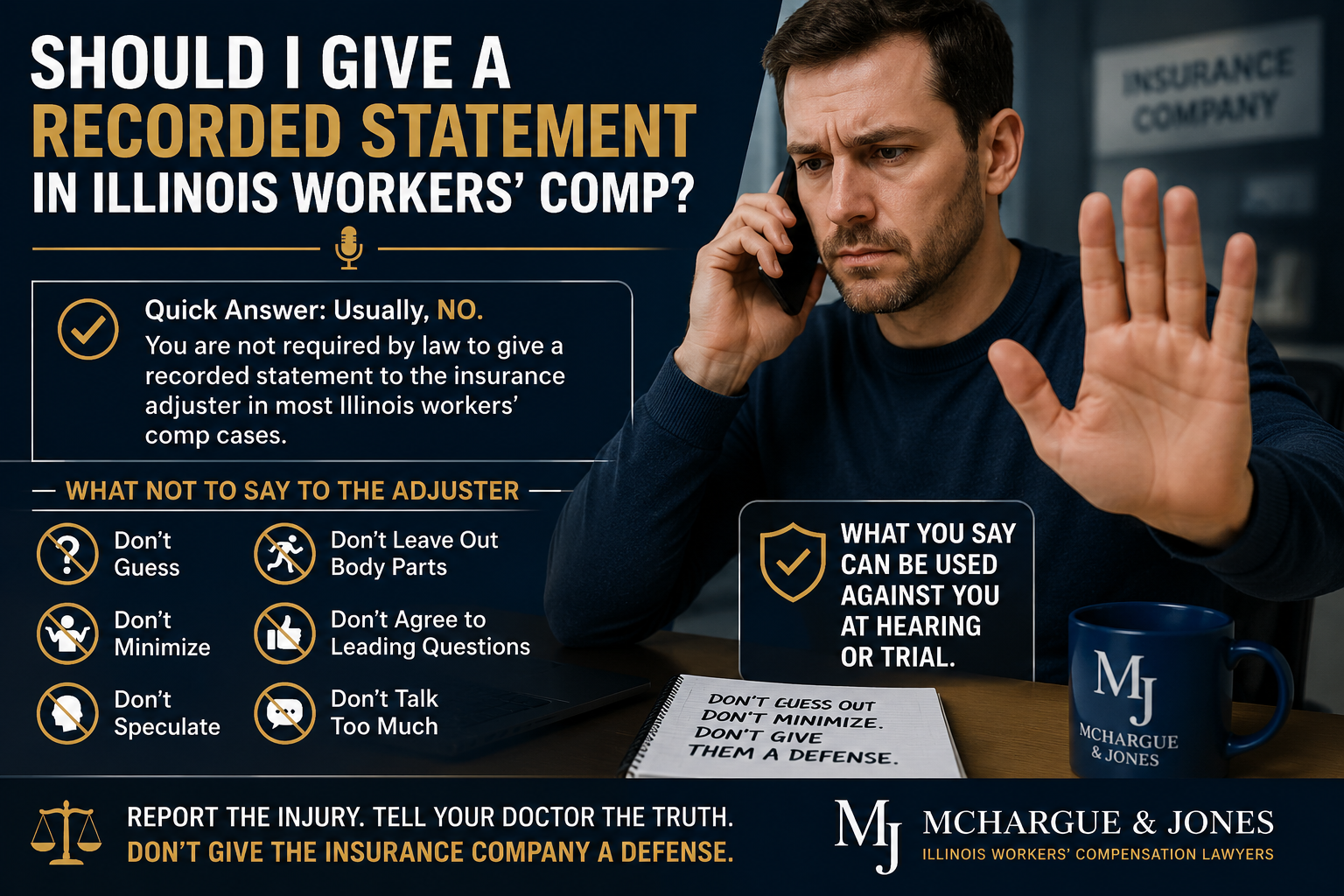


Should I Give a Recorded Statement to the Workers’ Comp Insurance Company in Illinois?
If the insurance company is asking for a recorded statement and you are not sure what to do, contact a Chicago workers’ compensation lawyer before you agree.
Short Answer: Do You Have to Give a Recorded Statement for Workers’ Comp in Illinois?
Usually, no. In most Illinois workers’ comp cases, you do not have to give a recorded statement to the insurance adjuster.
The insurance company may say the recorded statement is routine. They may say they need it to “open the claim,” “complete the investigation,” “process benefits,” or “get your side of the story.” But you should not assume that you are legally required to let the adjuster record you.
A recorded statement can feel harmless. You may think:
- “I have nothing to hide.”
- “I just want my claim approved.”
- “The adjuster seems nice.”
- “If I refuse, they will think I am lying.”
- “I do not want to make anyone mad.”
That is exactly why injured workers get talked into statements they later regret.
The adjuster’s job is to protect the insurance company’s claim file. If your answers create a defense, inconsistency, or credibility problem, the insurance company may use them. That does not mean the adjuster is evil. It means the adjuster works for the insurance side, not for you.
The safest answer is simple:
Do not give a recorded statement to the workers’ comp insurance adjuster without legal advice.
Reporting Your Injury Is Different From Giving a Recorded Statement
Do not confuse refusing a recorded statement with refusing to report your injury.
If you were hurt at work in Illinois, you should report the injury to your employer as soon as possible. Your employer may have a written policy about when and how to report workplace injuries. You may need to tell a supervisor, manager, dispatcher, HR representative, safety department, or company nurse. You may also need to complete an accident report or incident form.
You should follow those reasonable reporting steps.
You should also tell your medical providers that your injury happened at work. If you hurt your back lifting at work, say that. If you fell and hurt your knee, shoulder, and wrist, say that. If you developed pain from repetitive work, explain your job duties clearly. If symptoms spread, worsen, or become more specific after the first visit, make sure your doctor knows.
The distinction is this:
- Reporting the injury to your employer: important and often required by company policy.
- Giving your doctor an accurate history: extremely important for your health and your case.
- Completing a basic incident report: often part of the employer’s process.
- Giving a recorded statement to the workers’ comp adjuster: usually not required and often risky without legal advice.
If your employer refuses to file the claim, the insurance company denies the case, or there is already a dispute about what happened, read our guide on what to do after a denied workers’ comp claim in Illinois.
Why Does the Workers’ Comp Adjuster Want a Recorded Statement?
The workers’ comp adjuster wants information. Some of that information may be basic. Some of it may be used to create a defense.
The adjuster may ask about:
- how the injury happened;
- when and where it happened;
- who witnessed it;
- when you reported it;
- who you reported it to;
- what body parts hurt right away;
- what body parts hurt now;
- whether you had prior injuries or medical problems;
- what you told your supervisor;
- what you told your doctors;
- whether you finished your shift;
- whether you missed work;
- what your job duties are;
- whether you think you can work;
- whether you had symptoms before the accident;
- whether there were safety rules involved;
- whether you do physical activities outside of work.
Some questions may be fair. Some may be leading. Some may seem casual but create serious problems later.
The problem is that you may not know which is which while you are on the phone.
For example, the adjuster may ask:
“So you are not sure exactly what caused you to fall?”
If you answer “I guess not,” that may later become an unexplained-fall defense.
The adjuster may ask:
“You have had back pain before, right?”
If you casually answer “yes” without explaining the difference between old soreness and a new work injury, the insurer may later blame everything on a pre-existing condition.
The adjuster may ask:
“You only hurt your shoulder, correct?”
If you say yes before realizing your neck, arm, or hand symptoms are connected, the insurer may later deny those body parts.
This is why recorded statements are dangerous. They happen early, when the worker often does not yet know the full medical picture.
How a Recorded Statement Can Be Used Against You in an Illinois Workers’ Comp Case
A recorded statement can hurt an Illinois workers’ comp case in several ways.
1. The Insurance Company May Use It to Deny That the Accident Happened at Work
If your explanation is unclear, incomplete, or inconsistent, the insurance company may argue that you cannot prove a work accident.
This is especially dangerous in falls, repetitive-trauma cases, lifting injuries, back injuries, and cases with no witnesses. If you say something like “I do not know what happened,” the insurer may later argue that the injury is not compensable.
That may not be the full truth. Maybe your foot caught on a floor defect. Maybe you slipped on grease. Maybe you tripped over a mat. Maybe you were carrying work materials. Maybe you were performing a job duty. But if the first recorded answer is incomplete, the defense may use it.
2. The Insurance Company May Use It to Attack Notice
Notice is a common issue in Illinois workers’ comp. The adjuster may ask when you first told your employer, who you told, whether there was an incident report, and whether anyone witnessed the report.
If you guess or give the wrong date, the insurance company may later claim you reported late or changed your story.
If you do not remember the exact date or time, say you do not remember. Do not guess.
3. The Insurance Company May Use It to Limit the Body Parts in the Claim
This is one of the biggest practical problems.
An injured worker gives a recorded statement shortly after the accident and mentions only the worst pain. Later, other symptoms become more obvious. The insurance company then says:
“You never mentioned your neck, shoulder, knee, wrist, back, numbness, tingling, or headaches in the recorded statement.”
That does not always defeat the claim, but it creates a defense. Insurance companies often use missing early complaints to deny later treatment.
4. The Insurance Company May Use It to Blame a Pre-Existing Condition
Adjusters often ask about prior injuries, arthritis, old pain, prior surgery, sports injuries, car accidents, or medical treatment before the work accident.
You should never lie about prior medical history. But you also should not casually guess, minimize, or overexplain without understanding the question.
Illinois workers’ comp can cover an aggravation, acceleration, or worsening of a pre-existing condition. But a sloppy recorded statement can make that fight much harder.
5. The Insurance Company May Use It to Push an IME
If the adjuster hears something that creates a causation issue, prior-condition issue, body-part issue, or work-status issue, the insurance company may use that to send you to an independent medical examination.
An IME doctor may then give an opinion that the injury is not work-related, that you can return to work, or that treatment is not necessary. If you have been scheduled for one, read our guide on IMEs in Illinois workers’ compensation.
6. The Insurance Company May Use It at a Hearing or Trial
If your case goes to a hearing at the Illinois Workers’ Compensation Commission, your credibility matters.
The defense lawyer may compare your recorded statement to your accident report, medical records, deposition testimony, and trial testimony. If there are contradictions, the defense may argue that you are unreliable, exaggerating, or changing your story.
This is why early statements matter. If a case becomes disputed, the recorded statement may become part of the trial strategy. To understand how disputed cases are presented, read our Illinois workers’ comp hearing and trial guide.
What Not to Say to a Workers’ Comp Adjuster
The best advice is usually not to give a recorded statement without legal guidance. But if you are talking to the adjuster at all, be careful.
Here are things you should avoid saying to a workers’ comp adjuster.
Do Not Guess
Do not guess about times, dates, weights, distances, medical diagnoses, exact symptoms, or what your doctor will say.
If you do not know, say:
“I do not know.”
If you do not remember, say:
“I do not remember exactly.”
Guessing creates inconsistencies. Inconsistencies create defenses.
Do Not Say You Are “Fine” If You Are Not Fine
People say “I’m fine” out of habit. In workers’ comp, that phrase can hurt you.
If you are hurt, do not casually say you are fine. If you are still being evaluated, say that. If your symptoms are changing, say that. If you do not know the full extent of the injury yet, do not pretend that you do.
Do Not Minimize Your Injury
Do not say:
- “It is probably nothing.”
- “I think I just pulled something.”
- “I should be okay in a few days.”
- “It is only soreness.”
- “It is not that bad.”
Maybe the injury is minor. Maybe it is not. Early on, you may not know whether you have a sprain, herniated disc, torn meniscus, rotator cuff tear, fracture, nerve injury, or another serious condition.
Do Not Leave Out Body Parts
If multiple body parts hurt, say so. Do not focus only on the worst injury and ignore the others.
If your back hurts and pain goes down your leg, say that. If your neck injury causes headaches, shoulder pain, numbness, or tingling, say that to your doctor. If your knee gave out and you fell onto your wrist, make sure the wrist is documented too.
Missing early complaints are one of the easiest ways for the insurance company to dispute treatment later.
Do Not Speculate About Medical Causation
You are not your own doctor. Do not diagnose yourself for the adjuster.
Avoid saying things like:
- “Maybe this is just arthritis.”
- “Maybe it is from getting older.”
- “Maybe it is from an old injury.”
- “I do not know if work caused it.”
- “It might have happened outside work.”
Be truthful about your history, but let your doctors give medical opinions. You can explain what happened at work and when symptoms started. You do not need to give the insurance company a medical-causation defense.
Do Not Casually Agree With Leading Questions
Adjusters may ask questions in a way that suggests the answer.
For example:
- “So this came on gradually and nothing specific happened?”
- “You were already having pain before this, correct?”
- “You did not report it right away, right?”
- “You can probably do light duty, correct?”
- “You only hurt your back, right?”
Do not agree just to be polite. If the question is wrong, say it is wrong. If you do not know, say you do not know. If the answer needs explanation, do not let the adjuster force you into a yes-or-no answer.
Do Not Say You Can Work If Your Doctor Has You Off Work
Be careful with casual comments about returning to work.
If your doctor has you off work or on restrictions, do not tell the adjuster, “I can probably do my job,” unless that is actually true and medically safe. The insurance company may use that statement to push light duty, stop TTD checks, or challenge your restrictions.
Do Not Admit Fault or Blame Yourself
Illinois workers’ comp is generally not about proving your employer was at fault. But statements like “it was my fault,” “I was careless,” or “I should have known better” can still create problems.
Stick to what happened. Do not turn the call into a confession.
Do Not Talk About Settlement Too Early
Early in the case, you probably do not know the full value of the claim. You may not know whether you need surgery, whether you will have permanent restrictions, whether you will miss more work, or whether the insurance company will deny treatment.
Do not discuss settlement value before you understand the injury, medical plan, work status, and legal issues.
Do Not Treat the Adjuster Like Your Friend or Support Person
Some adjusters are pleasant. Some are good at sounding concerned. That does not make them your ally.
Casual conversations can lead to damaging statements. You may mention hobbies, side jobs, prior pain, family pressure, money problems, or activities that later get twisted against you.
Be polite. Be careful. Keep it short.
What Should You Say If the Workers’ Comp Adjuster Calls?
If the adjuster calls and asks for a recorded statement, you do not need to be rude. You can be polite and firm.
You can say:
“I am not comfortable giving a recorded statement right now. Please send any request in writing.”
Or:
“I want to speak with a workers’ comp lawyer before I give a recorded statement.”
Or, if you already have an attorney:
“Please contact my attorney directly.”
If the adjuster says the claim cannot move forward without the recorded statement, ask the adjuster to put that in writing. Then speak with a lawyer.
This is similar to dealing with a workers’ comp nurse case manager. The nurse or adjuster may be involved in the claim, but that does not mean you have to treat them like your personal support team. For more on that issue, read our article: Do I Have to Talk to the Workers’ Comp Nurse Case Manager in Illinois?
What If Your Employer Requires an Accident Report?
An accident report is different from a recorded statement to the insurance adjuster.
Your employer may have a written policy requiring employees to report injuries, fill out an incident report, notify a supervisor, or cooperate with an internal safety process. You should not ignore those requirements.
But when you complete an accident report, be careful and accurate.
Do not write a long essay. Do not guess. Do not minimize injuries. Do not leave out body parts. Do not say “no injury” if you are hurt. Do not say “not work-related” unless you are certain and have spoken with a lawyer.
A simple accident report may say:
“On [date], while working at [location], I injured my [body parts] when [brief description]. I am still being evaluated and will provide more information as needed.”
The goal is to report the injury clearly without guessing, minimizing, or creating unnecessary inconsistencies.
Why Your First Medical History May Matter More Than the Recorded Statement
In many Illinois workers’ compensation cases, the most important early statement is what you told the doctor.
Judges and arbitrators often look closely at the first medical records. They want to know:
- Did you tell the doctor the injury happened at work?
- Did you describe a specific accident or work activity?
- Did you report the correct body parts?
- Did your symptoms match what you later testified to?
- Did you give a consistent history over time?
If the first medical record says “hurt at home,” “no injury,” “unknown cause,” or lists only one body part, the insurance company may use that record to deny the claim.
This does not mean every imperfect medical record kills a case. Doctors and nurses sometimes write incomplete histories. Emergency rooms may focus on the worst injury and leave out details. Symptoms can also evolve. But the more consistent your records are, the stronger your case usually is.
That is why you should tell your doctors the truth, clearly and completely, from the beginning.
What If the Adjuster Says the Recorded Statement Is Required?
Ask the adjuster to put that in writing.
Sometimes injured workers are told that a recorded statement is required, mandatory, routine, or necessary before benefits can be paid. Do not rely on pressure over the phone.
You can say:
“Please send me the request in writing and identify why you believe a recorded statement is required.”
Then contact a lawyer.
Again, this does not mean you should refuse to report the injury or refuse to provide relevant medical documentation. It means you should not let the insurance company record an interview without understanding the risks.
What If You Already Gave a Recorded Statement?
Do not assume your case is ruined. But do not ignore it either.
If you already gave a recorded statement, try to get a copy or transcript. Make notes about what you remember being asked and what you remember saying. Then compare it to:
- the accident report;
- your first medical records;
- your doctor’s history;
- witness statements;
- texts or emails reporting the injury;
- your work restrictions;
- your treatment records.
If there are mistakes, gaps, or inconsistencies, a lawyer may still be able to explain them. Maybe you were medicated. Maybe the adjuster asked confusing questions. Maybe the statement was incomplete. Maybe your symptoms changed after the statement. Maybe the medical records support the claim despite the statement.
The key is to identify the problem early instead of waiting until the insurance company uses it against you.
Is It Ever Okay to Give a Recorded Statement?
Sometimes a lawyer may decide that a limited statement makes sense. But that should be a strategic decision, not something you do because the adjuster pressured you on a phone call.
If a recorded statement is going to happen, you should usually know:
- why the statement is being requested;
- who will ask the questions;
- whether the statement is actually required;
- what topics will be covered;
- whether your lawyer will be present;
- whether you can get a copy of the recording or transcript;
- whether the statement will be limited to basic facts.
In other words, if it is going to be done, it should be controlled.
When Should You Talk to a Workers’ Comp Lawyer Before Giving a Recorded Statement?
You should strongly consider talking to a workers’ comp lawyer before giving a recorded statement if:
- the injury is serious;
- you are missing work;
- you may need an MRI, injection, surgery, or specialist;
- the insurance company is delaying approval;
- your employer is disputing what happened;
- there were no witnesses;
- you have a prior injury or pre-existing condition;
- the adjuster is asking leading questions;
- you are being pushed back to work too soon;
- your claim has been denied;
- you have been scheduled for an IME;
- you are not sure what to say.
If the insurance company is already disputing the case, a recorded statement can become part of the defense. If medical care is denied, the case may need to be prepared for a hearing. If an IME is scheduled, the insurance company may be building a reason to stop checks or deny treatment.
If you are unsure whether you need legal help, read our article on when to hire a workers’ compensation attorney in Illinois.
Bottom Line: Be Careful Before Giving a Recorded Statement
You usually do not have to give a recorded statement to the workers’ comp insurance adjuster in Illinois.
You should report your injury to your employer. You should follow your company’s injury-reporting policy. You should tell your doctors the truth about how you were hurt and what body parts are injured. You should cooperate with reasonable claim steps.
But you do not need to help the insurance company build a defense against you.
The safest rule is simple:
Report the injury. Tell your doctors the truth. Do not guess. Do not minimize. Do not give a recorded statement without legal advice.
If in doubt, contact a lawyer and let the lawyer speak for you.
Recorded Statement Workers’ Comp FAQ
Do I have to give a recorded statement for workers’ comp in Illinois?
Usually, no. In most Illinois workers’ compensation cases, you are not required by law to give a recorded statement to the insurance adjuster. You should usually speak with a lawyer before agreeing to be recorded.
Is reporting my work injury the same as giving a recorded statement?
No. Reporting your injury to your employer is important. You may need to tell a supervisor, complete an accident report, and follow company policy. A recorded statement to the insurance adjuster is different and can be risky without legal advice.
What should I say if the workers’ comp adjuster asks for a recorded statement?
You can say: “I am not comfortable giving a recorded statement right now. Please send any request in writing.” If you have a lawyer, tell the adjuster to contact your attorney.
Can workers’ comp use my recorded statement against me?
Yes. The insurance company may compare your recorded statement to your accident report, medical records, doctor histories, deposition testimony, and hearing testimony. Inconsistencies can be used to deny benefits or attack your credibility.
What should I not say to a workers’ comp adjuster?
Do not guess, minimize your injuries, leave out body parts, speculate about medical causation, discuss settlement, admit fault, or casually say you are fine if you are not. Be truthful, but be careful.
What if I already gave a recorded statement?
Get a copy or transcript if possible and speak with a workers’ comp lawyer. A bad recorded statement does not always ruin a case, but mistakes or inconsistencies need to be addressed early.
Can the adjuster deny my claim if I refuse a recorded statement?
The insurance company can deny a claim for many reasons, but refusing a recorded statement does not mean your case is over. Your claim can still be supported through accident reports, medical records, witness statements, job-duty evidence, and doctor opinions.
Should I talk to the workers’ comp adjuster at all?
You should be careful. Some basic communication may be necessary, but you do not need to have long, casual, recorded conversations with the adjuster. If the injury is serious, disputed, or involves lost time, medical denial, or an IME, speak with a lawyer first.
Why do early statements matter so much in Illinois workers’ comp?
Judges and arbitrators often look closely at the first histories: what you told your employer, what you told the adjuster, and what you told your doctors. Big inconsistencies, guesses, or incomplete histories can hurt the case.
Can I refuse a recorded statement but still cooperate with the workers’ comp claim?
Yes. You can report the injury, follow your employer’s reporting policy, provide accurate medical information, and cooperate with reasonable claim steps without giving a recorded statement to the insurance adjuster.
Should I sign forms or releases before giving a recorded statement?
Be careful. Some forms may be routine, but others may be broad medical releases or documents that affect your rights. If you do not understand what you are signing, talk to a workers’ comp lawyer first.
Do I need a lawyer before giving a recorded statement?
If the injury is serious, you are missing work, treatment is delayed, the claim is disputed, or you are unsure what to say, yes, you should speak with a workers’ comp lawyer before giving a recorded statement.
Talk to McHargue & Jones Before Giving a Recorded Statement
If the workers’ comp insurance adjuster is asking for a recorded statement, do not panic and do not guess your way through it. McHargue & Jones can explain your rights, deal with the insurance company, and help protect your claim from early mistakes.
We represent injured workers in Chicago, Cook County, and throughout Illinois. You do not pay unless we recover for you. Call (312) 739-0000 or contact us for a free consultation.