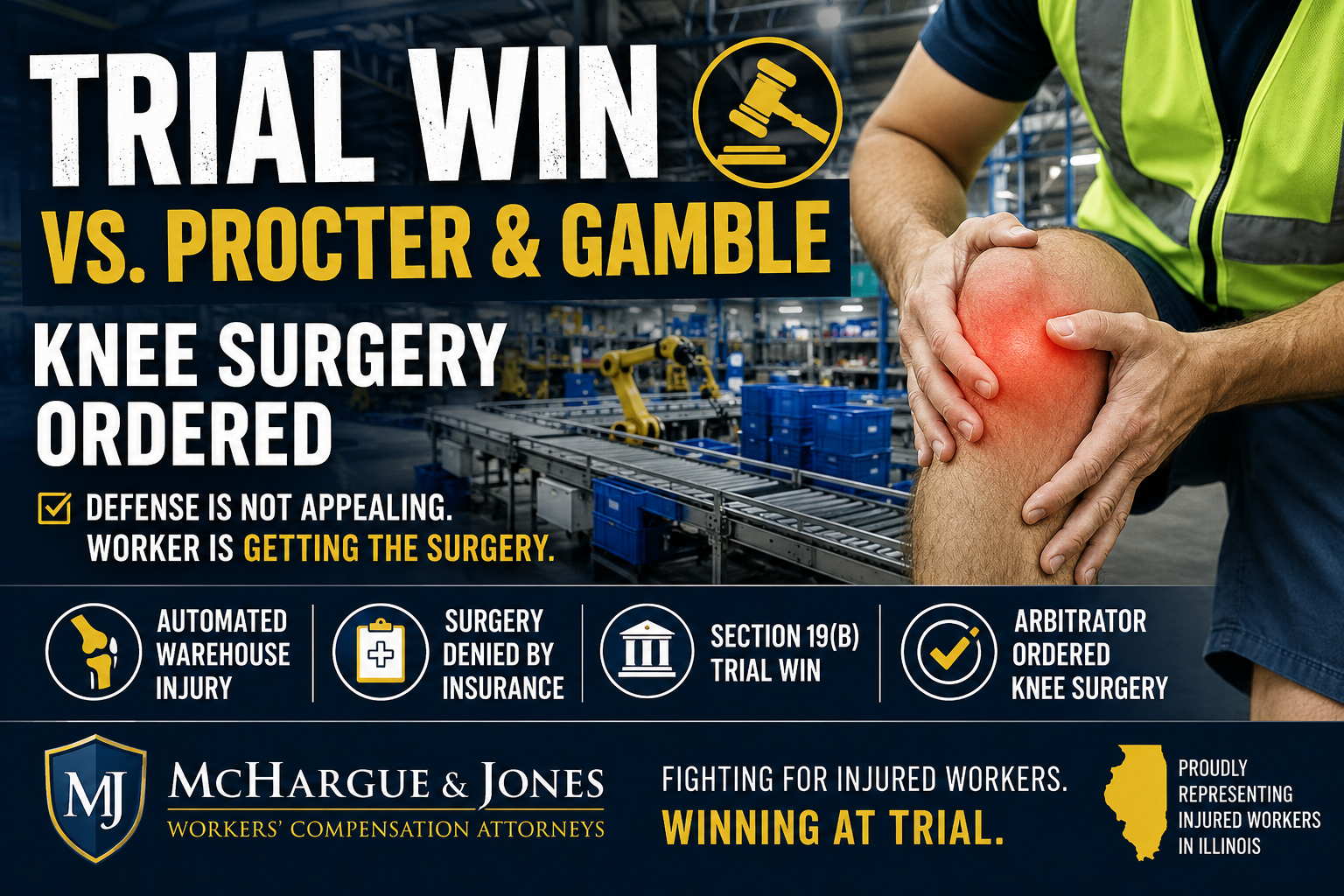


Trial Win vs. Procter & Gamble: Workers’ Comp Judge Orders Knee Surgery After Automated Warehouse Injury
This case also shows something important about modern warehouse work. Even when a warehouse is highly automated, workers still get hurt. Robots, conveyors, shuttles, scanners, lifts, and automated systems do not eliminate workers’ compensation rights.
If workers’ comp has denied your medical treatment, start with our guide on what to do when workers’ comp denies surgery in Illinois. If the entire claim has been denied, see our guide on what to do after a denied workers’ comp claim in Illinois.
Case Result: Procter & Gamble Ordered to Approve Knee Surgery
Employer: Procter & Gamble, Greater Chicago Fulfillment Center (Morris, IL)
Type of case: Illinois workers’ compensation Section 19(b) trial
Work setting: Large automated warehouse / fulfillment center
Job type: Automation technician troubleshooting warehouse system faults
Injury: Right knee injury
Medical dispute: Treating orthopedic surgeon recommended arthroscopic knee surgery; IME doctor disputed causation
Result: Arbitrator ordered Procter & Gamble to authorize arthroscopic right knee surgery
Appeal status: The defense is not appealing, so the worker is getting the surgery
Why This Procter & Gamble Workers’ Comp Trial Win Matters
This trial win matters because it was not just a dispute over paperwork. It was about whether an injured warehouse worker would get the knee surgery his treating orthopedic surgeon recommended.
The insurance side did what we often see in denied surgery cases. They sent the worker to an IME doctor. The IME doctor agreed there were findings on the MRI, but disputed whether the surgery was related to the work accident. The defense position was that the worker had a knee contusion and that the mechanism of injury did not explain the meniscus tear.
The treating surgeon disagreed. The worker continued to have pain and limitations. Conservative care did not solve the problem. The injection recommended by the IME doctor did not fix the knee. Surgery remained the treating surgeon’s recommendation.
That left the injured worker with a choice: accept the denial or fight it.
We fought it at trial.
The arbitrator ruled that the right knee condition was causally related to the work accident and ordered Procter & Gamble to approve the arthroscopic knee surgery. That is the point of a serious workers’ comp trial: to force the insurance company to provide benefits when the evidence supports the injured worker.
If you are facing a similar dispute, our Illinois workers’ comp hearing and trial guide explains how these cases are presented when the insurance company refuses to approve medical care.
The Job: Managing a Highly Automated Warehouse System
The injured worker was an automation technician at Procter & Gamble’s Greater Chicago Fulfillment Center. His job involved checking on the automation process and troubleshooting errors or faults inside a very large warehouse facility.
This was not a simple warehouse job where workers manually moved every box down a line. The facility used a multi-level automated conveyor and shuttle system for totes. When the automated system had a fault, the worker had to inspect the area, troubleshoot the problem, and fix the issue so the system could keep operating.
That is a modern warehouse job: the machines do much of the repetitive movement, but human workers still have to manage the system when it glitches.
Ten years ago, a facility like this might have required many more workers to move, sort, pick, and organize product. Now, many large warehouses are designed around automation, robotics, conveyors, scanners, shuttles, and computerized systems.
The glass-half-full view is that there will still be jobs managing the robots. The glass-half-empty view is that big business is trying to minimize warehouse jobs wherever it can.
But this case proves something important:
Even when the warehouse is automated, workers still get hurt — and they still have rights under Illinois workers’ compensation law.
If you work in a warehouse, distribution center, fulfillment center, or logistics facility, our page for Chicago warehouse workers’ compensation claims explains common injury patterns, medical disputes, denied claims, IME issues, and surgery denials in warehouse cases.
The Accident: Knee Injury While Clearing an Automation Fault
The work accident happened while the worker was clearing an automation fault inside the warehouse system.
He went into the automated system to fix a shuttle that was around chest height. There was another shuttle or tote system below him at about knee level that he could not see. While pushing the higher shuttle into position, he struck his right knee against the lower shuttle/tote system. The impact forced pressure onto the kneecap area and caused immediate right knee pain.
The pain got worse when he went down stairs, and he had to brace himself on the railing. He reported the injury to his team lead. Like many injured workers, he tried to keep working and hoped the knee would improve.
That part of the story matters.
Insurance companies often try to use an injured worker’s effort against him:
- “If it was serious, why did you keep working?”
- “If you needed surgery, why did you not go to the doctor immediately?”
- “If your knee was really hurt, why were you still doing your job?”
- “If you could work, why should we approve surgery?”
But real workers often keep working because they need a paycheck, because they hope the injury will get better, because they do not want to cause problems, or because their employer is trying to accommodate restrictions.
The arbitrator understood that. The worker gave consistent testimony, had consistent medical histories, reported the injury, treated, followed restrictions, attempted conservative care, and continued working despite ongoing symptoms.
For workers dealing with similar injuries, our guide on how much a knee injury is worth in Illinois workers’ comp explains how knee claims are evaluated, including meniscus tears, surgery, restrictions, and job impact.
Automation, Robotics, and Warehouse Injuries: Accidents Still Happen
Warehouse automation is a growing issue in workers’ compensation. More warehouses are being built around robotic systems, automated totes, shuttles, conveyors, scanners, lifts, and computer-controlled movement of product.
Automation may reduce some types of manual labor. But it does not eliminate warehouse danger.
In some ways, automation creates new risks. Workers may be required to:
- clear faults in moving systems;
- work around rails, shuttles, conveyors, totes, lifts, and robotic equipment;
- climb stairs, platforms, and multiple warehouse levels;
- respond quickly when production stops;
- troubleshoot equipment in tight spaces;
- walk long distances during long shifts;
- get up and down repeatedly while clearing system errors;
- work overnight or 12-hour shifts while managing automated processes.
Those tasks can still cause serious injuries to the knees, back, shoulders, neck, hands, wrists, feet, and ankles.
Large companies may invest heavily in automation, robotics, and artificial intelligence. But when a human worker is hurt keeping that system running, the case is still about a real person with real pain, real medical treatment, and real legal rights.
The fact that a warehouse is “automated” does not mean the injury is minor. It does not mean the worker is replaceable. And it does not mean workers’ comp can deny medical care.
The Medical Treatment: MRI, Meniscus Tear, Therapy, Injection, and Surgery Recommendation
After the accident, the worker eventually treated at a company-directed clinic. The early diagnosis was a knee contusion, and he was returned to work. But the knee pain continued.
He had difficulty with stairs, buckling, locking, and knee extension. Restrictions were placed on stair use. He started physical therapy, but his symptoms worsened while he continued working in the warehouse.
He was then referred to an orthopedic specialist. The treating orthopedic surgeon ordered an MRI. The MRI showed an anterior lateral meniscus tear and a cyst-like structure. After continued symptoms, physical therapy, work restrictions, and failed conservative treatment, the treating surgeon recommended arthroscopic partial lateral meniscectomy.
That medical progression is common in serious knee workers’ comp cases:
- the injury is initially treated as a contusion or strain;
- the worker keeps working and hopes it gets better;
- pain continues or worsens;
- stairs, walking, standing, lifting, or kneeling become difficult;
- an MRI shows a meniscus tear or internal knee problem;
- therapy does not fully resolve symptoms;
- the treating surgeon recommends arthroscopic surgery;
- the insurance company sends the worker to an IME;
- the IME doctor disputes causation or surgery.
That is why a torn meniscus workers’ comp case is not always simple. If you are dealing with a similar issue, read our guide on torn meniscus workers’ compensation cases in Illinois.
Why Workers’ Comp Denied the Knee Surgery
Procter & Gamble’s workers’ comp side sent the worker to a Section 12 independent medical examination. The IME doctor agreed there were MRI findings, including a meniscus tear, but disputed whether the work accident caused the tear or whether the surgery was related to the accident.
The IME doctor’s main argument was that a meniscus tear usually requires a twisting or torsional mechanism with the foot planted. Because the worker described a direct blow to the knee while his leg was moving, the IME doctor claimed the mechanism did not explain the meniscus tear.
Instead, the IME doctor diagnosed a knee contusion and recommended a corticosteroid injection before surgery.
This is a common insurance-company strategy in denied surgery cases:
- accept that something happened at work;
- call it a temporary contusion, strain, or sprain;
- deny that the surgical condition is related;
- recommend more conservative care;
- delay surgery;
- argue that ongoing symptoms are degenerative, pre-existing, or unrelated.
The worker then underwent the injection recommended by the IME doctor, even though the treating surgeon did not believe it would help. The injection did not fix the problem. The worker continued to have symptoms, and the treating surgeon again recommended surgery.
That became the core dispute: treating surgeon versus IME doctor.
If you are in that situation, our article on IME doctors vs. treating doctors in Illinois workers’ comp explains why these disputes often decide denied surgery cases. You should also review our guide to IMEs in Illinois workers’ compensation.
Why We Took the Case to a Section 19(b) Workers’ Comp Trial
When workers’ comp refuses to approve necessary surgery, time matters.
A denied surgery case is not just about money. It is about pain, function, medical recovery, job security, and whether the injured worker can return to a normal life.
That is why we proceeded under Section 19(b).
A Section 19(b) hearing is an expedited Illinois workers’ compensation trial procedure used for urgent disputes over benefits, medical care, TTD checks, surgery approval, and other time-sensitive issues. It is one of the strongest tools available when an insurance company refuses to authorize treatment recommended by the treating doctor.
In this case, the worker wanted the surgery. His treating surgeon recommended it. Conservative care had failed. The injection recommended by the IME doctor did not solve the problem. The worker continued to work, but he still had pain and activity limitations.
The insurance company would not voluntarily approve surgery.
So we took the case to trial.
If your case may need to be tried, our Illinois workers’ comp hearing and trial guide explains what happens at hearing, what evidence matters, and how disputed cases are decided.
Why the Arbitrator Ruled for the Injured Worker
The arbitrator found that the worker’s current right knee condition was causally related to the March 23, 2025 work accident.
Several facts mattered:
- the work accident was established;
- the worker gave credible testimony;
- his medical histories were consistent;
- he had no prior right knee problems or treatment;
- he had immediate symptoms after striking his knee;
- the MRI showed objective evidence of a meniscus tear;
- the treating surgeon recommended arthroscopic surgery;
- physical therapy did not resolve the symptoms;
- the injection recommended by the IME doctor failed;
- the IME doctor had not re-examined the worker after the failed injection;
- the IME opinion had weaknesses on cross-examination.
The arbitrator found the treating surgeon more persuasive than the IME doctor.
That is an important point for injured workers. Insurance companies often act like an IME report ends the case. It does not. An IME report is evidence. It is not the final decision.
The arbitrator can consider the treating doctor’s opinions, the MRI, the worker’s testimony, the consistency of the histories, the failure of conservative care, and whether the IME doctor’s opinion holds up under cross-examination.
In this case, the arbitrator focused on the chain of events: no prior knee symptoms, a work accident, immediate and ongoing symptoms, objective MRI findings, conservative care, failed injection, continued pain, and a treating surgeon’s recommendation for surgery.
That timeline won.
The Result: Procter & Gamble Must Authorize the Knee Surgery
The arbitrator ordered Procter & Gamble to authorize the arthroscopic right knee partial lateral meniscectomy recommended by the treating orthopedic surgeon.
That means the injured worker won the most important issue in the case: he is getting the surgery workers’ comp refused to approve.
Even more importantly, the defense is not appealing. That means the decision will stand, and the worker can move forward with the medical treatment he needs.
This result matters because insurance companies frequently deny or delay surgery in Illinois workers’ comp cases. They may argue:
- the injury is only a contusion;
- the MRI finding is degenerative;
- the worker has a pre-existing condition;
- the mechanism of injury does not match the diagnosis;
- the worker has not failed enough conservative care;
- the treating surgeon is wrong;
- the IME doctor should be believed instead.
Sometimes those defenses work. Sometimes they do not. In this case, they did not.
Lessons for Injured Warehouse Workers
This Procter & Gamble trial win has lessons for warehouse workers, distribution workers, fulfillment center workers, automation technicians, mechanics, maintenance workers, and anyone working around modern warehouse systems.
1. A Warehouse Injury Does Not Have to Look Dramatic to Be Serious
This was not a forklift rollover or a fall from a roof. It was a knee impact while troubleshooting an automated system. But the injury led to ongoing symptoms, MRI findings, failed conservative care, and a surgical recommendation.
Workers often underestimate injuries at first. Insurance companies do too.
2. Automation Does Not Eliminate Workers’ Comp Rights
Modern warehouses may have robots, conveyors, shuttles, scanners, lifts, and computer-controlled systems. But if a worker is injured while managing, fixing, or responding to that system, the same Illinois workers’ comp laws apply.
The key question is still whether the injury arose out of and occurred in the course of employment.
3. An IME Denial Is Not the End of the Case
The IME doctor disagreed with the treating surgeon. That happens constantly. But the arbitrator was not required to accept the IME opinion.
The worker’s testimony, medical records, treating doctor’s recommendation, MRI findings, and failed conservative treatment all mattered.
4. Consistent Histories Matter
The worker’s consistent accident history helped the case. He reported striking his right knee at work and continued to describe the same basic mechanism throughout the medical records and testimony.
In Illinois workers’ comp, consistency is powerful. Inconsistencies give the insurance company room to deny the claim.
5. Trial Readiness Creates Leverage
Insurance companies know which firms are willing to try disputed workers’ comp cases. When surgery is denied, being willing to prepare the worker, challenge the IME, present medical evidence, and go to hearing can make all the difference.
This is also why hiring the right attorney matters. For more on that, read the benefits of hiring a workers’ comp attorney in Illinois.
About This Result
This case was tried by attorney Matthew C. Jones before the Illinois Workers’ Compensation Commission. The arbitrator ordered Procter & Gamble, Greater Chicago Fulfillment Center to authorize the recommended arthroscopic right knee surgery, and the defense is not appealing.
Prior results do not guarantee a similar outcome. Every workers’ compensation case depends on its own facts, medical records, doctors, testimony, and legal issues. But this result shows that denied surgery cases can be fought successfully when the evidence supports the injured worker.
Related Illinois Workers’ Comp Trial Wins
This Procter & Gamble case is part of a broader pattern we see in serious Illinois workers’ comp litigation: the insurance company denies surgery, relies on an IME doctor, and forces the injured worker to trial.
Other McHargue & Jones trial-win examples include:
- Trial win vs. Aldi Distribution Center forcing approval of workers’ comp surgery
- Joliet Section 19(b) trial win ordering hip replacement surgery after workers’ comp denial
- Illinois workers’ compensation trial wins where surgeries were approved
Different injuries. Different employers. Same basic insurance-company playbook: deny, minimize, blame something else, and force the worker to fight for treatment.
At McHargue & Jones, we do not bluff about trial. If a case needs to be tried, we prepare it and try it.
Denied Surgery After a Warehouse Injury?
If you were hurt working in a warehouse and the insurance company denied surgery, do not assume the denial is final.
The next steps may include:
- reviewing the denial letter or IME report;
- getting the treating surgeon’s opinion clearly documented;
- identifying whether the injury caused or aggravated the medical condition;
- checking whether physical therapy, injections, or other conservative treatment failed;
- filing the correct petition with the Illinois Workers’ Compensation Commission;
- preparing the case for hearing if the insurance company refuses to approve care.
For broader information about warehouse injuries, visit our Chicago warehouse workers’ comp page. For knee-specific issues, see our guides on Illinois knee injury workers’ comp cases and torn meniscus workers’ compensation claims.
FAQ: Workers’ Comp Surgery Denials, Warehouse Injuries, and Procter & Gamble Trial Win
Can a workers’ comp judge order knee surgery in Illinois?
Yes. If the treating doctor recommends knee surgery and the insurance company refuses to approve it, an Illinois Workers’ Compensation Commission arbitrator can order the employer or insurer to authorize surgery after a hearing. In this Procter & Gamble case, the arbitrator ordered approval of arthroscopic right knee surgery.
What is a Section 19(b) workers’ comp trial?
A Section 19(b) trial is an expedited Illinois workers’ compensation hearing used for urgent disputes, including denied medical treatment, denied surgery, stopped TTD checks, and other time-sensitive benefit issues. It can be an important tool when the insurance company refuses to approve necessary care.
Why do insurance companies deny meniscus surgery in workers’ comp cases?
Insurance companies often deny meniscus surgery by claiming the tear is degenerative, pre-existing, unrelated to the accident, or not consistent with the described mechanism of injury. They may also argue that the worker has not failed enough conservative treatment. These arguments often come from an IME doctor.
Can a direct blow to the knee be a workers’ comp injury?
Yes. A direct blow to the knee can be a covered Illinois workers’ comp injury if it happens during work and causes or aggravates a knee condition. The insurance company may still dispute whether the blow caused a specific diagnosis, such as a meniscus tear, but that dispute can be decided by the Illinois Workers’ Compensation Commission.
What if the IME doctor says my surgery is not work-related?
An IME opinion is not the final word. The arbitrator can consider the treating doctor’s opinion, MRI findings, medical records, testimony, prior health, symptoms after the accident, and whether conservative treatment failed. Many disputed surgery cases come down to treating doctor versus IME doctor.
Can workers’ comp cover an aggravation of a pre-existing knee condition?
Yes. Illinois workers’ comp may cover an injury that aggravates, accelerates, or makes a pre-existing condition symptomatic. The worker does not have to prove that the knee was perfect before the accident. The key is whether the work accident contributed to the current condition.
Do warehouse workers have workers’ comp rights if the facility is automated?
Yes. Automation, robotics, conveyors, shuttles, and computer-controlled warehouse systems do not eliminate workers’ comp rights. If a worker is hurt while performing job duties in an automated warehouse or fulfillment center, the claim may be covered under Illinois workers’ compensation law.
What should I do if workers’ comp denied my knee surgery?
Do not assume the denial is final. Get a copy of the denial or IME report, follow up with your treating doctor, make sure the medical opinion is clearly documented, and speak with a workers’ comp lawyer. If the denial is unreasonable, the case may need to be taken to hearing.
Can I keep working and still win a workers’ comp surgery dispute?
Yes. Many injured workers continue working because they need a paycheck or because the employer accommodates restrictions. Continuing to work does not automatically mean you are not hurt. The important issues are your medical evidence, restrictions, symptoms, job duties, and whether the recommended treatment is reasonable and related to the work injury.
Does a workers’ comp trial win guarantee a similar result in my case?
No. Prior results do not guarantee a similar outcome. Every Illinois workers’ comp case depends on its own facts, medical records, doctors, testimony, and legal issues. But trial wins like this show that denied surgery cases can be fought successfully when the evidence supports the injured worker.
Talk to McHargue & Jones About a Denied Workers’ Comp Surgery
If you were hurt working in a warehouse, fulfillment center, distribution facility, or automated system and workers’ comp denied your knee surgery, McHargue & Jones can review your case and explain your options.
We represent injured workers in Chicago, Cook County, and throughout Illinois. We handle denied workers’ comp claims, IME disputes, warehouse injuries, knee injuries, meniscus tears, and surgery-denial cases. You do not pay unless we recover for you.
Call (312) 739-0000 for a free consultation.