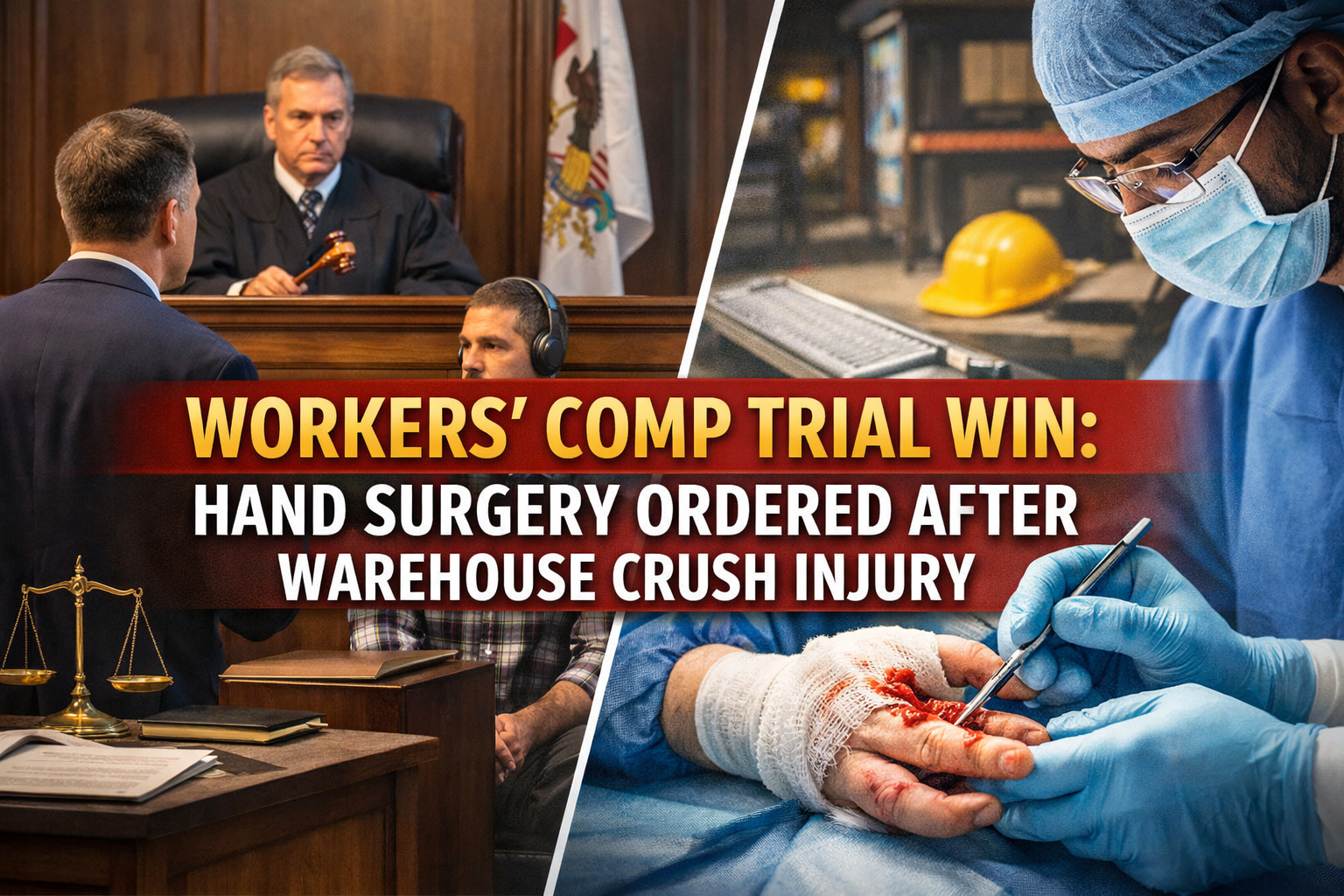


Trial Win: Workers’ Compensation Judge Orders Hand Surgery After Warehouse Crush Injury
By Matthew C. Jones,
Chicago workers’ compensation trial lawyer at McHargue & Jones.
Case Result Summary
Employer: Triune Logistics – Chicago warehouse employer
Location of Trial: Illinois Workers’ Compensation Commission hearing site at the Daley Center in Chicago
Injury: Crush injury to right middle finger while lifting metal ramps
Dispute: Insurance company disputed causation, denied surgery, and refused to pay medical bills
Result: Workers’ compensation judge ordered approval of hand surgery and payment of outstanding medical expenses
Workers’ compensation claims involving crush injuries and nerve damage are frequently disputed by insurance companies.
Employers and insurers often argue that an injury is minor, that treatment is unnecessary, or that symptoms are unrelated to the workplace accident.
At McHargue & Jones, we regularly represent injured workers whose claims have been denied, whose medical treatment has been refused, or whose disability checks have been stopped. When insurance companies refuse to approve necessary treatment, our attorneys take those cases to trial before the Illinois Workers’ Compensation Commission.
This recent trial win involved a warehouse worker injured while working for Triune Logistics, a logistics company operating in Chicago. The case was tried by attorney
Adam Rosner and resulted in a ruling ordering the employer to authorize surgery and pay medical expenses.
The Workplace Accident
The injured worker was employed in a logistics warehouse performing physically demanding tasks such as unloading containers, driving forklifts, and handling heavy metal materials throughout the day.
On the date of the accident, the worker was lifting a heavy metal ramp with a supervisor. During the process, the worker’s right middle finger became trapped between two metal ramps.
The crushing force caused a severe laceration to the fingertip. The worker immediately noticed bleeding, numbness, and loss of sensation in the finger.
Crush injuries like this are common in warehouse environments where employees routinely handle heavy equipment, ramps, and pallets. Distribution center work often involves repetitive lifting and exposure to heavy materials that can cause serious hand and finger injuries.
We represent many injured warehouse workers whose injuries occur in logistics facilities throughout the Chicago area.
Medical Treatment After the Finger Crush Injury
The worker sought emergency medical care shortly after the accident. Doctors diagnosed a laceration and crush injury to the right middle finger that required wound repair and follow-up treatment.
Over time, the worker developed ongoing symptoms including numbness, hypersensitivity, and reduced grip strength. The pain also began radiating into the hand and forearm.
These types of crush injuries can damage small nerve branches in the fingertip and cause persistent nerve pain.
When conservative treatments such as therapy and injections fail, surgery may become necessary to relieve symptoms and restore function.
The Treating Surgeon Recommended Surgery
After multiple rounds of treatment failed to relieve the worker’s symptoms, the treating hand surgeon recommended surgery to address the injury.
The recommended procedure included an A1 pulley release and digital neurectomy. These procedures are used to relieve nerve-related pain and improve function in cases involving traumatic injury to the finger.
The goal of the surgery was to reduce the severe nerve pain and restore grip strength in the injured hand.
The Insurance Company Denied Treatment
Despite the treating surgeon’s recommendation, the employer’s insurance company refused to approve the surgery.
Denied treatment is a common problem in workers’ compensation cases. Insurance companies frequently rely on hired doctors performing Independent Medical Examinations (IMEs) to dispute treatment recommendations made by the injured worker’s doctor.
In this case, the insurance company relied on an IME doctor who claimed the worker did not need surgery and could return to full duty work.
Insurance companies may also stop disability checks during these disputes. These payments are known as temporary total disability (TTD) benefits.
Workers’ compensation law generally requires employers to pay for reasonable and necessary medical treatment related to a work injury. Benefits can include surgery, therapy, medications, and wage replacement for workers who cannot work while recovering.
The Workers’ Compensation Trial
Because the insurance company refused to approve surgery, the case proceeded to trial before the Illinois Workers’ Compensation Commission.
The hearing took place at the Commission’s Cook County hearing site at the Daley Center in downtown Chicago.
The injured worker testified about how the accident occurred and how the injury affected his ability to use his hand.
The worker testified through a Spanish interpreter, which is common in many workers’ compensation trials involving Chicago warehouse employees.
The primary issues at trial included:
- whether the crush injury caused the worker’s ongoing symptoms
- whether the medical treatment was reasonable and necessary
- whether the recommended surgery should be authorized
Through medical evidence and testimony, attorney Adam Rosner demonstrated that the worker’s ongoing symptoms were directly related to the workplace accident.
The Judge Favored the Treating Surgeon Over the IME Doctor
The arbitrator ultimately found the treating surgeon’s opinions more persuasive than the IME doctor’s report.
The judge concluded that the crush injury caused the worker’s ongoing pain, numbness, and grip strength problems.
As a result, the arbitrator determined that the recommended surgery was reasonable and necessary to treat the worker’s condition.
The Judge Ordered Surgery and Payment of Medical Bills
After reviewing the evidence, the arbitrator ruled in favor of the injured worker.
The decision ordered the employer to:
- authorize and pay for the recommended hand surgery
- pay outstanding medical bills
- cover additional treatment related to the injury
Medical treatment in Illinois workers’ compensation cases is generally covered at 100 percent when it is related to the workplace injury.
How Much Is a Hand Injury Worth in an Illinois Workers’ Compensation Case?
Many injured workers ask what their case may ultimately be worth.
The value of a hand or finger injury claim depends on several factors including the severity of the injury, whether surgery is required, and whether the worker suffers permanent loss of function.
You can learn more about how these cases are evaluated in our guide to how much a hand injury may be worth in an Illinois workers’ compensation case. Workers who suffer finger injuries may be entitled to benefits covering medical treatment, lost wages, and compensation for permanent disability.
Denied Workers’ Compensation Claim?
Many injured workers contact our firm after their claim has been denied, their checks have stopped, or the insurance company refuses to approve medical treatment. Workers’ compensation claims can be more complex than they seem, especially if benefits are denied or delayed. A Chicago work injury lawyer can help you understand your rights: https://mcharguelaw.com/
If this has happened in your case, you may want to read our guide on what to do when a workers’ compensation claim is denied in Illinois. At McHargue & Jones, we regularly represent injured workers in these disputes and take cases to trial when insurance companies refuse to approve necessary treatment.
Frequently Asked Questions About Workers’ Compensation Trials
Can a workers’ compensation judge order surgery?
Yes. If a treating doctor recommends surgery and the insurance company refuses to approve it, a workers’ compensation judge can order the employer to authorize the procedure after a hearing.
What happens if workers’ compensation stops paying checks?
If disability checks stop while you remain unable to work, your lawyer can request a hearing before the Illinois Workers’ Compensation Commission to determine whether payments should resume.
Are crush injuries common in warehouse jobs?
Yes. Warehouse employees regularly handle heavy equipment, pallets, and metal materials that can cause crush injuries to the hands and fingers.
About the Author
This article was written by
Matthew C. Jones, a Chicago workers’ compensation trial lawyer at McHargue & Jones.
The case described above was tried by attorney Adam Rosner, who represents injured workers throughout Illinois in workers’ compensation litigation.