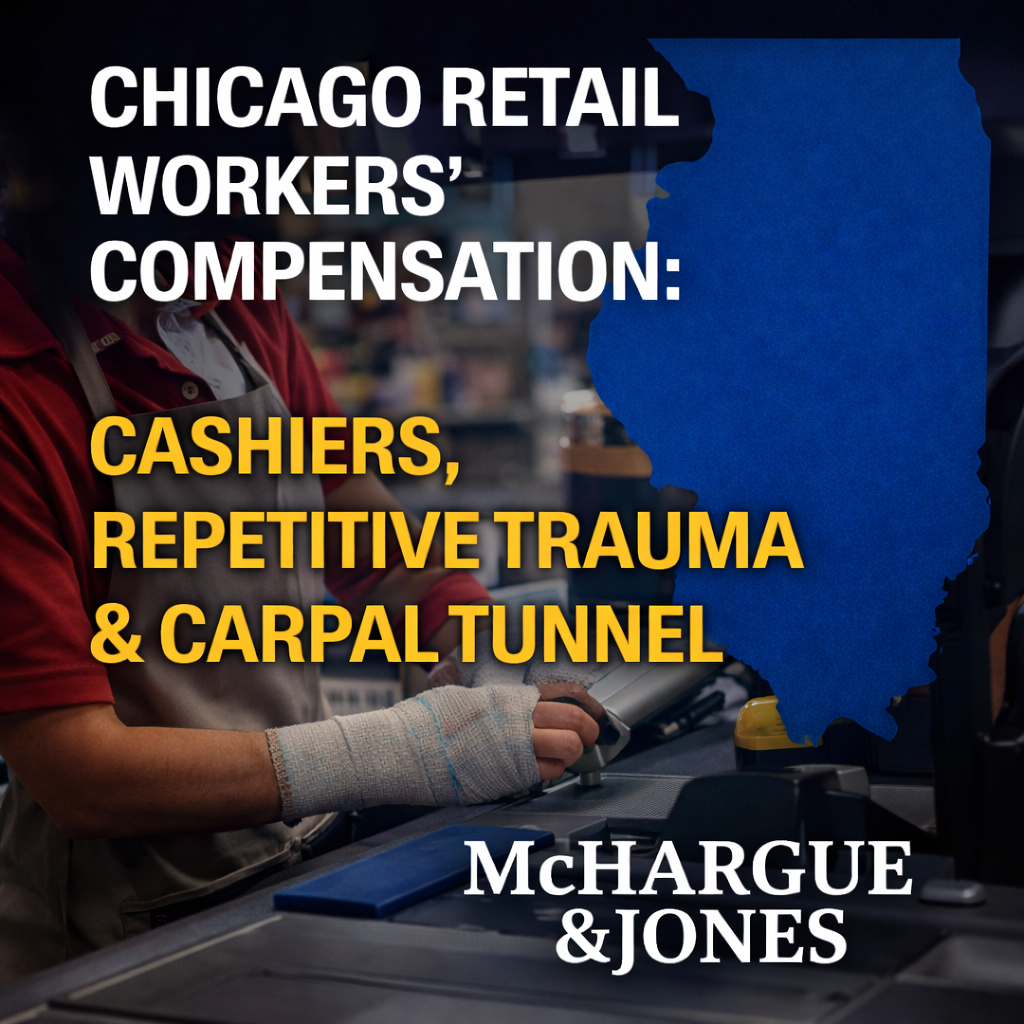


Retail Workers & Cashiers: Workers’ Compensation Claims in Chicago
Retail workers and cashiers in Chicago and Cook County experience some of the most common — and most frequently denied — workplace injuries in Illinois. Employees at large retailers such as Target, Walmart, Jewel-Osco, Walgreens, grocery stores, pharmacies, and big-box chains perform physically demanding tasks every shift, including repetitive scanning, stocking shelves, lifting heavy merchandise, and standing for long hours on hard floors. Under the Illinois Workers’ Compensation Act, retail workers may be entitled to medical treatment, wage replacement, and disability benefits when their job duties cause or contribute to injuries like repetitive trauma, carpal tunnel syndrome, shoulder injuries, and back injuries.
This article explains how Chicago retail workers’ compensation claims work, which injuries qualify, and what injured retail employees should know when employers or insurance companies delay or deny benefits.
Common Injuries in Chicago Retail Workers’ Compensation Cases
Retail injuries are often dismissed as “part of the job,” but Illinois law recognizes many of these conditions as compensable work injuries.
Repetitive Trauma Injuries in Retail Jobs
Retail work involves constant repetition — scanning items, bagging purchases, lifting boxes, folding merchandise, and reaching overhead. Over time, these repetitive motions can cause repetitive trauma injuries, also known as cumulative trauma injuries. Illinois workers’ compensation law allows claims for repetitive trauma when work activities are a contributing cause of the condition, even if there was no single accident, as explained in this guide on repetitive stress injuries and Illinois workers’ compensation.
These claims are common among cashiers, stockroom workers, fulfillment associates, and sales floor employees throughout Chicago.
Cashier injuries are not accidental or unusual—they are well-documented occupational hazards recognized by the Occupational Safety and Health Administration (OSHA). OSHA identifies retail cashier work as high risk for musculoskeletal disorders caused by repetitive motion, awkward postures, frequent reaching, and lifting, including carpal tunnel syndrome, tendinitis, bursitis, and back strain. According to OSHA’s retail ergonomics guidance, poorly designed checkout stations and repetitive scanning significantly increase injury risk when employers fail to adjust workstations, rotate tasks, or reduce repetitive hand and wrist movements (OSHA, Guidelines for Retail Grocery Stores: Ergonomics for the Prevention of Musculoskeletal Disorders). When these recognized workplace hazards lead to injury, Illinois law allows retail workers to pursue repetitive stress and cumulative trauma workers’ compensation claims even if symptoms develop gradually rather than from a single accident.
Carpal Tunnel and Hand/Wrist Injuries for Cashiers
Cashiers are especially vulnerable to carpal tunnel syndrome and other hand and wrist injuries caused by repetitive scanning, gripping, twisting, and bagging. Symptoms often develop gradually and may include numbness, tingling, weakness, and night pain. Illinois workers’ compensation covers carpal tunnel when job duties cause or aggravate the condition, and benefits may be available for medical care, time off work, and permanent disability, as discussed in this breakdown of how much carpal tunnel is worth in an Illinois workers’ comp case.
Shoulder Injuries From Stocking and Lifting
Retail shoulder injuries frequently result from overhead stocking, lifting heavy boxes, pulling pallets, and repetitive reaching. These injuries may involve rotator cuff tears, impingement, or chronic shoulder pain that limits a worker’s ability to return to retail duties. Shoulder injuries are a common source of disputes in Chicago retail workers’ compensation cases, particularly when employers push early return-to-work programs, as outlined in this overview of shoulder injury value in Illinois workers’ compensation.
Back Injuries in Retail Work
Back injuries are among the most serious injuries retail workers face. Lifting, twisting in confined stockrooms, moving merchandise, or slipping on store floors can lead to strains, disc herniations, and long-term spinal issues. Even injuries that start as “minor” back pain can develop into permanent limitations. Illinois workers’ compensation benefits for retail back injuries are discussed in detail in this explanation of how back injury claims are valued under Illinois workers’ comp law.
Workers’ Compensation at Major Chicago Retail Employers
Walmart Workers’ Compensation Claims in Illinois
Walmart is one of the largest retail employers in Chicago and across Illinois. Walmart workers’ compensation claims are commonly administered by Sedgwick, and injured workers often encounter disputes over light duty assignments, independent medical exams (IMEs), and permanent work restrictions. Retail employees injured at Walmart should understand how these claims are handled and what rights they have under Illinois law, as explained in this detailed guide to Walmart workers’ compensation claims in Illinois.
Target Workers’ Compensation Claims in Chicago
Target employees in Chicago experience many of the same workplace injuries as other retail workers, including repetitive trauma, carpal tunnel, shoulder injuries, and back injuries. Target workers’ compensation claims are often managed through third-party administrators, which can make the process more complex. An overview of these cases and what injured employees should expect is available in this article on Target workers’ compensation claims in Illinois.
Are Seasonal and Holiday Retail Workers Covered?
Seasonal and holiday retail workers in Chicago are frequently told they are not eligible for workers’ compensation benefits, but that is often incorrect. In many cases, seasonal employees are covered by Illinois workers’ compensation as long as they are employees injured in the course of their job duties. Coverage issues for temporary and holiday retail workers are addressed in this explanation of workers’ compensation for holiday and seasonal employees.
Frequently Asked Questions About Chicago Retail Workers’ Compensation
Do retail workers qualify for workers’ compensation in Chicago?
Yes. Full-time, part-time, and seasonal retail workers in Chicago and Cook County are generally covered under Illinois workers’ compensation law when they are injured at work or due to job duties.
Do I need a single accident to file a claim?
No. Illinois recognizes repetitive trauma injuries, meaning workers can file claims even when injuries develop gradually over time.
What if my employer offers light duty that still causes pain?
Light duty must comply with medical restrictions. If the work exceeds restrictions or worsens the injury, workers may still be entitled to benefits.
Where are Chicago workers’ compensation cases handled?
Disputed claims are handled by the Illinois Workers’ Compensation Commission, with hearings commonly held at the Chicago arbitrators’ site in the Loop.
Help for Injured Retail Workers in Chicago
Retail workers in Chicago and Cook County often face delayed treatment, denied claims, and pressure to return to work too soon — especially in repetitive trauma and cumulative injury cases. If you were injured working as a cashier, stocker, fulfillment associate, or seasonal retail employee, you may be entitled to benefits even if your employer disputes your claim. Information about your rights and legal options is available through this page on working with a Chicago workers’ compensation lawyer.