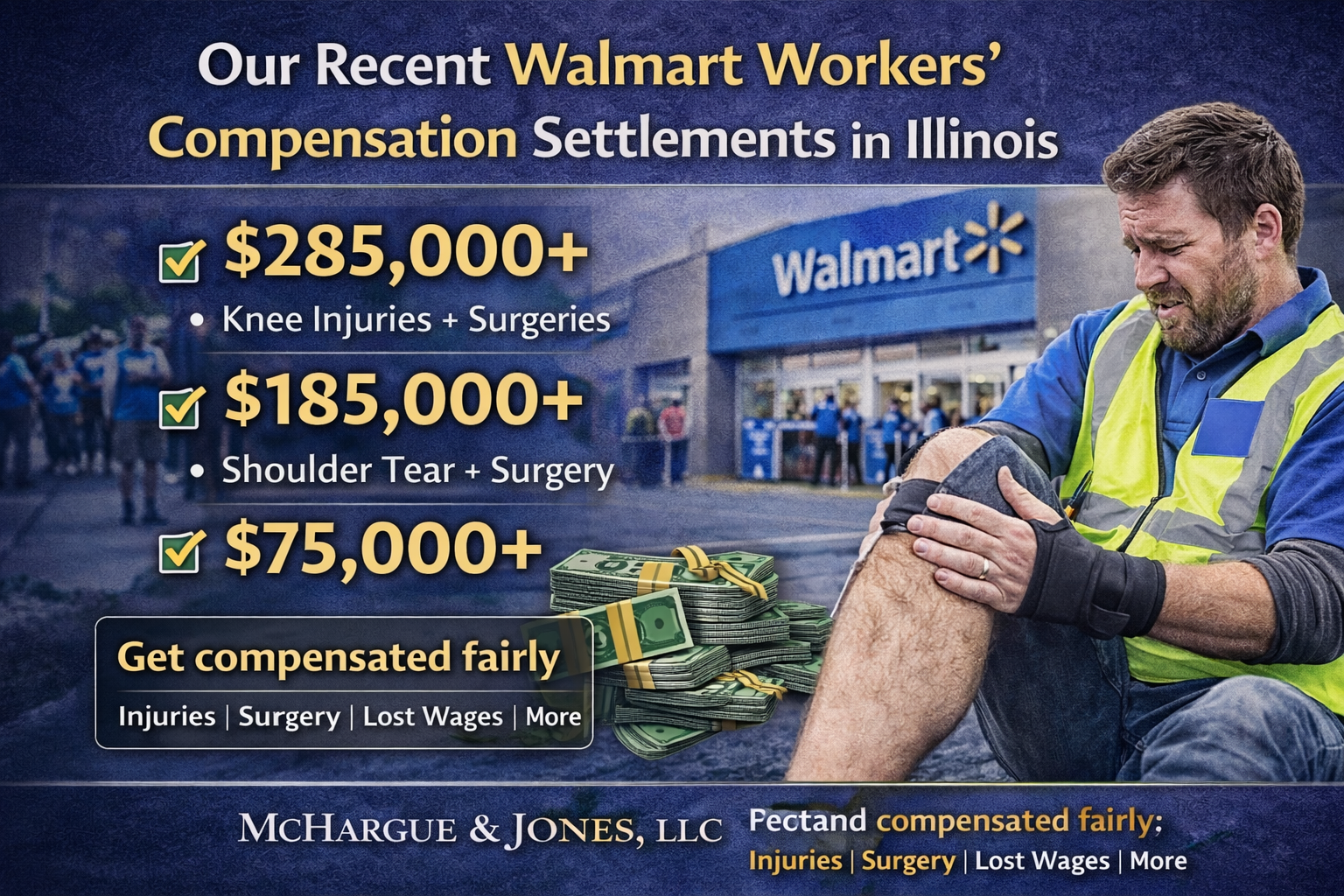


Our Recent Walmart Workers’ Compensation Settlements in Illinois
By Matthew C. Jones, Chicago Workers’ Compensation Attorney
This article explains recent Walmart workers’ compensation settlements in Illinois based on cases our office has handled. These examples are anonymized and shared only for educational purposes. Every case is different, and past results do not guarantee future outcomes.
A lot of injured Walmart workers are intimidated at the beginning of the case.
That is understandable. Walmart is one of the largest employers in the country. Many workers assume the company has endless resources, strong insurance defense lawyers, and claims teams that are too big to fight. Some even worry that a workers’ compensation lawyer may be reluctant to take on a company that large.
That has not been our experience.
We have handled Walmart workers’ compensation cases across Illinois. We know the issues that come up in these claims. We know the patterns we tend to see from Walmart and its claims handling. We know many of the defense firms and lawyers who regularly appear in these cases, and they know us. Most importantly, we have a real history of obtaining fair settlements for injured Walmart workers.
Walmart is a large employer, but it is not too big to be held accountable in the Illinois workers’ compensation system.
When Walmart workers call our office, they usually want to know two things: how their claim is likely to be handled, and what their case may actually be worth. This page focuses on the settlement side of that question.
If you want the broader overview of how Walmart claims work, including Sedgwick, IMEs, light duty, and permanent restrictions, start here: Walmart Workers’ Compensation Claims in Illinois: What Injured Walmart Workers Need to Know About Sedgwick, Light Duty, IMEs, and Permanent Restrictions.
If you were just injured and need the immediate next steps, read: What to Do After a Workplace Injury at Walmart in Illinois.
What Is a Walmart Workers’ Comp Settlement Worth in Illinois?
There is no single average Walmart workers’ comp settlement that tells you very much.
Some Walmart cases resolve for relatively modest amounts. Others settle for much more. The value usually depends on the body part injured, whether surgery was needed, whether the claim was disputed, whether the worker ended up with permanent restrictions, whether future medical remains at issue, and whether the worker can realistically return to the same type of job.
Wage rate also matters more than many people realize.
Walmart store employees often have lower average weekly wages than workers in Walmart distribution centers or warehouse settings. That can have a major effect on settlement value, even where the underlying injury is similar. A shoulder, knee, hand, or back case with a higher wage rate may be worth dramatically more than the same case with a lower wage rate because Illinois workers’ compensation benefits are tied in part to earnings.
That is one reason distribution center and warehouse Walmart cases can look very different from in-store cases. The work is often heavier, the wage rate is often better, and the settlement math can change accordingly.
If you want a broader explanation of how Illinois workers’ comp cases are valued, read: What Is My Illinois Workers’ Comp Case Worth?.
Recent Themes We See in Walmart Workers’ Comp Settlements
Although every Walmart claim is different, there are some recurring themes we see again and again in these cases.
One of the biggest is Walmart’s tendency to accommodate permanent restrictions rather than leave the worker completely off work. In some cases, that means ordinary light duty. In others, the position looks more like a custom or hybrid role created to keep the worker employed in some limited capacity.
That does not necessarily reduce the value of the case.
A worker may still have a strong loss-of-trade argument if permanent restrictions prevent a return to the same kind of work, even if Walmart keeps that person employed in some modified role. We see this especially in shoulder cases, hand cases, and other claims where the worker remains employable but can no longer safely do the same repetitive, physical, or lifting-intensive work as before.
Another recurring theme is the importance of objective proof. In disputed Walmart cases, FCEs and permanent restrictions can make a major difference, especially where the defense relies on an IME doctor to minimize the injury, dispute causation, or cut off treatment.
We also frequently see settlement value turn on a few practical questions: whether surgery was needed, whether future medical remains in play, whether the worker can truly return to the same job, whether Walmart’s accommodated job is really meaningful, and whether the case should be valued as a scheduled injury or as a broader person-as-a-whole or loss-of-trade claim.
Those are some of the themes reflected in the recent examples below.
Recent Walmart Workers’ Compensation Settlement Examples in Illinois
These examples show why there is no single “average” Walmart workers’ comp settlement.
1. Shoulder Injury, Multiple Surgeries, Permanent Restrictions, Light Duty, and a Six-Figure Settlement
One of the larger Walmart settlements we handled involved a serious shoulder injury that became heavily contested.
We took multiple depositions and fought to obtain shoulder surgeries that had been denied. The worker was eventually discharged with permanent restrictions. Walmart then offered a light-duty position.
That is a pattern we see often in Walmart cases. Walmart may try to accommodate permanent restrictions rather than leaving the worker completely out of work, especially where doing so may reduce exposure to wage differential or permanent total disability claims.
But accommodation does not end the value analysis.
In this case, a major issue was loss of trade. We argued successfully that, even though the worker remained employable, she could not return to the same kind of work. Another important component was future medical exposure, including a Medicare Set-Aside issue.
The case ultimately resolved for $150,000.
This is a good example of how surgery, permanent restrictions, loss of trade, and future medical can all combine to increase the value of a Walmart workers’ comp settlement.
Related reading:
- How Much Is a Shoulder or Rotator Cuff Injury Worth in Illinois Workers’ Comp?
- Does Surgery Increase the Value of My Workers’ Comp Case in Illinois?
- How FCEs and Permanent Restrictions Affect Workers’ Compensation Settlements in Illinois
2. Slip and Fall in Store, Two Shoulder Surgeries, and a Strong Person-as-a-Whole Settlement ($60,000)
Another Walmart case involved a slip and fall followed by two right shoulder surgeries.
The worker first had surgery for a rotator cuff tear, then later required additional treatment for frozen shoulder and adhesions. After recovery, the worker was left with permanent restrictions that Walmart accommodated.
Again, this is a classic Walmart fact pattern: permanent restrictions are accommodated, but the worker still has a serious permanent loss.
The case resolved for a substantial person-as-a-whole settlement after surgeries, prolonged recovery, and permanent limitations.
For more on shoulder cases, see:
- How Much Is a Shoulder or Rotator Cuff Injury Worth in Illinois Workers’ Comp?
- Does Surgery Increase the Value of My Workers’ Comp Case in Illinois?
3. Hand Contusion, No Surgery, FCE, Permanent Restrictions, and a $40,000 Settlement
Not every good Walmart workers’ comp settlement involves surgery.
In one case, an older Walmart worker suffered a crushing-type hand injury. Nothing was torn and nothing was broken. On paper, that may sound like a smaller claim. But the worker had permanent ongoing hand problems, and the case was heavily contested.
We pushed hard on the medical and functional evidence, including an FCE and permanent restrictions. Walmart then created a kind of hybrid position to keep the worker employed, involving limited floor work, folding, and other light tasks.
Even without surgery, the case resolved for $40,000 on a relatively low wage rate.
This is an important reminder that no surgery does not automatically mean low settlement value. Permanent restrictions, functional loss, and credibility still matter.
4. Bilateral Carpal Tunnel With Surgery and a Strong Scheduled-Hand Result
We also handled a Walmart repetitive-trauma case involving bilateral carpal tunnel syndrome and surgery.
The treatment was approved, which matters because many repetitive trauma cases are really fights over authorization and causation. Here, the case settled at 13% loss of use of each hand, which was a strong result because the realistic trial upside was only somewhat higher, if at all.
Some workers hear “carpal tunnel” and assume the case should be huge. That is not always realistic. In Illinois, bilateral carpal tunnel cases often have a practical upper range if they are being valued strictly as scheduled hand claims. A good lawyer’s job is not just to chase unrealistic numbers. It is to understand what the case is truly worth and get the best outcome available under the facts.
Related reading:
5. Meniscus Tear, IME Cutoff, and a Quick Walmart Settlement
Another case involved a knee injury with a torn meniscus. The worker had surgery, but did not recover the way everyone hoped. There were also degenerative knee issues that we argued had been aggravated by the work accident. Walmart’s IME doctor said the ongoing problems were not related.
That is a very common dispute in Walmart knee cases. The worker in this case decided he did not want to go to trial and fight over additional treatment or possible future care. He wanted a quick compromise and closure.
We obtained a $15,000 settlement (low due to his abnormally low average weekly wage)
That was more than a plain uncomplicated meniscus tear might have been worth, but less than the case might have been worth if the worker had chosen to fight longer over additional treatment and causation.
This is an important point: a good result is not always the absolute highest possible trial value. Sometimes the best result is the right strategic outcome for the client.
6. Distribution Center Hand and Finger Injuries With Surgery
Walmart distribution center cases can be very different from in-store claims.
In one recent case, a hard-working Walmart distribution center employee developed serious hand and finger problems from repetitive gripping, grasping, force, lifting, and heavy use. The case involved multiple injuries, including hand and finger conditions that required both conservative care and surgery.
Distribution center workers often have better wage rates than in-store workers, and the work is usually more physically demanding. Both facts can increase value.
This case also illustrates an issue that matters in hand settlements: sometimes multiple finger injuries are worth more when they are understood as impairing the function of the entire hand, not just separate fingers in isolation.
Related reading:
7. Disputed Back and Leg Claim Resolved by Compromise – $80,000
Another Walmart case involved a disputed lumbar spine and leg claim, including fights over radiculopathy, injections, disc bulges, and unpaid medical bills.
These back cases often become battles between the treating doctor and the IME doctor. Here, we were able to resolve the case for a strong compromise that included a component for disputed medical along with permanent disability value.
8. Lower-Wage Knee Claim With a Meaningful Result
Wage rate matters in Walmart settlement value.
A lower-wage worker with a real injury may still deserve serious attention and good legal help even if the final number is smaller than a higher-wage case with the same body part.
That is not because the injury is less real. It is because Illinois benefit rates are tied to earnings, and that affects the math.
We are happy to help workers with smaller cases too. Everyone deserves help, not just people with large six-figure exposure.
What These Recent Walmart Settlements Show
The biggest takeaway is that Walmart workers’ comp settlement value is driven by facts, not averages.
A Walmart case may be worth more when:
- surgery confirms a serious structural injury
- permanent restrictions prevent a return to the same work
- an FCE proves measurable loss of function
- Walmart’s modified job does not eliminate a loss-of-trade argument
- future medical remains open or disputed
- a Medicare Set-Aside must be considered
- the worker has a strong treating doctor and the IME is weak
A Walmart case may be worth less when:
- the worker returns to full duty with no restrictions
- treatment is minimal
- the wage rate is low
- the worker prefers a quick compromise instead of trial risk
- the defense has strong arguments on causation or degeneration
Retail Walmart Cases vs. Walmart Distribution Center Cases
It is important to separate in-store Walmart cases from distribution center cases.
Retail store cases often involve:
- cashier repetitive trauma injuries
- hand and wrist claims
- shoulder injuries from stocking
- slip and falls
- lifting injuries
Distribution center cases often involve:
- heavier lifting
- more repetitive gripping and force
- faster production demands
- more serious hand, shoulder, and back injuries
- higher wage rates that can materially affect settlement value
Quick FAQ: Walmart Workers’ Comp Settlements in Illinois
What is the average Walmart workers’ comp settlement?
There is no useful single average. Walmart settlement value depends on the injury, treatment, wage rate, restrictions, disputes, and whether the worker can return to the same kind of job.
Does Walmart offer light duty after a work injury?
Often yes. Walmart frequently tries to accommodate restrictions. But a light-duty offer does not automatically mean the settlement value is low.
Does surgery increase the value of a Walmart workers’ comp case?
Often yes, especially in shoulder, hand, and back cases. But surgery is not the only driver of value. Non-surgical cases with permanent restrictions can still settle well.
What if Sedgwick or Walmart’s IME doctor cuts off treatment?
That happens often. It does not necessarily mean the case is over. Many strong Walmart settlements involve IME disputes, denied treatment, and fights over causation.
Can I still settle my Walmart case if I am still working there?
Yes. Some workers remain employed by Walmart in modified positions and still receive substantial settlements.
Do Walmart distribution center injuries settle for more than store injuries?
Sometimes. Distribution center jobs are often more physically demanding and may involve higher wages, both of which can affect case value.
Hurt Working at Walmart in Illinois?
If you were injured at Walmart, do not assume the first settlement offer tells you what your case is really worth.
Walmart claims often involve Sedgwick, IMEs, denied treatment, permanent restrictions, light duty, and disputes over whether the worker can truly return to the same kind of work.
If you want to understand how Walmart claims work, start here: Walmart Workers’ Compensation Claims in Illinois.
If you want to know what to do immediately after an injury, read: What to Do After a Workplace Injury at Walmart in Illinois.
Call (312) 739-0000 for a free consultation about your Illinois Walmart workers’ compensation case.