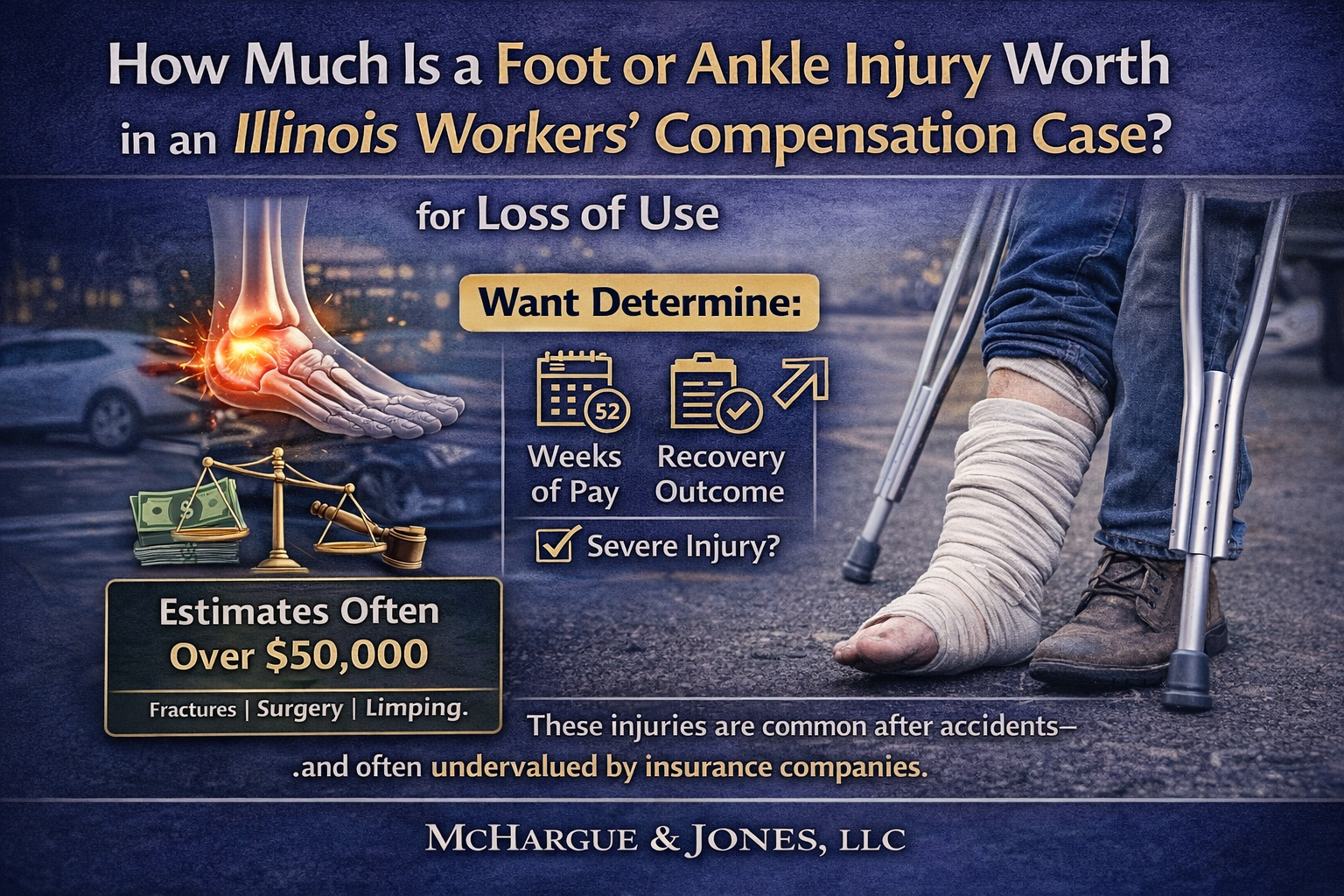


How Much Is a Foot or Ankle Injury Worth in an Illinois Workers’ Compensation Case?
If you hurt your foot or ankle at work in Illinois, one of the first questions you probably have is: how much is my workers’ comp case worth? The honest answer is that foot injury settlements vary widely. A simple ankle sprain that heals with physical therapy is very different from an Achilles tear that needs surgery, a metatarsal fracture fixed with hardware, or a crushing injury that leaves you with permanent standing and walking restrictions.
At my office, I have handled everything from routine ankle sprains to career-ending crush and burn cases involving grafts, nerve damage, multiple reconstructions, and permanent work restrictions. I have also seen insurance adjusters dramatically undervalue foot and ankle cases because they focus only on the diagnosis and miss the real issue: what the injury does to your ability to work for a living.
If you want the bigger picture on how Illinois workers’ comp settlements are valued, start with my hub guide on how much your Illinois workers’ comp case may be worth. If you are looking for help with your case now, you can also contact a Chicago workers comp lawyer.
How Illinois Foot Injury Settlements Are Calculated
In Illinois workers’ compensation, many foot and ankle cases begin with a permanent partial disability analysis. In plain English, that usually means looking at your average weekly wage, the scheduled value of the body part, and the percentage loss assigned to the injured foot or leg. I explain that formula in detail in my Illinois workers’ comp settlement chart.
For a foot injury, the percentage matters, but the percentage is only part of the story. Two workers can have the same diagnosis and very different outcomes. One may heal, return to the same job, and settle as a straightforward PPD case. Another may be left with permanent restrictions on standing, walking, climbing, balancing, or working on uneven surfaces and end up in a loss of trade, wage differential, or even permanent total disability case.
That is why there is no honest “average foot injury settlement” number that applies to everyone. What matters is:
- what part of the foot or ankle was injured
- whether you needed surgery
- whether you have hardware, arthritis, instability, or nerve damage
- whether you reached maximum medical improvement with permanent restrictions
- whether you returned to the same job and same pay
- whether your long-term employability was damaged
Common Work-Related Foot and Ankle Injuries That Affect Settlement Value
Ankle Sprains and Ligament Injuries
Many work-related ankle injuries start as a twist, bad landing, slip and fall, or stepping off a surface awkwardly. In the simpler cases, an ankle sprain is treated conservatively with therapy, bracing, and time off work. Those cases can still have settlement value, but they often resolve on the lower end if the worker returns to full duty without surgery or permanent restrictions.
But not all “sprains” are minor. Some workers develop chronic instability, persistent pain, or ligament damage that leads to surgery, including reconstruction of structures like the ATFL. Once surgery, ongoing instability, or permanent restrictions enter the picture, value can increase substantially.
Achilles Tears
Achilles injuries can be some of the more serious tendon injuries in workers’ compensation because they directly affect push-off strength, walking endurance, climbing, and balance. For a laborer, warehouse worker, delivery worker, roofer, factory worker, or tradesperson, an Achilles tear can change everything.
In my experience, Achilles cases often carry higher value than many other tendon injuries, especially when surgery is required and the worker never gets fully back to normal. Even when a worker eventually returns to some employment, ongoing weakness, stiffness, and endurance problems can materially affect long-term earning power.
Metatarsal Fractures
Metatarsal fractures are common work injuries. Some heal without surgery and settle as more modest PPD cases, depending on which metatarsal is involved, how well it heals, and whether the worker is left with lasting pain or altered gait. Others require surgery, often an ORIF with plates or screws, especially when the fracture is displaced or unstable.
In general, a metatarsal fracture without surgery will often be valued less than a major ankle fracture or more complex lower extremity injury. But when surgery is required, hardware remains, or the worker develops mobility problems, chronic pain, or permanent restrictions, value rises.
Jones Fractures and Other Hard-to-Heal Foot Fractures
Some foot fractures are more problematic because they heal slowly, fail to heal well, or leave workers with long-term limitations. Jones fractures are a good example. When I evaluate these cases, I am looking not just at the fracture itself but at whether the healing process was delayed, whether surgery was needed, whether the worker developed chronic symptoms, and whether they could return to their old job safely.
Those are exactly the kinds of cases where a “fracture” label understates the real value issue. A foot fracture that looks ordinary on paper can become a much bigger case when it affects balance, endurance, and the ability to tolerate standing or walking throughout a full workday.
Lisfranc Injuries and Midfoot Trauma
Lisfranc injuries and other midfoot injuries can be major cases because they affect stability, weight-bearing, gait mechanics, and future arthritis risk. If the worker needs surgery or is left with long-term pain and difficulty standing or walking, these cases can become much more significant than a typical uncomplicated fracture.
Crushing Injuries
Crushing injuries can be some of the highest-value foot and ankle workers’ comp cases because they are often multifactorial. These are not just broken bones. They can involve fractures, ligament damage, tendon injury, nerve damage, skin loss, vascular problems, chronic swelling, altered gait, and permanent restrictions all at once.
I have represented workers with crushing injuries from machinery, heavy bins, industrial accidents, and vehicle-related incidents. For example, a forklift driver pinned against a wall with the foot exposed, or a worker whose foot is smashed by a large garbage bin, may have layered injuries that do not fit neatly into a single diagnosis. Those are cases where careful documentation matters.
Burn Injuries to the Foot
Not all serious foot injury cases are fractures. I handled a terrible case involving a worker at a food processing plant who was cleaning a vat of boiling hot soup when it spilled into his boot. That case involved major skin damage, grafting, and permanent nerve injury. From a settlement standpoint, these cases can be substantial because they may involve disfigurement, sensory loss, hypersensitivity, chronic pain, and severe standing tolerance issues.
Catastrophic Bilateral Ankle or Foot Injuries
I have also handled catastrophic falls where the worker shattered both ankles, went through multiple reconstructions, endured years of surgeries and treatment, and received benefits over a very long period. Once you are dealing with bilateral trauma, multiple surgeries, chronic instability, hardware, permanent restrictions, and loss of employability, you may be far outside the range of a routine scheduled injury case.
Does Surgery Increase the Value of a Foot Injury Settlement?
Usually, yes, but not automatically. Surgery often increases value because it signals a more serious injury, creates more medical expense, increases the chance of permanent impairment, and can leave hardware, scar tissue, reduced mobility, or future arthritis behind. But surgery alone is not the whole analysis.
I wrote more about that here: does surgery increase the value of a workers’ comp case in Illinois?
What I care about most after surgery is outcome. Did the surgery work? Did the worker get back to unrestricted duty? Are there permanent restrictions? Is there ongoing swelling, pain, weakness, instability, or a need to elevate the foot? That is what drives case value.
Typical Foot and Ankle Settlement Ranges in Illinois
Every case is different, and I do not like pretending there is one magic payout number. But as a very general framework for PPD-type foot and ankle cases, here are rough ranges I often think about when evaluating these claims:
- Fractures without surgery: often around 5% to 15%, depending on what fractured and how the worker recovered
- Fractures with surgery: often around 10% to 25%, and sometimes more if there is permanent hardware, limited motion, arthritis, or mobility issues
- Ligament or tendon tears without surgery: often around 5% to 15%
- Ligament or tendon tears with surgery: often around 10% to 25%
- Achilles tears: often at the higher end of tendon cases because they can seriously affect walking, climbing, and endurance
Those numbers are not guarantees. They are just a starting point. A worker who returns to the same job with no restrictions may land in a routine range. A worker who cannot stand or walk all day anymore may have a case worth dramatically more because the claim may no longer be just about a scheduled foot value.
The Real Driver of Value: Can You Return to Your Usual Work?
This is the part insurance companies and adjusters often miss, especially in cases involving permanent standing and walking restrictions.
If you are a white-collar worker who can sit most of the day, the impact of a foot or ankle injury may be significant but still manageable. If you are a warehouse worker, delivery driver, laborer, machine operator, tree worker, factory worker, or tradesperson who has to stand, walk, climb, balance, or work on uneven ground all day, the same injury can be career-ending.
That is why I focus so heavily on functional outcome. Can you do your old job for a full workday? Can you climb ladders? Can you handle uneven surfaces? Can you safely walk long distances in a plant, warehouse, or yard? Can you tolerate prolonged standing without swelling, pain, or instability?
I have had multiple foot and ankle cases where those restrictions changed the entire value of the claim. One FedEx worker I represented suffered a crushing ankle injury, developed permanent restrictions involving standing and walking, could not return to his usual work, and ultimately resolved the case on a loss of trade theory at 50% of a person. For workers in physically demanding jobs, these are often the facts that matter most. If you want to see that page, here is my guide on FedEx workers’ compensation claims in Illinois.
We recently settled a case for
Why Standing and Walking Restrictions Can Make a Case Much Bigger
In my experience, adjusters often do not appreciate how devastating permanent standing and walking restrictions can be for a laborer. They may look at a report and say, “He only has a 50-pound lifting restriction, that is no big deal.” And that might be true if the worker can still stand and walk normally throughout the day.
But once a worker has permanent restrictions on standing tolerance, walking distance, stair climbing, ladder work, uneven surfaces, or prolonged weight-bearing, the labor market can shrink fast. There are only so many sedentary or semi-sedentary jobs available. There are even fewer for someone without a GED, without computer skills, or without a work history outside physical labor.
I strongly suspect part of the disconnect is that many adjusters sit at desks all day and do not truly understand what these restrictions do to a worker whose job has always depended on being on his feet. On paper, the injury may not look catastrophic. In real life, it can end a career.
That is why I sometimes need to hire a vocational expert to explain the obvious: if the worker cannot stand or walk for a full workday, and his background is in labor-intensive jobs, that restriction may destroy his employability. In the right case, that can push the claim far beyond ordinary PPD and into six-figure exposure through loss of trade, wage differential, or permanent total disability benefits.
FCEs, Job-Specific Testing, and Vocational Evidence Matter
When these cases involve permanent restrictions, a standard FCE is often helpful, but sometimes it is not enough.
Traditional FCEs are usually good at measuring things like lifting, pushing, and pulling. But some foot and ankle cases turn on more specific questions. What about ladder climbing? What about rooftops? What about uneven surfaces? What about repeated stair use? What about prolonged standing on concrete floors in a factory, warehouse, or delivery environment?
In some of my cases, I have gone the extra mile and obtained a more specialized occupational therapy evaluation to document those exact limitations. Done well, that can materially strengthen the case because it translates a vague complaint into concrete work restrictions tied to the actual job demands.
I discuss this in more detail here: how FCEs and permanent restrictions affect workers’ comp settlements in Illinois.
“`html
Example: $460,000 Workers’ Comp Settlement for a Tree Cutter With Severe Bilateral Ankle Injuries
A serious foot or ankle case can be worth far more when the injury keeps the worker from ever returning to heavy labor. In one McHargue & Jones case, a tree cutter fell from a tree after a harness failure and suffered devastating injuries to both ankles. The case was heavily disputed, including fights over whether he was an employee or independent contractor and how to calculate his average weekly wage because he was paid in cash. After we prepared the case for a 19(b) trial, the defense backed down, approved medical care, paid substantial back benefits, and the case ultimately resolved for a $460,000 workers’ compensation settlement. The settlement reflected not just the ankle injuries themselves, but the worker’s surgeries, future medical needs, permanent restrictions, age, work history, and loss of access to heavy tree-service and labor work.
What Makes a Foot Injury Case Worth More?
- surgery, especially ORIFs, tendon repairs, reconstructions, grafting, or multiple operations
- permanent hardware
- chronic instability, altered gait, swelling, or reduced range of motion
- permanent nerve damage or sensory loss
- arthritis risk or post-traumatic degeneration
- inability to return to the pre-injury job
- permanent restrictions on standing, walking, climbing, or uneven surfaces
- vocational loss for workers in physically demanding jobs
- future medical care exposure
- credible treating doctor opinions and strong functional testing
What Makes a Foot Injury Case Worth Less?
- a minor injury that resolves quickly with conservative care
- full-duty return to the same job with no lasting restrictions
- normal gait and no ongoing swelling or instability
- no surgery and minimal objective findings
- weak causation evidence or preexisting non-work-related issues that dominate the case
Do Not Settle a Foot Injury Case Too Early
One of the biggest mistakes I see is settling before the long-term outcome is clear. A foot or ankle injury may look like a straightforward case early on, only to later develop into chronic pain, failed conservative care, surgical intervention, permanent hardware, arthritis, nerve symptoms, or work restrictions that were not obvious at first.
Before resolving a settlement, I want to know:
- have you truly reached maximum medical improvement?
- what restrictions, if any, are permanent?
- can you return to your usual and customary line of work?
- do you need a vocational evaluation?
- does the case belong in a wage differential, loss of trade, or permanent total disability analysis instead of ordinary PPD?
Frequently Asked Questions About Foot Injury Workers’ Comp Settlements
How much is a foot injury worth in workers’ comp?
It depends on the diagnosis, treatment, surgery, restrictions, and your ability to return to work. A simple sprain and a crushing injury with permanent restrictions are not valued remotely the same way.
Does foot surgery increase a workers’ comp settlement?
Often yes, because surgery usually signals a more serious injury and raises the odds of permanent impairment. But the real question is how you function after surgery.
What is a Jones fracture worth in workers’ comp?
There is no honest fixed number. Value depends on whether it healed well, whether surgery was needed, whether there was delayed union or nonunion, and whether the worker developed long-term restrictions or mobility problems.
Can an ankle sprain be a serious workers’ comp case?
Yes. Some ankle sprains resolve with therapy. Others lead to chronic instability, surgery, and permanent limitations that materially affect employability.
What if I cannot return to my old job because of standing and walking restrictions?
That may be the most important fact in the case. If your restrictions keep you out of your usual work, your claim may need to be evaluated for wage differential, loss of trade, or permanent total disability exposure rather than just scheduled PPD.
Talk to a Lawyer Who Actually Understands Foot Injury Value
Foot and ankle workers’ comp cases are often undervalued when insurers look only at the diagnosis and ignore the worker’s real-life job demands. In my practice, I have handled routine sprains, Achilles tears, metatarsal fractures, crush injuries, severe burn cases, bilateral reconstructions, and employability disputes involving permanent standing and walking restrictions. Those facts matter, and they often make all the difference in settlement value.
If you want to learn more about how I evaluate these cases, you can read more from Matthew C. Jones. You can also start with my main guides on how much an Illinois workers’ comp case is worth, the Illinois workers’ comp settlement chart, and FCEs and permanent restrictions.