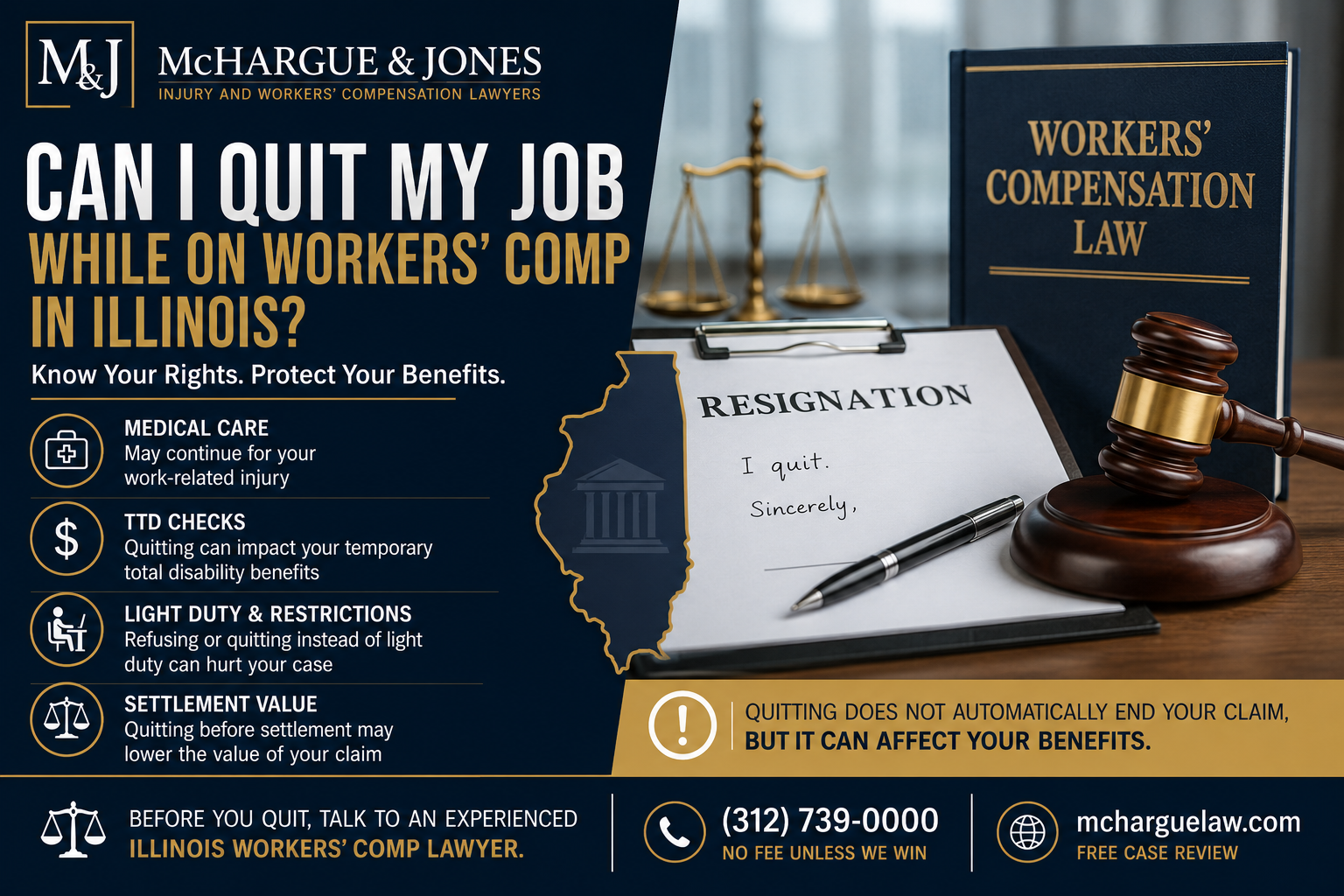


Can I Quit My Job While on Workers’ Comp in Illinois?
McHargue & Jones represents injured workers across Chicago, Cook County, and Illinois in disputed workers’ compensation claims involving TTD checks, light duty, permanent restrictions, denied medical care, settlement disputes, resignation demands, and trials before the Illinois Workers’ Compensation Commission.
For a broader overview, visit our main Illinois workers’ compensation page.
Thinking About Quitting While on Workers’ Comp?
Before you resign, make sure you understand how quitting may affect TTD checks, medical treatment, light duty, permanent restrictions, settlement value, and future benefits.
Or call (312) 739-0000 • No fee unless we win • Se habla español
Quick Answer: Can You Quit Your Job While on Workers’ Comp?
Yes, you can quit your job while on workers’ comp in Illinois. But whether you should quit is a very different question.
If your injury happened while you were employed, quitting later does not automatically erase the workers’ compensation claim. The claim is based on the work injury. If the injury is covered, the employer’s insurance company may still owe reasonable and necessary medical care and other benefits.
The biggest risk usually involves wage-loss benefits, especially temporary total disability, commonly called TTD. If you voluntarily quit, the insurance company may argue that your lost wages are caused by your resignation, not the work injury.
That argument can be especially dangerous if:
- Your doctor released you to light duty;
- Your employer offered work within your restrictions;
- You quit before reaching maximum medical improvement;
- You quit before permanent restrictions were addressed;
- You quit for reasons unrelated to the injury;
- You quit before settlement; or
- You quit without medical documentation explaining why you cannot do the job.
Before resigning, talk to a workers’ compensation attorney. You can also read our guide: Do I need an Illinois workers’ compensation attorney?
What Benefits Could Be Affected If You Quit?
Quitting can affect different parts of a workers’ compensation case in different ways. The most important benefits to understand are medical benefits, TTD checks, light-duty wage benefits, permanent disability, and settlement value.
For a full breakdown, read our guide to Illinois workers’ compensation benefits.
Medical treatment
Quitting generally does not automatically eliminate your right to medical treatment for a covered work injury. If the injury arose out of and in the course of your employment, the workers’ compensation insurance company may still be responsible for reasonable and necessary treatment related to that injury.
That can include doctor visits, physical therapy, injections, imaging, surgery, medication, and other treatment connected to the work injury.
But quitting can still create practical problems. The insurance company may become more aggressive, schedule an IME, question whether treatment remains related to the work injury, or use the resignation as part of a broader argument to limit benefits.
TTD checks
Temporary Total Disability benefits, or TTD, are often the biggest issue when someone quits while on workers’ comp.
TTD is generally paid when you are unable to work because of the work injury, or when you are under restrictions and your employer cannot provide work within those restrictions. If you voluntarily resign, the insurance company may argue that you are no longer losing wages because of the injury. They may claim you are losing wages because you quit.
That does not mean the insurance company is always right. But quitting gives them an argument. That argument can delay checks, stop checks, lower settlement value, and force the case toward litigation.
If your checks have already stopped, read Workers’ comp stopped my checks in Illinois: what to do next.
Light-duty work
Light duty is another major problem area. If your doctor releases you to work with restrictions and your employer offers a job that truly fits those restrictions, quitting instead of accepting the light-duty job may hurt your claim for continued wage benefits.
The insurance company may argue:
- You could have worked;
- The job was within your restrictions;
- You refused suitable employment;
- Your wage loss is voluntary; and
- TTD should stop as of the date you quit.
The details matter. A light-duty job must actually fit your medical restrictions. If the employer says it has light duty but the job requires lifting, standing, bending, reaching, driving, or repetitive work beyond your doctor’s limits, that is a different issue.
Before refusing light duty or quitting because of light duty, get the job description in writing and make sure your doctor reviews it.
Permanent partial disability and settlement value
Quitting can also affect settlement discussions. Workers’ comp settlement value often depends on the injury, treatment, surgery, restrictions, work status, wage loss, permanent disability, and whether future medical care is being closed.
If you quit before your medical condition is stable, before your restrictions are final, or before your work status is clear, the insurance company may try to use the resignation to reduce the value of the case.
That does not mean quitting always destroys settlement value. But it can change the negotiation. The other side may argue that future wage loss, job separation, or difficulty returning to work is not because of the injury, but because you chose to quit.
Can You Quit If Your Job Is Making the Injury Worse?
Sometimes an injured worker wants to quit because the job is physically impossible, the employer is ignoring restrictions, or returning to work is making the injury worse.
If that is your situation, do not simply walk out if you can avoid it. The better approach is to document the problem first.
Before quitting, consider:
- Did your doctor take you off work?
- Did your doctor issue written restrictions?
- Does the job violate those restrictions?
- Did you report the problem to your employer?
- Did you ask for the job duties in writing?
- Did your doctor review the light-duty job description?
- Did you document pain, worsening symptoms, or unsafe duties?
If your doctor says you cannot perform the job or the job is outside your restrictions, that documentation may help protect your benefits. Without documentation, the insurance company may argue you quit for personal reasons.
What If You Quit for a Better Job?
Leaving for a better job is different from quitting because you cannot work due to the injury.
If you quit and take another job that pays the same or more, your medical claim may still continue, but wage-loss benefits may not be an issue. If the new job pays less, or if you later cannot perform the new job because of the work injury, the analysis can become more complicated.
Before changing jobs while on workers’ comp, think about:
- Whether the new job is within your restrictions;
- Whether the new job pays less;
- Whether the job change affects your ability to attend medical appointments;
- Whether you are still receiving TTD or TPD;
- Whether your doctor has approved the work; and
- Whether the insurance company may argue your wage loss is unrelated to the injury.
A better job may be the right move. But make sure the workers’ compensation consequences are understood before resigning.
What If You Quit Because the Workplace Is Toxic?
Many injured workers want to quit because the workplace becomes uncomfortable after a claim. Supervisors may act differently. Coworkers may gossip. The employer may push light duty too aggressively. The injured worker may feel like a target.
Those feelings are real. But from a workers’ compensation standpoint, quitting because the workplace is stressful or unpleasant can create problems unless there is strong documentation.
If you believe your employer is retaliating against you because you filed a workers’ comp claim, that is different from simply wanting to leave. Read our related guide: Can you be fired for filing workers’ comp in Illinois?
If you believe the job is medically unsafe, talk to your doctor and get written restrictions or a work-status note before quitting.
Can Quitting Hurt Your TTD Checks?
Yes. This is the biggest risk.
If you are receiving TTD checks and you quit, the insurance company may try to stop paying. They may argue you voluntarily removed yourself from the workforce, refused available work, or caused your own wage loss.
Whether that argument succeeds depends on the facts. Important questions include:
- Were you completely off work by doctor’s order?
- Were you released to light duty?
- Was light duty actually available?
- Did the light-duty job fit your restrictions?
- Did you quit for medical reasons?
- Did your doctor document why you could not keep working?
- Did you quit before or after MMI?
- Were permanent restrictions already assigned?
If TTD is important to your case, do not resign without legal advice. A short resignation letter can create a long workers’ compensation fight.
Can Quitting Hurt Your Case If You Later Have Permanent Restrictions?
It can.
Permanent restrictions can affect the value and direction of a workers’ compensation case. If your doctor says you cannot return to your old job, issues may include job accommodation, vocational rehabilitation, wage differential benefits, permanent partial disability, or settlement value.
If you quit before permanent restrictions are assigned or before the employer has addressed whether it can accommodate them, the insurance company may argue that any later job loss is because you quit, not because of the injury.
This can matter in serious cases involving back injuries, neck injuries, shoulder injuries, repetitive trauma, surgery, or jobs that require heavy lifting, standing, bending, climbing, driving, or repetitive use of the hands.
If you have permanent restrictions or think you may receive them, read our guide: I have permanent work restrictions: what happens next in Illinois workers’ comp?
Should You Quit Before Your Workers’ Comp Case Settles?
Usually, you should be very cautious about quitting before settlement. Quitting may not destroy the case, but it can affect leverage, wage-loss arguments, and the way the insurance company values the claim.
Before quitting before settlement, ask:
- Are you still treating?
- Are you still receiving TTD checks?
- Are you working light duty?
- Have you reached maximum medical improvement?
- Do you have permanent restrictions?
- Has your doctor released you to full duty?
- Is future medical care expected?
- Is the employer asking for resignation as part of settlement?
Sometimes resignation becomes part of a negotiated settlement. That is different from quitting on your own before the settlement is complete.
If the employer or insurance company is asking you to resign as part of settlement, read our guide: Do I have to resign to settle my workers’ comp case in Illinois?
Quitting on Your Own vs. Resigning as Part of a Workers’ Comp Settlement
Quitting on your own is not the same as resigning as part of a negotiated workers’ compensation settlement.
Quitting on your own
If you quit on your own while your workers’ comp case is still open, the insurance company may argue that your lost wages are voluntary. That can create disputes over TTD checks, light-duty work, wage-loss benefits, permanent restrictions, and settlement value.
For example, if your doctor released you to light duty and your employer had work available within your restrictions, quitting instead of returning to that job may give the insurance company an argument to stop TTD benefits. If you quit before permanent restrictions are known, the insurance company may later argue that your job loss was caused by your resignation instead of the work injury.
Resigning as part of settlement
Resigning as part of settlement is different. In some Illinois workers’ compensation cases, the employer or insurance company may refuse to settle unless the injured worker signs a resignation and release. You do not have to accept that term, but if you do accept it, you should understand what rights you are giving up and whether the settlement amount fairly accounts for the resignation.
A settlement resignation may affect your job, health insurance, seniority, union rights, unemployment issues, rehire rights, and other potential employment claims. It may also affect how the workers’ compensation settlement is negotiated.
For a deeper discussion, read our guide: Do I have to resign to settle my workers’ comp case in Illinois?
If your employer is threatening to fire you, pressuring you to quit, cutting your hours, or treating you differently because you filed a claim, read: Can you be fired for filing workers’ comp in Illinois?
“`
Is Quitting the Same as Being Fired?
No. Quitting and being fired are not the same thing in a workers’ compensation case.
If your employer fires you because you filed a workers’ comp claim, that may raise retaliation issues. If you voluntarily quit, the insurance company may argue that you caused your own wage loss.
That does not mean every resignation hurts the case. But the legal and practical arguments are different.
If your employer is threatening your job, pressuring you to quit, cutting your hours, or treating you differently because of your claim, read: Can you be fired for filing workers’ comp in Illinois?
What Should You Do Before Quitting While on Workers’ Comp?
Before quitting, take these steps:
- Talk to your doctor. Make sure your work status and restrictions are clear.
- Get restrictions in writing. Verbal complaints are harder to prove.
- Ask for light-duty job details in writing. Know exactly what work is being offered.
- Do not assume medical benefits automatically end. But expect the insurance company to look for arguments.
- Do not assume TTD checks will continue. Quitting can give the insurer a reason to challenge wage benefits.
- Save all communications. Keep texts, emails, HR messages, work notes, and adjuster letters.
- Do not sign a resignation or release without review. Settlement paperwork may affect more than workers’ comp.
- Speak with a workers’ compensation lawyer. The timing and wording of a resignation can matter.
If the insurance company is denying benefits, pushing light duty, scheduling an IME, stopping checks, or pressuring settlement, legal help can make a major difference. Read: Do I need an Illinois workers’ compensation attorney?
Talk to an Illinois Workers’ Comp Lawyer Before You Quit
If you are thinking about quitting while on workers’ comp, McHargue & Jones can review your injury, work restrictions, TTD checks, light-duty issues, settlement status, and whether resigning could hurt your case.
Call (312) 739-0000 • No fee unless we win
The Bottom Line
- You can legally quit your job while on workers’ comp in Illinois.
- Quitting does not automatically erase your workers’ compensation claim.
- Medical treatment for a covered work injury may still be owed.
- TTD checks and wage-loss benefits are where quitting can create the biggest problems.
- Quitting instead of accepting valid light duty can hurt your case.
- Quitting before permanent restrictions are addressed can create future disputes.
- Resigning as part of settlement is different from quitting on your own.
- Talk to a workers’ compensation lawyer before resigning.
Every case is different. If you are thinking about quitting after a work injury, get advice before you make a decision that may affect your benefits, settlement value, or future options.
Frequently Asked Questions
Can I quit my job while on workers’ comp in Illinois?
Yes. You can legally quit your job while you have a workers’ compensation claim. But quitting can affect TTD checks, wage-loss benefits, light-duty issues, settlement value, and future disputes, so you should speak with a lawyer before resigning.
Do I lose workers’ comp if I quit my job?
Not automatically. Quitting does not automatically erase the workers’ compensation claim. Medical benefits for a covered work injury may still be owed. The biggest risk is usually wage-loss benefits, especially TTD.
Will my medical treatment continue if I quit?
Medical treatment may continue if the injury is covered and the treatment is reasonable, necessary, and related to the work injury. But quitting can make the insurance company more aggressive about disputing parts of the claim.
Can quitting stop my TTD checks?
It can. If you voluntarily quit, the insurance company may argue that your wage loss is caused by your resignation instead of the work injury. Whether TTD continues depends on the facts, medical restrictions, work status, and whether suitable work was available.
What if my employer offered light duty and I quit?
If the light-duty job was within your doctor’s restrictions and you quit instead of accepting it, the insurance company may argue that TTD should stop. If the job was not actually within your restrictions, you should document that and speak with a lawyer.
Can I quit if my job is making my injury worse?
Possibly, but get medical documentation first. If your doctor says the job is outside your restrictions or unsafe for your injury, that documentation may help protect your claim. Quitting without documentation can create problems.
Can quitting hurt my settlement?
Yes. Quitting can affect settlement value if the insurance company argues that wage loss, job separation, or return-to-work problems are unrelated to the work injury. The timing of resignation can matter.
Should I quit before my workers’ comp case settles?
Usually, you should be cautious about quitting before settlement. If you are still treating, receiving TTD, working light duty, waiting for surgery, or expecting permanent restrictions, resigning too soon may create disputes.
Is quitting the same as resigning as part of a workers’ comp settlement?
No. Quitting on your own while the case is open is different from signing a resignation as part of a negotiated settlement. A settlement resignation should be reviewed carefully because it may affect your job, benefits, and other rights.
Can my employer make me quit to get a workers’ comp settlement?
An employer or insurance company may refuse to settle unless resignation is included, but you do not have to accept a settlement that requires resignation. If settlement terms are not acceptable, hearing may be an option.
Can I be fired instead of quitting while on workers’ comp?
Your employer cannot legally fire you because you filed a workers’ compensation claim. But employers may claim they fired someone for unrelated reasons. If your job is threatened after a work injury, document everything and speak with a lawyer.
Should I talk to a lawyer before quitting while on workers’ comp?
Yes. A lawyer can review your work status, restrictions, TTD checks, light-duty offer, settlement posture, and whether quitting could damage the case. In many cases, getting advice before quitting is much safer than trying to fix the problem afterward.