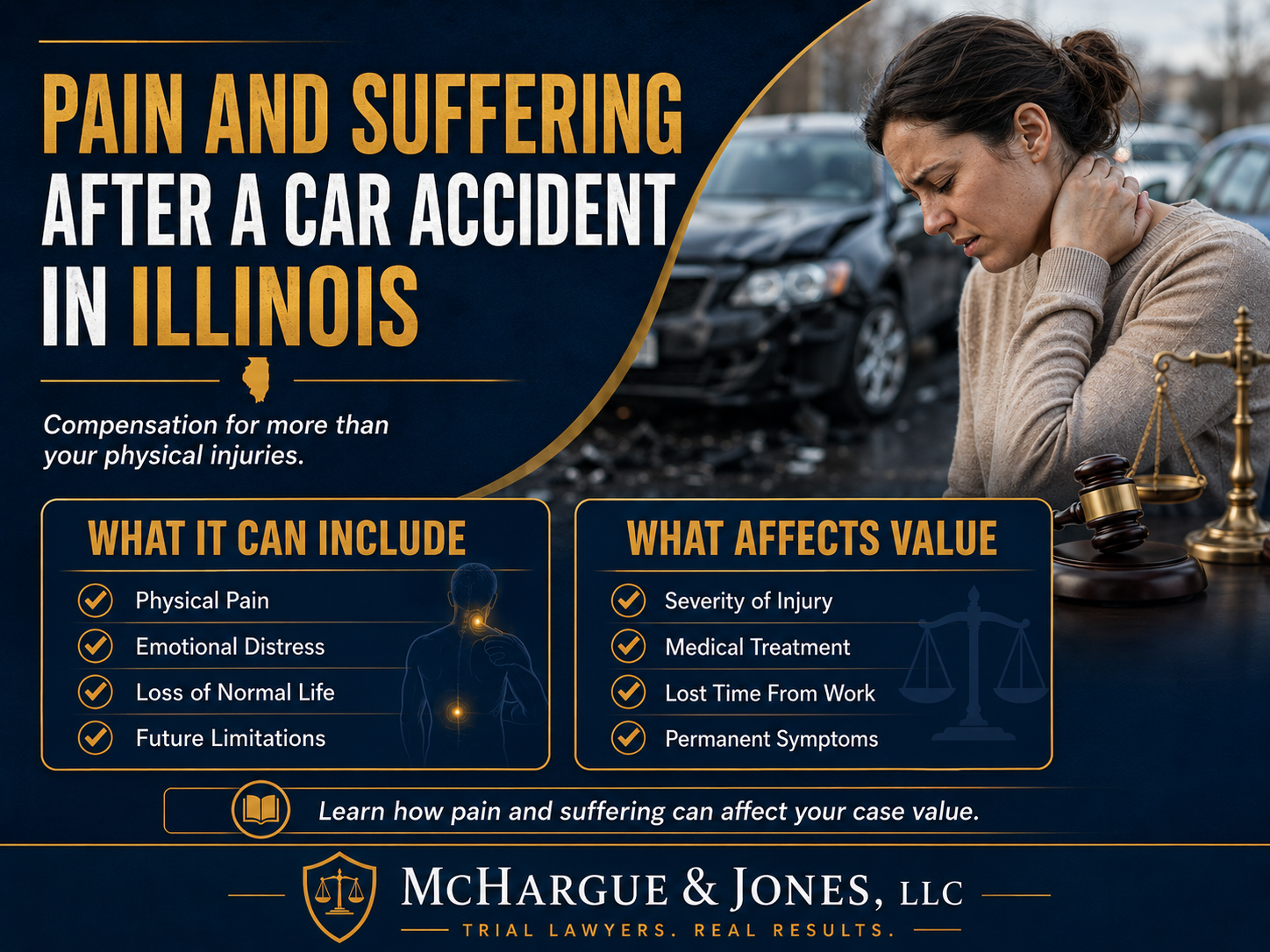


Pain and Suffering After a Car Accident in Illinois
Pain and suffering can be one of the most important parts of an Illinois car accident claim. Medical bills and lost wages matter, but they do not always show the full impact of a crash. A serious car accident can leave you dealing with daily pain, sleep problems, anxiety, missed family activities, physical limits, surgery, scarring, permanent symptoms, or a loss of normal life.
Insurance companies know this. That is why they often try to minimize pain and suffering damages by arguing the crash was minor, your treatment was too much, your symptoms are subjective, your pain came from a pre-existing condition, or your injuries should have healed quickly.
This guide explains what pain and suffering means after a car accident in Illinois, how these damages are valued, what evidence helps prove them, and how pain and suffering fits into the bigger picture of an Illinois car accident claim.
Quick Answer: What Is Pain and Suffering in an Illinois Car Accident Case?
Pain and suffering is compensation for the physical pain, emotional distress, inconvenience, loss of normal life, and daily limitations caused by a car accident injury. It may include neck pain, back pain, headaches, shoulder pain, anxiety, sleep problems, loss of activities, scarring, permanent symptoms, and the overall disruption the crash caused in your life.
There is no automatic formula that determines pain and suffering in Illinois. The value depends on the evidence, including the seriousness of the injury, medical treatment, recovery time, permanency, credibility, available insurance, and how clearly the crash caused the injury.
Is the insurance company undervaluing your pain and suffering?
McHargue & Jones helps injured people understand the full value of their car accident claims, including medical bills, lost wages, pain and suffering, loss of normal life, and available insurance coverage.
What Counts as Pain and Suffering After a Car Accident?
Pain and suffering is broader than being sore after a crash. It is the human impact of the injury. In an Illinois car accident case, pain and suffering may include both physical and emotional harm.
Physical pain and limitations
- Neck pain
- Back pain
- Headaches
- Shoulder, knee, or hip pain
- Radiating pain, numbness, or tingling
- Reduced range of motion
- Difficulty sleeping, walking, lifting, sitting, or driving
- Pain from physical therapy, injections, or surgery
Emotional and life impact
- Anxiety after the crash
- Fear of driving
- Sleep problems
- Loss of normal activities
- Loss of hobbies or exercise
- Difficulty caring for children or family
- Stress, frustration, or embarrassment
- Scarring, disfigurement, or permanent symptoms
How Is Pain and Suffering Calculated in Illinois?
There is no fixed pain and suffering calculator that automatically determines what an Illinois car accident case is worth. Online calculators can be misleading because they cannot account for medical proof, injury severity, credibility, insurance limits, fault disputes, treatment history, or how a jury may view the case.
During settlement negotiations, insurance companies and lawyers may discuss methods like a multiplier approach or a per-day approach. Those methods can be useful talking points, but they are not guaranteed formulas under Illinois law.
The real question is whether the evidence shows how the crash changed your life. That is why pain and suffering value usually depends on the quality of the medical documentation, the consistency of your symptoms, the seriousness of your injury, and the available insurance coverage.
For the broader settlement picture, read our guide on how much a car accident case is worth in Illinois.
What Increases Pain and Suffering Value?
Pain and suffering damages usually increase when the injury is serious, well-documented, long-lasting, and clearly connected to the crash.
Medical proof
- Emergency room records
- Consistent follow-up treatment
- Imaging results
- Specialist care
- Physical therapy
- Injections or surgery
Injury severity
- Long recovery time
- Permanent symptoms
- Surgery recommendations
- Work restrictions
- Scarring or disfigurement
- Loss of normal life
Case evidence
- Photos of vehicle damage
- Crash report
- Witness statements
- Clear liability proof
- No major treatment gaps
- Credible documentation
What Can Hurt Pain and Suffering Value?
Insurance companies often attack pain and suffering because it is not as simple as adding up medical bills. They may argue that your pain is exaggerated, unrelated, or not supported by the records.
Common insurance arguments include:
- The crash was too minor to cause serious injury
- You waited too long to see a doctor
- You had gaps in medical treatment
- Your symptoms came from a pre-existing condition
- Your imaging shows age-related changes
- Your treatment was excessive
- Your social media posts contradict your injury claim
- You gave a recorded statement that minimized your symptoms
These arguments are common in soft tissue car accident injury claims, whiplash cases after rear-end crashes, and claims involving pre-existing conditions after a car accident.
Why Medical Treatment Matters for Pain and Suffering
Medical treatment does two things. First, it protects your health. Second, it creates the records needed to prove the injury, symptoms, treatment plan, restrictions, and recovery timeline.
If you do not get medical care, the insurance company may argue that you were not really hurt. If you stop treatment too early, they may argue that you recovered. If your records do not describe your pain and limitations clearly, they may argue that your suffering was minimal.
That does not mean you should over-treat or exaggerate. It means you should be honest with your doctors, follow medical advice, explain your symptoms clearly, and document how the injury affects your daily life.
For more on this issue, read why seeing a doctor after a car accident matters.
Pain and Suffering in Minor Car Accident Cases
A lower-impact crash can still cause real pain. Some people feel worse the next day or several days later, especially with neck injuries, back injuries, headaches, shoulder injuries, and soft tissue trauma.
But minor car accident cases are often heavily disputed. The insurance company may point to low property damage, delayed treatment, or normal imaging findings to argue that pain and suffering should be small.
The key is documentation. If symptoms continue, treatment is consistent, and the medical records connect the injury to the crash, a so-called minor accident may still support a claim for pain and suffering.
For more, read our page on whether you should get a lawyer for a minor car accident in Chicago.
Pain and Suffering in Serious Injury and Surgery Cases
Serious injuries usually create stronger pain and suffering arguments because they often involve longer treatment, more disruption, higher medical bills, greater physical limitations, and a higher risk of permanent symptoms.
Examples include:
- Disc injuries requiring injections or surgery
- Shoulder injuries requiring surgery
- Fractures
- Traumatic brain injuries
- Permanent scarring
- Catastrophic injuries
- Long-term restrictions or disability
If your case involves surgery, pain and suffering may include the pain before surgery, the surgery itself, recovery, therapy, scars, complications, restrictions, and the effect on your work and daily life. Learn more about neck surgery after a car accident in Illinois and shoulder surgery after a car accident in Illinois.
For life-changing injuries, see our page on catastrophic injuries after car accidents.
Pain and Suffering by Injury Type
Different injuries create different pain and suffering arguments. A short-term strain is not valued the same way as surgery, permanent nerve symptoms, or a disabling injury. The more specific the documentation, the harder it is for the insurer to dismiss the impact.
Neck injuries
Neck pain, stiffness, headaches, radiating symptoms, and sleep problems can affect work, driving, lifting, and daily activity.
Back injuries
Back pain may interfere with sitting, standing, bending, lifting, sleeping, and returning to work.
Soft tissue injuries
Soft tissue injuries are often painful but disputed because they may not appear clearly on imaging.
How Policy Limits Affect Pain and Suffering Settlements
Even when pain and suffering is significant, the available insurance coverage can limit what can realistically be recovered. This is one of the most important issues in many Illinois car accident cases.
For example, if the at-fault driver only has minimum insurance coverage, the total available settlement may not fully cover medical bills, lost wages, pain and suffering, and attorney fees. That is why it is important to identify all available insurance policies, including the at-fault driver’s coverage, your own uninsured or underinsured motorist coverage, and any other available sources of recovery.
For more on this issue, read our guide on how insurance policy limits work in Illinois car accident cases.
What If the At-Fault Driver Has No Insurance or Not Enough Insurance?
Pain and suffering does not disappear just because the other driver has no insurance or not enough insurance. In many cases, the next question is whether there is uninsured motorist coverage, underinsured motorist coverage, or another available policy.
If the driver had no insurance, your own uninsured motorist coverage may provide a path to recovery. If the other driver had insurance but not enough to cover the full harm, underinsured motorist coverage may become important.
This also matters in hit-and-run crashes. If the fleeing driver is never found, the claim may become an uninsured motorist claim through your own policy.
Read more about uninsured motorist claims in Illinois, underinsured motorist claims in Illinois, and Chicago hit-and-run accident claims.
How Much of a Settlement Do You Actually Keep?
When people ask about pain and suffering, they often want to know what they will actually receive after medical bills, health insurance liens, case expenses, and attorney fees are handled.
The settlement amount and the amount you keep are not always the same. A fair settlement evaluation should account for the total case value, the available insurance, medical bills, liens, expenses, fees, and the strength of the liability and damages evidence.
For examples, read our guide on how much of a $25K, $50K, or $100K car accident settlement you may keep in Illinois.
What Evidence Helps Prove Pain and Suffering?
Because pain and suffering is about how the injury affects your life, the evidence needs to tell that story clearly and credibly.
Helpful evidence may include:
- Medical records describing symptoms and limitations
- Physical therapy notes
- Imaging reports
- Specialist opinions
- Surgery recommendations
- Work restriction notes
- Photos of injuries, bruising, scars, or swelling
- Photos of vehicle damage and the crash scene
- Witness statements
- Family observations about changes in your daily life
- A simple pain journal or symptom timeline
- Proof of missed work and missed activities
If the crash just happened, start with our step-by-step guide on what to do after a car accident in Chicago.
Should You Give a Recorded Statement About Your Pain?
Be careful with recorded statements. Insurance adjusters may ask questions before you know the full extent of your injuries. Many people minimize symptoms early because they hope they will feel better, do not want to complain, or have not yet seen a specialist.
Later, the insurance company may use that early statement to argue that your pain and suffering claim is exaggerated. You should be honest, but you should also avoid guessing, minimizing, or giving broad statements before you understand your medical condition.
For more, read whether you should talk to the other driver’s insurance company after a car accident.
How Comparative Fault Can Reduce Pain and Suffering Damages
Illinois uses modified comparative fault. If you are found more than 50% at fault, you may be barred from recovering damages. If you are 50% or less at fault, your recovery may be reduced by your percentage of fault.
This matters for pain and suffering because the insurance company may try to reduce the value of the entire claim by blaming you for the crash. They may argue that you were speeding, distracted, following too closely, failed to yield, or made your injuries worse by delaying treatment.
Fault disputes are one reason the crash report, photos, witness statements, traffic camera footage, and early investigation can matter so much.
Is There a Deadline to Claim Pain and Suffering in Illinois?
In many Illinois personal injury cases, the lawsuit deadline is generally two years from the date of the injury. Some cases may involve shorter deadlines or special notice rules, especially if a government entity is involved.
Even if the legal deadline seems far away, evidence can disappear much sooner. Vehicle damage may be repaired, surveillance video may be overwritten, witnesses may become difficult to find, and medical records may become harder to connect to the crash if treatment is delayed.
That is why it is important to act quickly if pain continues after a crash.
How McHargue & Jones Helps Prove Pain and Suffering
McHargue & Jones helps injured people build car accident claims that account for the full impact of the injury, not just the bills that have already arrived.
We help by:
- Reviewing the crash facts and available insurance coverage
- Gathering medical records and bills
- Documenting treatment, symptoms, and restrictions
- Identifying wage loss and future treatment issues
- Addressing insurance company arguments about pre-existing conditions
- Evaluating UM/UIM coverage when the at-fault driver has no insurance or not enough insurance
- Preparing settlement demands that explain pain, suffering, and loss of normal life
- Advising clients before quick settlements or recorded statements create problems
We handle car accident cases on a contingency fee, which means there is no attorney fee unless we win. Learn more about how much a car accident lawyer costs in Illinois.
Related Car Accident Resources
- Chicago car accident lawyer
- How much is a car accident case worth in Illinois?
- How insurance policy limits work in Illinois car accident cases
- How much of a settlement do you actually keep?
- Uninsured motorist claims in Illinois
- Underinsured motorist claims in Illinois
- Soft tissue car accident injuries
- Pre-existing conditions after a car accident
FAQ About Pain and Suffering After a Car Accident in Illinois
What is pain and suffering after a car accident?
Pain and suffering is compensation for the physical pain, emotional distress, inconvenience, loss of normal life, and daily limitations caused by a car accident injury. It may include ongoing pain, sleep problems, anxiety, loss of activities, scarring, permanent symptoms, and reduced quality of life.
How is pain and suffering calculated in Illinois?
Illinois does not use one automatic formula for pain and suffering. The value depends on the facts, including injury severity, treatment, recovery time, permanency, medical proof, credibility, available insurance coverage, and how clearly the crash caused the injury.
Is there a pain and suffering calculator for Illinois car accidents?
Online calculators can be misleading. They cannot fully account for medical records, fault disputes, insurance limits, treatment history, surgery, pre-existing conditions, permanent symptoms, or how the injury affects your daily life.
Can I get pain and suffering for whiplash or soft tissue injuries?
Yes, if the evidence supports the claim. Whiplash and soft tissue injuries can cause real pain and limitations, but insurers often dispute them. Consistent medical treatment, clear symptom documentation, and proof connecting the injury to the crash are important.
Related: soft tissue car accident injuries and whiplash after a rear-end car accident.
Does surgery increase pain and suffering value?
Surgery can increase pain and suffering value because it usually shows a more serious injury, longer recovery, greater disruption, scarring, physical therapy, and possible permanent limitations. The value still depends on the medical evidence, liability, and available insurance.
Related: neck surgery after a car accident and shoulder surgery after a car accident.
Can a pre-existing condition hurt my pain and suffering claim?
A pre-existing condition can make the case more disputed, but it does not automatically prevent recovery. If the crash aggravated or worsened a prior condition, you may still have a claim. Medical records and doctor opinions are often important in proving the difference between old symptoms and new crash-related harm.
Related: pre-existing conditions after a car accident in Illinois.
What evidence proves pain and suffering?
Helpful evidence may include medical records, physical therapy notes, imaging, specialist opinions, work restrictions, photos, witness statements, family observations, a symptom timeline, and proof of how the injury affected your work, sleep, activities, and daily life.
Can pain and suffering be limited by insurance coverage?
Yes. Even if the injury is serious, available insurance coverage can affect the amount that can realistically be recovered. This is why policy limits, uninsured motorist coverage, and underinsured motorist coverage may be important.
Related: how insurance policy limits work, uninsured motorist claims, and underinsured motorist claims.
How long do I have to claim pain and suffering after a car accident in Illinois?
In many Illinois personal injury cases, the deadline is generally two years from the date of injury. Some cases may have shorter deadlines or special notice rules, especially if a government entity is involved. You should act quickly because evidence can disappear long before the legal deadline.
Talk to a Chicago car accident lawyer about your pain and suffering claim
If you were injured in a car accident, McHargue & Jones can review your case, explain your legal options, identify available insurance coverage, and help you understand what a fair settlement may include.