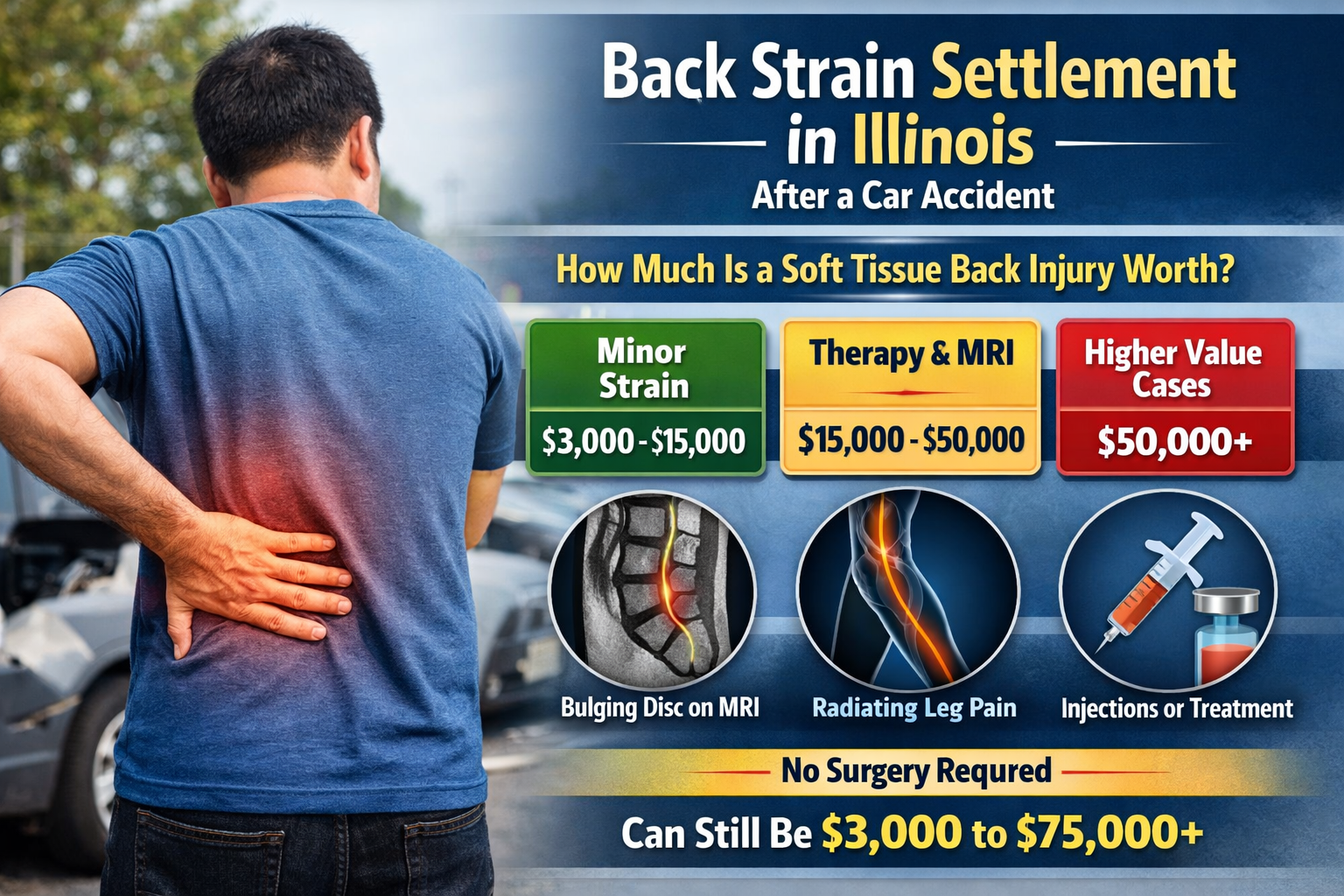


Back Strain Settlement Illinois: How Much Is a Soft Tissue Back Injury Worth After a Car Accident?
A back strain or soft tissue back injury settlement in Illinois often ranges from $3,000 to $75,000+ for non-surgical car accident cases. The value depends on the medical treatment, MRI findings, pain and suffering, lost wages, treatment duration, fault, and available insurance coverage.
Many back strain cases involve physical therapy, doctor visits, medication, missed work, and sometimes an MRI. Some resolve in a few weeks. Others involve disc bulges, herniated discs, sciatica, radiating pain, numbness, tingling, or months of treatment that can significantly increase settlement value.
Insurance companies often call these “soft tissue” claims and try to minimize them. But a back strain can still cause real pain, sleep problems, difficulty sitting, standing, bending, lifting, driving, working, and caring for family. The key is proving the injury with consistent medical treatment and clear documentation.
For the bigger picture, see our guide on how much a car accident case is worth in Illinois.
[/vc_column_text][/vc_column][/vc_row]
Quick Answer: What Is a Back Strain Settlement Worth in Illinois?
A typical Illinois back strain settlement after a car accident may range from $3,000 to $75,000+ for non-surgical cases. Minor cases with short treatment may settle on the lower end. Moderate cases with physical therapy, MRI imaging, specialist care, missed work, or months of pain may be worth more.
If the back injury involves a herniated disc, radiating leg pain, sciatica, injections, surgery, permanent restrictions, or major work loss, it may no longer be a simple back strain case and should be evaluated as a more serious spine injury claim.
Is the insurance company minimizing your back injury?
McHargue & Jones helps injured people evaluate back strain, soft tissue back injury, disc injury, and sciatica claims after Illinois car accidents.
How Much Is a Soft Tissue Back Injury Settlement Worth in Illinois?
For typical soft tissue back injury settlements in Illinois, value depends mostly on treatment, symptoms, documentation, and insurance coverage. Many non-surgical back injury cases fall into broad ranges like these:
- $3,000 to $20,000: minor back strain, brief medical care, short physical therapy, little or no missed work, and symptoms that resolve fairly quickly.
- $20,000 to $75,000: moderate back strain or soft tissue injury involving longer treatment, physical therapy, MRI imaging, specialist care, missed work, or ongoing daily limitations.
- $75,000 to $100,000+: higher-end non-surgical cases involving disc findings, radiating pain, sciatica, nerve symptoms, injections, significant wage loss, or stronger insurance coverage.
- Higher-value cases: surgery, permanent restrictions, major earning loss, catastrophic spine injury, or commercial/truck accident coverage.
Some back strain claims are evaluated around 2 to 3 times the medical bills, but that is only a rough starting point. It is not a legal rule. Insurance companies often dispute treatment, causation, billing, pre-existing conditions, and whether the crash was serious enough to cause the injury.
What Drives Back Strain Settlement Value?
Back injury value usually depends on whether the records show a real injury, consistent treatment, daily limitations, wage loss, objective findings, and enough insurance coverage to pay the claim.
Medical proof
- ER or urgent care records
- Doctor follow-up visits
- Physical therapy notes
- MRI or imaging findings
- Specialist evaluations
- Treatment consistency
Symptom severity
- Low back pain
- Sciatica
- Radiating leg pain
- Numbness or tingling
- Sleep problems
- Limits with sitting, standing, or lifting
Insurance and fault
- At-fault driver limits
- UM/UIM coverage
- Clear liability
- No major comparative fault
- Commercial or umbrella coverage
- Defense arguments about degeneration
What Is a Soft Tissue Back Injury After a Car Accident?
A soft tissue back injury generally refers to damage involving muscles, ligaments, tendons, fascia, and supporting structures in the back. These injuries are common after rear-end crashes, side-impact crashes, high-speed collisions, and crashes where the body twists or braces for impact.
Common back injuries after a car accident include:
- Lower back strain
- Lumbar sprain
- Muscle spasms
- Facet joint irritation
- Inflammation around the lumbar spine
- Disc bulge or protrusion
- Herniated disc
- Sciatica or radiating leg pain
Even without surgery, these injuries can make it hard to sit, stand, bend, sleep, drive, lift, work, or handle normal daily responsibilities. For a broader overview, see our soft tissue car accident injury guide.
Why Back Injury Cases Often Involve MRIs and Disc Findings
One reason back injury cases can become more valuable than basic soft tissue claims is that they often involve MRI imaging. If pain continues after initial treatment, a doctor may order an MRI to evaluate whether there is a disc injury or other structural problem.
An MRI may show:
- Disc bulges
- Disc protrusions
- Herniated discs
- Annular tears
- Nerve compression
- Degenerative changes
Even when surgery is not recommended, objective imaging can change how a case is evaluated. It can support the claim that the injury is more than temporary soreness. At the same time, insurance companies often argue that MRI findings are degenerative, age-related, or pre-existing.
If the insurer is blaming an old condition, read our guide on pre-existing conditions after a car accident in Illinois.
Radiating Pain, Sciatica, and Nerve Symptoms Can Increase Value
A key factor in back injury value is whether pain stays in the back or travels into the hip, buttock, leg, or foot. Radiating symptoms may suggest nerve involvement, which can make the case more serious.
Symptoms that may increase settlement value include:
- Sciatica
- Pain traveling down one or both legs
- Numbness or tingling
- Weakness in the leg or foot
- Burning pain
- Difficulty walking or standing
- Symptoms that worsen with sitting, bending, or lifting
These symptoms may lead to additional treatment, MRI imaging, specialist care, pain management, injections, or surgical evaluation. Even if surgery is never performed, radiating pain can move a case out of the “minor back strain” category.
When a Back Strain Case Becomes More Serious
Some back injury claims start with a simple strain diagnosis but become more serious over time. This often happens when pain continues despite conservative treatment or when symptoms begin radiating into the legs.
Treatment may progress to:
- Extended physical therapy
- Orthopedic or spine specialist evaluation
- Pain management care
- MRI imaging
- Epidural steroid injections
- Work restrictions
- Surgical evaluation
Once injections or invasive treatment are recommended, the case value can increase substantially. If surgery becomes necessary, the claim may need to be evaluated as a serious spine injury or catastrophic injury claim rather than a basic soft tissue case.
Related: neck surgery after a car accident in Illinois and catastrophic injuries after auto accidents.
How Medical Bills Affect a Back Strain Settlement
Medical bills are one of the biggest drivers of settlement value in a back strain or soft tissue back injury case. A claim may include:
- Emergency room or urgent care treatment
- Primary care visits
- Chiropractic care
- Physical therapy
- Medication
- X-rays or MRI imaging
- Orthopedic or spine specialist visits
- Pain management treatment
- Injections in more serious cases
Higher medical bills can support higher settlement value, but they do not automatically make the case worth more. The treatment must be reasonable, related to the crash, and supported by the records. Insurance companies may argue the bills are too high, the care was unnecessary, or the back pain came from something other than the accident.
If you are unsure whether treatment matters, read why seeing a doctor after a car accident matters.
How Pain and Suffering Affect a Back Injury Settlement
Pain and suffering is often a major part of a back injury settlement. Back pain can affect almost every part of daily life, even when there is no surgery.
A back strain or soft tissue back injury may interfere with:
- Sleeping
- Sitting at work
- Standing for long periods
- Bending or lifting
- Driving
- Exercise
- Household chores
- Childcare
- Walking or using stairs
- Normal hobbies and activities
Insurance companies often focus on bills and imaging, but the real impact of a back injury may be the loss of normal life. Learn more about pain and suffering after a car accident in Illinois.
How Lost Wages and Work Limits Affect Value
Lost wages can increase settlement value, especially when the back injury affects physical work. People who drive, lift, carry, bend, stand, climb, deliver, warehouse, perform healthcare work, construction work, or manual labor may have a harder time returning to work after a back injury.
Important questions include:
- How much work did you miss?
- Did a doctor give work restrictions?
- Could you return to the same job?
- Did you lose overtime or bonuses?
- Did back pain reduce your ability to lift, bend, sit, stand, or drive?
- Did the injury reduce future earning capacity?
A back injury case is usually worth more when medical records and employer documentation clearly show missed work, restrictions, or long-term work impact.
Insurance Companies Often Undervalue Soft Tissue Back Injuries
Insurance companies frequently argue that soft tissue back injuries are minor, especially when there is limited vehicle damage, no fracture, no surgery, or normal X-rays.
Common insurance arguments include:
- The crash was too minor to cause a back injury
- The back pain was pre-existing or degenerative
- The treatment was excessive
- The medical bills are inflated
- The MRI findings are age-related
- There were gaps in treatment
- The injured person should have recovered sooner
- The injured person minimized symptoms in a recorded statement
That does not mean the claim has no value. It means documentation matters. If an adjuster wants a statement, read what to know before speaking to the insurance company after a car accident.
Insurance Limits Can Cap Your Back Injury Settlement
Insurance coverage can control the real-world settlement. A back injury case may be worth more than the at-fault driver’s policy limits, especially if the injury involves MRI findings, injections, wage loss, or months of treatment.
If the at-fault driver only has a minimum policy, the available recovery from that driver’s insurance may be limited even if the damages are higher. That is why every serious car accident claim should evaluate:
- The at-fault driver’s bodily injury limits
- Whether the driver was working at the time
- Whether the vehicle owner has separate coverage
- Whether umbrella or excess coverage applies
- Whether underinsured motorist coverage applies
- Whether uninsured motorist coverage applies in a hit-and-run or uninsured driver case
Learn more about how insurance policy limits work in Illinois car accident cases, underinsured motorist coverage in Illinois, and uninsured motorist claims in Illinois.
How Fault Affects a Back Strain Settlement in Illinois
Fault can change settlement value. If liability is clear, the case is usually stronger. If liability is disputed, or the injured person may share some fault, settlement value may be reduced.
Illinois uses modified comparative fault. If the injured person is found more than 50% at fault, recovery may be barred. If the injured person is 50% or less at fault, compensation may be reduced by the percentage of fault assigned.
Evidence may include the crash report, vehicle damage, photos, witness statements, traffic camera footage, medical timeline, and statements made to insurance companies.
For more, read whether Illinois is a no-fault car accident state and what is included in a car accident police report.
Back Injury vs. Neck Injury Settlements
Back and neck injuries are both common after car accidents, but they are not always valued the same way. Back injury cases may involve more MRI findings, disc issues, sciatica, and treatment escalation. Neck injury cases often involve whiplash, headaches, stiffness, and reduced range of motion.
Back injury cases may be worth more when they involve:
- Herniated disc findings
- Radiating leg pain
- Sciatica
- Nerve symptoms
- Injections
- Work restrictions
- Long-term limitations
If your injury involves the neck, read our guide on neck sprain and strain settlement value after a car accident and our page on whiplash after rear-end accidents.
Can Rear-End Accidents Cause Back Strains?
Yes. Rear-end crashes can cause back strains, lumbar sprains, disc symptoms, and radiating pain. The body may be forced forward and backward, the spine may compress or twist, and the lower back may absorb force from the seat, seatbelt, and bracing movement.
Insurance companies may argue that rear-end crashes with limited visible damage cannot cause a serious back injury. But the medical records, symptoms, imaging, and treatment timeline may tell a different story.
For more, visit our rear-end accident guide.
What If the Back Injury Was Pre-Existing?
Insurance companies often argue that back pain came from arthritis, degenerative disc disease, prior injuries, age-related changes, or an old work injury. This is common when an MRI shows degeneration.
A pre-existing condition does not automatically defeat a car accident claim. If the crash aggravated, worsened, or lit up a prior back condition, the claim may still have value.
Important questions include:
- Were you having back pain before the crash?
- Did symptoms start or worsen after the accident?
- Did pain begin radiating into the leg after the crash?
- Did the MRI show a disc injury?
- What does the treating doctor say about causation?
- Was treatment consistent after the accident?
For more, read our guide on pre-existing conditions after a car accident in Illinois.
What Makes a Back Strain Case Worth More or Less?
Factors that increase value
- Consistent medical treatment
- Physical therapy over weeks or months
- MRI findings
- Disc bulge, protrusion, or herniation
- Sciatica or radiating leg pain
- Injections or specialist care
- Missed work or restrictions
- Clear fault and strong insurance coverage
Factors that reduce value
- Very short treatment
- Long gaps in care
- Weak medical documentation
- Low-impact crash arguments
- Prior back problems
- No work loss or activity limits
- Disputed fault
- Low insurance policy limits
How Can You Maximize a Back Strain Settlement?
The best way to protect a back injury claim is to document the injury early, follow medical advice, and avoid giving the insurance company reasons to argue the injury was minor or unrelated.
Helpful steps include:
- Get medical care if you have back pain after the crash
- Tell doctors exactly when and how symptoms began
- Report radiating pain, numbness, tingling, weakness, or sleep problems
- Follow the treatment plan
- Attend physical therapy if prescribed
- Avoid treatment gaps
- Document missed work and restrictions
- Save photos of vehicle damage and crash evidence
- Do not minimize symptoms in a recorded statement
- Do not settle before understanding the full medical picture
For practical next steps, read our step-by-step guide on what to do after a car accident in Chicago.
Do You Need a Lawyer for a Back Strain Car Accident Case?
Not every back strain case requires a lawyer. But legal help can matter when the insurer disputes treatment, blames a pre-existing condition, says the crash was minor, refuses to account for pain and suffering, or offers less than the medical bills justify.
A lawyer may be especially helpful if:
- You went to the ER or urgent care
- You needed physical therapy
- You had an MRI
- You have disc findings
- You have sciatica or radiating pain
- You missed work
- The at-fault driver has low insurance limits
- UM or UIM coverage may apply
If you are unsure, read should I get a lawyer for a minor car accident in Chicago and when should I hire a lawyer after a car accident. If cost is the concern, see how much a car accident lawyer costs in Illinois.
How Long Does a Back Strain Settlement Take?
A back strain settlement may take months or longer, depending on treatment, recovery, insurance coverage, and whether the insurer disputes fault or causation.
Many cases should not be settled until the medical picture is clear. If you settle too early, the settlement may not account for future treatment, ongoing pain, missed work, injections, MRI findings, or worsening symptoms.
Before settlement, you should understand:
- Whether treatment is complete
- Whether an MRI is needed
- Whether symptoms are still radiating
- Whether injections or specialist care are being recommended
- Whether you have work restrictions
- Whether all insurance coverage has been identified
- Whether medical liens affect your net recovery
For net recovery issues, read how much of a $25K, $50K, or $100K settlement you may keep in Illinois.
Bottom Line: Back Strain Settlement Value in Illinois
For non-surgical back strain and soft tissue back injury cases in Illinois, $3,000 to $75,000+ is a realistic broad range. Some cases are worth less. Some are worth more, especially when there are MRI findings, sciatica, nerve symptoms, injections, wage loss, or strong insurance coverage.
The most important value factors are:
- Medical treatment and documentation
- Duration of symptoms
- Physical therapy and specialist care
- MRI findings
- Sciatica or radiating pain
- Pain and suffering
- Lost wages and work limits
- Fault and comparative negligence
- Insurance policy limits
These cases are common, but they are often undervalued. With proper treatment, documentation, and insurance coverage analysis, a back strain claim may be worth more than the insurance company first admits.
For a broader overview, visit our main Illinois car accident page.
Every case is different. A back strain or soft tissue back injury claim should be evaluated based on the medical records, symptoms, treatment, work impact, liability facts, and available insurance.
Related Car Accident Resources
- Chicago car accident lawyer
- How much is a car accident case worth in Illinois?
- Pain and suffering after a car accident in Illinois
- Soft tissue car accident injuries
- Neck sprain and strain settlement value
- Whiplash after a rear-end accident
- Neck surgery after a car accident in Illinois
- Pre-existing conditions after a car accident
- How insurance policy limits work in Illinois car accident cases
- Underinsured motorist claims in Illinois
Frequently Asked Questions About Back Strain Settlements in Illinois
How much is a back strain settlement worth after a car accident in Illinois?
A back strain settlement after a car accident in Illinois may range from $3,000 to $75,000+ for many non-surgical cases. The value depends on medical bills, treatment duration, MRI findings, pain and suffering, lost wages, fault, and available insurance coverage.
Is a back strain considered a soft tissue injury?
Yes. A back strain is usually considered a soft tissue injury because it involves muscles, ligaments, tendons, or other supporting structures. However, symptoms can become more serious if there are disc findings, nerve symptoms, sciatica, or radiating pain.
Does an MRI increase the value of a back injury settlement?
An MRI can increase settlement value if it shows objective findings such as a disc bulge, disc protrusion, herniated disc, annular tear, or nerve compression. Insurance companies may still argue that the findings are degenerative or pre-existing, so medical causation remains important.
Does sciatica increase a back injury settlement?
Sciatica or radiating leg pain can increase settlement value because it may suggest nerve involvement. Symptoms like numbness, tingling, weakness, or pain traveling into the leg may lead to additional treatment, imaging, specialist care, injections, or a higher settlement evaluation.
Can insurance limits reduce a back strain settlement?
Yes. Even if a back injury case is worth more, recovery may be limited by the at-fault driver’s insurance policy unless underinsured motorist coverage, uninsured motorist coverage, umbrella coverage, commercial coverage, or another source of recovery applies.
What makes a back strain case worth more?
Consistent treatment, physical therapy, MRI findings, disc injury, sciatica, radiating pain, missed work, injections, strong pain documentation, clear liability, and strong insurance coverage can all increase settlement value.
Can the insurance company argue my back injury was pre-existing?
Yes. Insurance companies often argue that back pain, disc bulges, herniations, or degeneration existed before the crash. That does not automatically defeat the claim. If the crash aggravated or worsened a prior condition, the case may still have value.
Should I hire a lawyer for a back strain car accident case?
Not always, but a lawyer can help if the insurance company is disputing treatment, blaming a pre-existing condition, minimizing pain and suffering, offering less than the medical bills, or if the case involves MRI findings, sciatica, injections, missed work, or insurance-limit issues.
Talk to a Chicago car accident lawyer about your back injury settlement
If you suffered a back strain, soft tissue back injury, disc injury, sciatica, or radiating pain after a car accident, McHargue & Jones can review the crash, medical records, treatment, insurance coverage, and settlement value of your claim.