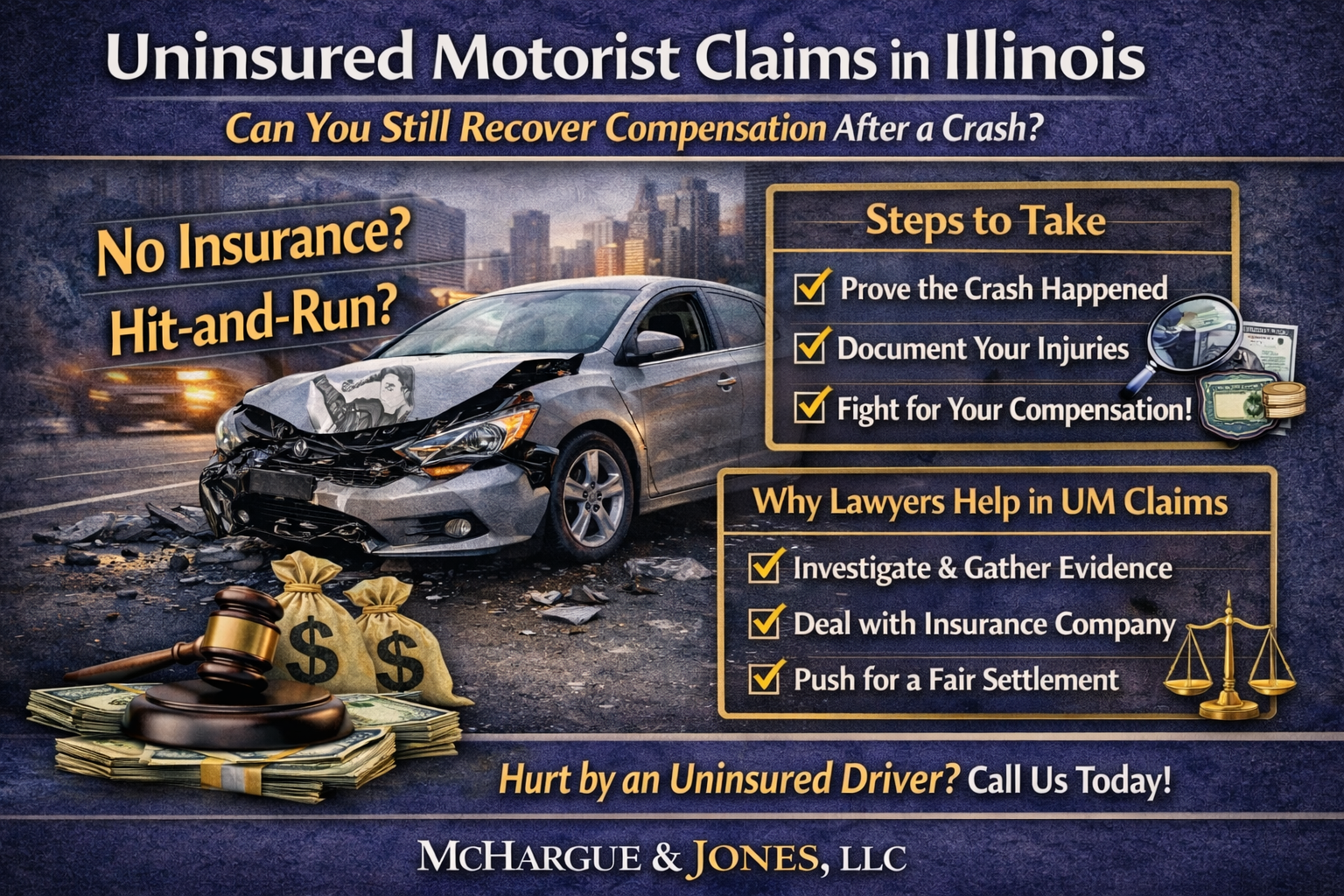


Uninsured Motorist Claims in Illinois: How You Can Still Recover Compensation
If the driver who caused your crash had no insurance, you may still be able to recover compensation. In many Illinois cases, the most important claim is not against the other driver at all. It is an uninsured motorist claim through your own insurance policy.
That is where many people get blindsided. They assume that because the claim is through their own insurance company, payment should be straightforward. It often is not. You still have to prove how the crash happened, prove your injuries, document your treatment, and show what the case is truly worth. And even then, your own insurance company may still delay, underpay, or push the case toward arbitration.
At McHargue & Jones, LLC, we help injured people pursue uninsured motorist claims after serious car accidents, including crashes involving uninsured drivers and hit-and-run drivers who cannot be identified. If there is a path to recovery, our job is to find it, build it, and fight for it.
[/vc_column_text][/vc_column][/vc_row]
Injured by an uninsured driver? Contact us online or call (312) 739-0000 for a free consultation.
Can You Collect Money If the Other Driver Had No Insurance?
Yes, often you can.
If the at-fault driver had no insurance, you may still be able to recover compensation through your own uninsured motorist claim. That can include damages tied to medical bills, lost wages, pain and suffering, disability, and the ways the injury has affected your everyday life.
This is one of the most important things people miss after a serious crash. They hear the other driver had no insurance and assume there is no case. In reality, there may still be a strong claim. The real question is not just whether the other driver had coverage. The real question is what insurance is available to compensate you now.
How an Uninsured Motorist Claim Works
In practical terms, an uninsured motorist claim is often the claim you make when there is no meaningful liability insurance available from the at-fault driver.
That usually means one of two things:
- The driver who caused the crash had no insurance at all
- The driver fled the scene and cannot be identified, which often turns the case into an uninsured motorist claim through your own policy
So while the crash may have been caused by the other driver, the recovery process often shifts to your own insurance company. That does not make the case easier. It just changes who you are fighting with.
If the other driver had insurance but not enough insurance, that is usually a different kind of case. For that situation, see our page on underinsured motorist claims in Illinois. If the driver fled the scene, visit our page on Chicago hit-and-run accident claims.
Why These Claims Are Often Harder Than People Expect
Many uninsured motorist claims become difficult because the insurance company is looking for reasons to pay less.
Even though the claim is through your own policy, the insurer may still:
- Question whether the crash happened the way you say it did
- Argue there is not enough proof that the other driver was uninsured
- Claim there is not enough proof of a hit-and-run driver
- Say your injuries are minor or unrelated
- Argue that your treatment was excessive
- Point to gaps in care
- Blame symptoms on pre-existing conditions
- Offer a settlement that is far too low
- Push the dispute into arbitration
That is why these cases should be treated like real contested injury claims from the beginning. The fact that the money may come from your own policy does not mean the insurance company will volunteer to pay full value.
What You Need To Win an Uninsured Motorist Claim
To recover fair compensation, you usually need to prove:
- How the crash happened
- Why the other driver was at fault
- Why there is no available liability coverage from the at-fault driver
- The nature and extent of your injuries
- The treatment you received
- Your wage loss and other financial damages
- The pain, limitations, and life impact caused by the collision
These are evidence-driven cases. Police reports, photos, witness statements, medical records, billing records, wage documentation, and scene evidence may all matter. If you are early in the process, our step-by-step guide on what to do after a car accident in Chicago can help you avoid mistakes that weaken the claim.
Why Seeing a Doctor Quickly Matters So Much
You cannot build a strong uninsured motorist case without good medical documentation.
If you wait too long to get checked out, the insurance company may argue that you were not really hurt, that your symptoms came from something else, or that your treatment is exaggerated. Prompt medical care protects your health, but it also creates the record that helps connect the crash to the injury.
This comes up constantly in cases involving delayed pain, neck injuries, back injuries, headaches, radiating symptoms, and mobility problems. It is especially common in whiplash claims and soft tissue car accident cases. For more on this issue, read The Importance of Seeing a Doctor After a Car Accident.
What If the Crash Looked Minor but You Are Actually Hurt?
This happens all the time. A crash can look small at first and still cause real injuries.
Insurance companies love to point to low property damage and pretend the injury claim must be small too. That is not how real cases work. A so-called minor crash can still lead to weeks or months of treatment, time off work, serious pain, and lasting problems.
That is why our page on whether you should get a lawyer for a minor car accident in Chicago is often relevant in uninsured motorist cases as well.
What Damages Can You Recover in an Uninsured Motorist Case?
The available damages depend on the policy, the injuries, and the facts of the case, but an uninsured motorist claim may involve compensation related to:
- Medical expenses
- Future medical treatment
- Lost wages
- Loss of earning capacity
- Pain and suffering
- Disability or reduced quality of life
- Permanent injury or disfigurement
That is why an early offer can be dangerous. The first number the insurance company offers often does not reflect the true value of the case. If you want a better sense of how injury claims are evaluated, see our page on what a car accident case may be worth in Illinois.
Can Pedestrians and Cyclists Recover Through an Uninsured Motorist Claim?
Sometimes, yes. These claims are not limited to drivers and passengers.
Depending on the policy and the injured person’s status as an insured, pedestrians and cyclists may also have access to uninsured motorist coverage after being struck by an uninsured or unidentified driver. This can be especially important in hit-and-run cases involving people who were walking or biking when they were hit.
Those cases often require fast reporting, careful evidence preservation, and a close review of available coverage.
Common Injuries in Uninsured Motorist Cases
Uninsured motorist claims can involve everything from painful but treatable injuries to permanent, life-changing harm. Common examples include:
- Whiplash and neck injuries
- Soft tissue injuries
- Back and disc injuries
- Shoulder and knee injuries
- Concussions and head trauma
- Broken bones
- Scarring and disfigurement
- Permanent disability and catastrophic injuries after auto accidents
Do not let the insurance company dismiss your case just because the crash seemed minor at first or your symptoms became worse over the next several days instead of immediately.
Why Hiring a Lawyer Can Make a Real Difference
Uninsured motorist claims are often more complicated than people expect. You may be dealing with serious injuries, missing-driver issues, policy questions, valuation disputes, and an insurance company that is actively looking for ways to reduce what it pays.
A lawyer can help by:
- Identifying all available insurance coverage
- Gathering and organizing the evidence needed to prove the claim
- Developing the medical proof needed to support damages
- Documenting lost wages and other financial harm
- Negotiating with the insurance company
- Preparing the case for arbitration or litigation when necessary
If you are unsure whether legal help makes sense in your case, read our page on when you should hire a lawyer after a car accident in Chicago.
Frequently Asked Questions About Uninsured Motorist Claims in Illinois
Can I still recover money if the other driver had no insurance?
Yes, often you can. In many cases, the path to compensation is an uninsured motorist claim through your own insurance policy.
Does uninsured motorist coverage apply to hit-and-run accidents?
In many cases, yes. When the at-fault driver cannot be identified, the claim often becomes an uninsured motorist claim.
What is the difference between uninsured and underinsured motorist claims?
An uninsured motorist claim usually involves no available liability insurance from the at-fault driver. An underinsured motorist claim usually involves a driver who had insurance, but not enough to cover the full damages.
Will my own insurance company pay fairly?
Not necessarily. Even though the claim is through your own policy, your insurer may still dispute fault, injuries, treatment, or value.
What if I was a pedestrian or cyclist hit by an uninsured driver?
Depending on the policy and whether you qualify as an insured person under it, uninsured motorist coverage may still apply.
What if the insurance company wants arbitration?
That can happen in uninsured motorist cases. It does not mean the case is over, but it does mean the claim needs to be prepared thoroughly and supported by strong evidence.
How McHargue & Jones Helps With Uninsured Motorist Claims
Being hit by an uninsured driver can leave you feeling like there is no good option. But in many cases, there is still a path to recovery. The key is identifying it early, documenting it properly, and being prepared when the insurance company refuses to pay what the claim is worth.
At McHargue & Jones, LLC, we help injured people pursue uninsured motorist claims, underinsured motorist claims, and related serious injury cases throughout the Chicago area. If you were hurt and the at-fault driver had no insurance, we can help you understand your options and fight for compensation.
Need help with an uninsured motorist claim? Call (312) 739-0000 or contact us online for a free consultation.