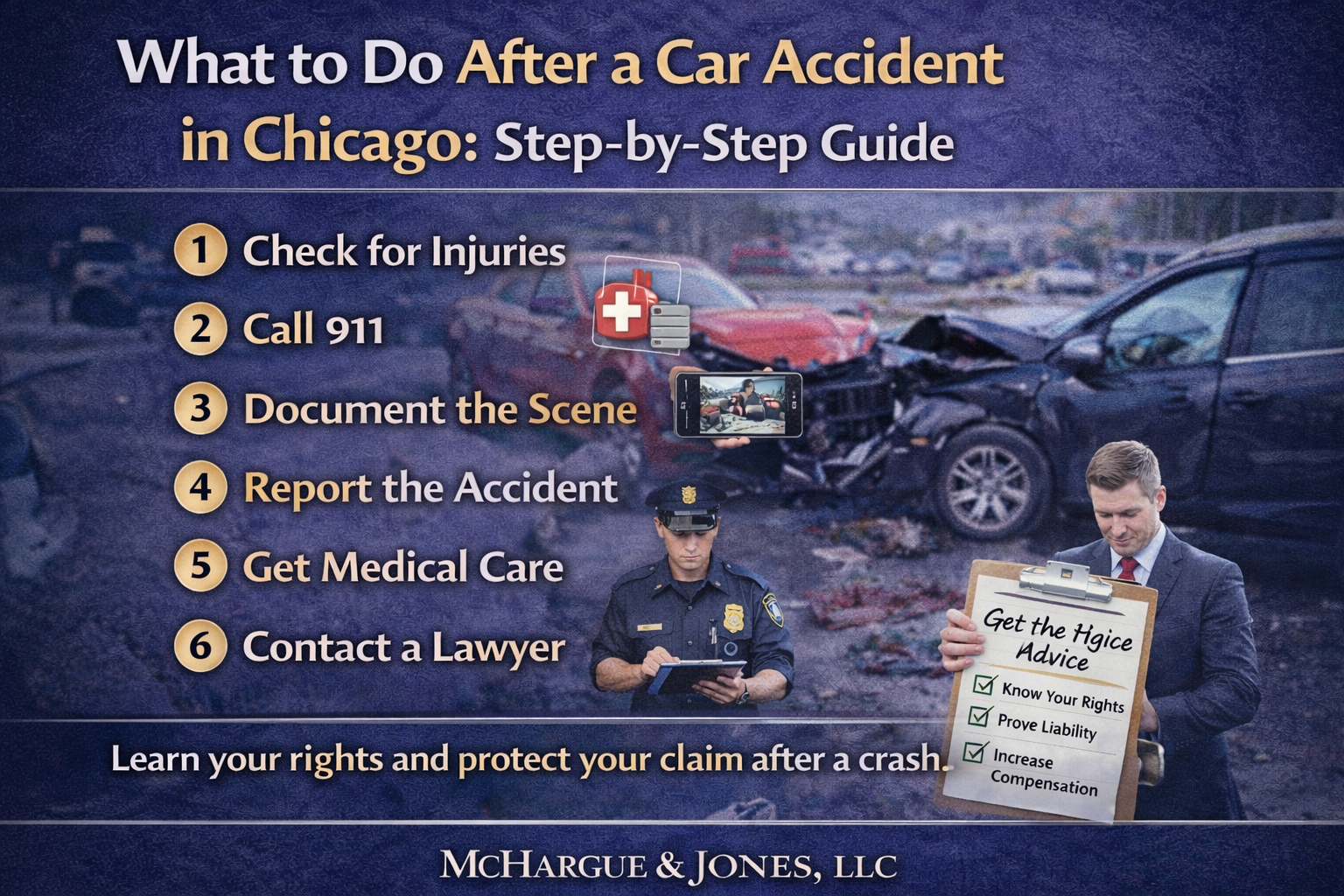


What to Do After a Car Accident in Chicago (Step-by-Step Guide)
Even small mistakes can hurt a case. Delaying medical treatment, failing to photograph the scene, admitting fault, giving a careless recorded statement, or accepting a quick settlement before you know the full extent of your injuries can all reduce the value of an Illinois car accident claim.
This guide explains what to do after a Chicago car accident, why each step matters, and when you should talk to a lawyer before dealing with the insurance company.
If you were injured in a crash, McHargue & Jones represents car accident victims in Chicago and throughout Illinois. Call (312) 739-0000 for a free consultation. You do not pay unless we recover for you. Se habla español.
Hurt in a Chicago car accident?
Before you give a recorded statement, accept a settlement, or sign a release, McHargue & Jones can review your case and explain your options.
Start Your Free Case Review
Or call (312) 739-0000
What Should You Do Immediately After a Car Accident in Chicago?
The first steps after a crash are simple, but they matter. Your priorities are safety, medical care, evidence, and protecting your claim.
- Call 911 and check for injuries.
- Move to a safe location if you can do so safely.
- Get medical attention, even if symptoms seem minor.
- Exchange information with all drivers.
- Photograph the vehicles, roadway, injuries, and scene.
- Get the police report or crash report information.
- Notify your insurance company, but stick to the facts.
- Talk to a lawyer before accepting a settlement or signing a release.
Each step helps create a record of what happened, who was involved, what injuries were reported, and what evidence supports the claim.
Step 1: Call 911 and Check for Injuries
Call 911 after a crash, especially if anyone is hurt, traffic is blocked, vehicles are badly damaged, or there is any dispute about what happened. Emergency responders can secure the scene, provide medical help, and create an official record of the collision.
Do not assume you are fine just because you can walk around. Adrenaline can mask pain. Neck injuries, back injuries, concussions, shoulder injuries, knee injuries, and soft-tissue injuries may become more obvious later that day or the next morning.
If you have pain, dizziness, confusion, numbness, tingling, headache, weakness, or any worsening symptoms, get medical attention. For more detail, read our article on why you should see a doctor after a car accident.
Step 2: Move to Safety, But Do Not Destroy Evidence
If the vehicles are creating a danger and can be moved safely, get out of traffic and turn on your hazard lights. If the vehicles cannot be moved, stay in a safe place and wait for police or emergency responders.
Before moving vehicles, take quick photos if it is safe. Vehicle position, lane location, debris, skid marks, traffic signals, road conditions, and damage patterns can all matter later if the insurance company disputes fault.
Step 3: Exchange Information With All Drivers
Get the other driver’s name, address, phone number, driver’s license information, license plate number, insurance company, policy information, and vehicle make/model. If there are passengers or witnesses, get their names and contact information too.
Keep the conversation short and factual. Do not argue, apologize, admit fault, or speculate about what caused the crash. Simple statements like “I’m sorry” may feel polite at the scene but can later be twisted into an admission.
Step 4: Document the Scene and Your Injuries
Photos and videos can become some of the most important evidence in the case. If you can safely do so, document the vehicles before they are repaired or moved, the point of impact, visible injuries, airbag deployment, debris, road conditions, weather, lighting, traffic signs, traffic signals, and anything that may explain how the crash happened.
Also take photos of your injuries over time. Bruising, swelling, cuts, casts, braces, stitches, and visible limitations may look different days or weeks after the crash. This evidence can help support not only medical bills, but also pain and suffering after a car accident in Illinois.
Step 5: Get a Police Report or Crash Report Information
A police report helps create an official record of the crash. It may include driver information, insurance information, vehicle information, crash location, statements, citations, diagrams, witness information, and the officer’s observations.
In Illinois, crash reporting rules may apply when a crash causes injury, death, or enough property damage. The Illinois State Police explains that each driver involved in an Illinois traffic crash must file a crash report if the crash caused death, bodily injury, or more than $1,500 of property damage when all drivers are insured. If any driver does not have insurance, the threshold is $500.
For more on how the report can affect a claim, read our guide on what is included in a car accident police report.
Step 6: Get Medical Attention as Soon as Possible
You should see a doctor as soon as possible after a crash, especially if you have pain or symptoms. Delays in treatment are one of the most common reasons insurance companies deny, delay, or undervalue injury claims.
Medical records do two things. First, they help diagnose and treat your injury. Second, they create a timeline that connects your symptoms to the crash. If you wait too long, the insurance company may argue that you were not really hurt, that something else caused your symptoms, or that the treatment was unnecessary.
Be accurate with your doctor. Explain how the crash happened, what body parts hurt, when symptoms started, and whether symptoms are getting worse. Do not exaggerate, but do not minimize your pain either.
Step 7: Notify Your Insurance Company Carefully
You should usually notify your own insurance company promptly after a crash. Your policy may require timely notice, and your own coverage may matter for property damage, medical payments coverage, uninsured motorist coverage, or underinsured motorist coverage.
That said, be careful. Stick to the basic facts: when and where the crash happened, who was involved, and whether you are seeking medical care. Avoid admitting fault, guessing about speed or distance, minimizing injuries, or giving a recorded statement to the other driver’s insurance company without legal advice.
The Illinois Department of Insurance explains that after an auto accident, you may have the option to make a claim with your own insurance company if you have the appropriate coverage, called a first-party claim, or with the other driver’s insurance company, called a third-party claim. Those claims involve different rights and obligations.
Will the Insurance Company Offer a Settlement After the Crash?
The insurance company may offer a settlement after a car accident, but it is not automatic. Before making an offer, the adjuster usually investigates fault, confirms coverage, reviews the medical records, evaluates property damage, and decides what the claim is worth.
That means a quick offer is not always a good offer. It may come before the full medical picture is known. It may not account for future treatment, pain and suffering, lost wages, medical liens, or how the injury affects your daily life. In other cases, the insurer may delay or refuse to make an offer because it disputes fault, claims your injuries are pre-existing, says your treatment was excessive, or argues there is not enough proof.
Before accepting any settlement, be careful with the release. A release usually means you accept money in exchange for giving up your right to seek more compensation for that crash later.
For a deeper explanation, read our guide on whether insurance will offer a settlement after a car accident in Illinois.
How These Steps Affect What Your Case May Be Worth
What you do after a crash can directly affect settlement value. Insurance companies evaluate proof. They look at how the accident happened, what the vehicle damage shows, when you first reported pain, whether your medical records are consistent, whether treatment was reasonable, whether you missed work, and whether your injuries have lasting effects.
Strong documentation can support value. Delays, gaps, inconsistent histories, missing photos, and unclear medical records can reduce value. That does not mean a case is lost, but it gives the insurance company arguments to pay less.
If you are trying to understand possible compensation, read our guide on how much a car accident case is worth in Illinois.
Be Careful Before Accepting a Quick Settlement
Insurance companies sometimes make early offers to close claims quickly. That can be tempting, especially if you are missing work, your car is damaged, or medical bills are coming in. But once you settle and sign a release, you usually cannot reopen the claim because your symptoms got worse or you later needed more treatment.
Before accepting a settlement, you should understand the full value of the claim, the available policy limits, your medical bills, health insurance liens, unpaid provider balances, lost wages, pain and suffering, and what you may actually keep from the settlement.
If a lawyer fee is part of your concern, read how much a car accident lawyer costs in Illinois. If the settlement number is already on the table, see how much of a $25K, $50K, or $100K settlement you may actually keep in Illinois.
Special Situations After a Chicago Car Accident
Some crashes require extra caution. A hit-and-run accident may involve uninsured motorist coverage. A rear-end accident may still involve disputes over injury severity, pre-existing conditions, or whether the crash caused the medical treatment.
Policy limits can also change the case. A serious injury may be worth more than the at-fault driver’s insurance coverage. If that happens, uninsured or underinsured motorist coverage may become important. For more, read our guide on how insurance policy limits work in Illinois car accident and truck accident cases.
When Should You Talk to a Chicago Car Accident Lawyer?
You may not need a lawyer for a minor property-damage-only claim. But if you were injured, the other driver’s insurance company is calling, fault is disputed, the offer seems low, treatment is ongoing, you missed work, or you are being asked to sign a release, it is smart to get legal advice before moving forward.
A lawyer can help preserve evidence, deal with adjusters, identify available insurance coverage, gather medical records, document wage loss, evaluate settlement value, resolve liens, and file a lawsuit if the insurance company will not make a fair offer.
Do not wait until the deadline is close. Under Illinois law, most personal injury actions must be filed within two years of the injury. Certain cases may involve shorter deadlines, especially if a government entity is involved, so it is better to ask early.
Trying to protect your car accident claim?
McHargue & Jones can review the crash facts, insurance issues, medical treatment, settlement offer, and next steps for free.
Free consultation: (312) 739-0000 | Start your free case review
Common Mistakes That Can Hurt Your Car Accident Claim
The most common mistakes are usually avoidable. After a Chicago car accident, do not wait too long to get medical care, fail to photograph the scene, admit fault, ignore symptoms, give a broad recorded statement, post about the crash online, miss follow-up appointments, or accept a quick settlement before you know the full extent of your injuries.
These mistakes do not always destroy a claim, but they create problems. The insurance company may use them to argue that you were not seriously hurt, that the crash did not cause your injuries, or that your claim is worth less.
Bottom Line: What Should You Do After a Car Accident in Chicago?
After a Chicago car accident, focus on safety, medical care, documentation, and protecting your legal rights. Call 911, get medical attention, exchange information, document the scene, obtain the police report, notify your insurance company carefully, and avoid signing anything until you understand your claim.
The insurance company may eventually offer a settlement, but that offer should be evaluated in light of fault, medical treatment, policy limits, liens, lost wages, pain and suffering, and the long-term impact of your injuries.
McHargue & Jones represents injured car accident victims in Chicago and throughout Illinois. We help clients deal with insurance companies, settlement offers, medical bills, liens, policy limits, and lawsuits when necessary.
Call (312) 739-0000 or start your free case review online. No fee unless we recover for you. Se habla español.
What Our Clients Say
Real Google reviews from injured people we’ve helped across Illinois.
Questions after a car accident?
Tell us what happened. We can review your case for free and explain what to do next.
Prefer to call? (312) 739-0000
Frequently Asked Questions
What should I do immediately after a car accident in Chicago?
Call 911, check for injuries, move to safety if possible, exchange information, document the scene, and seek medical attention. You should also get the police report information and notify your insurance company carefully.
Do I need to call the police after a car accident in Chicago?
Yes, especially if anyone is injured, a vehicle cannot be safely driven, there is significant property damage, the other driver leaves, or there is a dispute about what happened. A police report can also help document the crash for insurance and legal purposes.
How long after a car accident should I see a doctor?
You should see a doctor as soon as possible, ideally the same day or within 24 hours if you have pain or symptoms. Delayed treatment can make it easier for the insurance company to argue that your injuries were not caused by the crash.
What should I not say after a car accident?
Do not admit fault, guess about what happened, minimize your injuries, or give a broad recorded statement without legal advice. Stick to basic facts when speaking with police, drivers, and insurance companies.
Will the insurance company offer a settlement after a car accident?
It may, but a settlement offer is not automatic. The insurance company usually investigates fault, coverage, medical treatment, and damages before making an offer. If liability or injury causation is disputed, the insurer may delay, deny, or make a low offer.
Should I accept the first settlement offer after a car accident?
Not before you understand the full value of your claim and what rights you are giving up. A first offer may not account for future treatment, pain and suffering, lost wages, liens, or the long-term impact of your injury.
How much is my car accident case worth?
Case value depends on fault, injury severity, medical treatment, lost wages, pain and suffering, permanency, policy limits, and available evidence. Strong documentation and consistent medical care usually help support value.
Can I still file a claim if I did not go to the doctor right away?
Yes, but delays can weaken the claim. You should seek medical care as soon as possible and be honest about when symptoms started and why treatment was delayed.
How long do I have to file a car accident lawsuit in Illinois?
Most Illinois personal injury lawsuits must be filed within two years of the injury. Some cases may involve shorter deadlines, especially claims involving government entities, so it is important to get legal advice early.
Disclaimer: This article is for general information only and is not legal advice. Reading this article does not create an attorney-client relationship. Every Illinois car accident case depends on its own facts, injuries, medical records, insurance coverage, liability evidence, deadlines, and applicable law. Prior results do not guarantee a similar outcome.