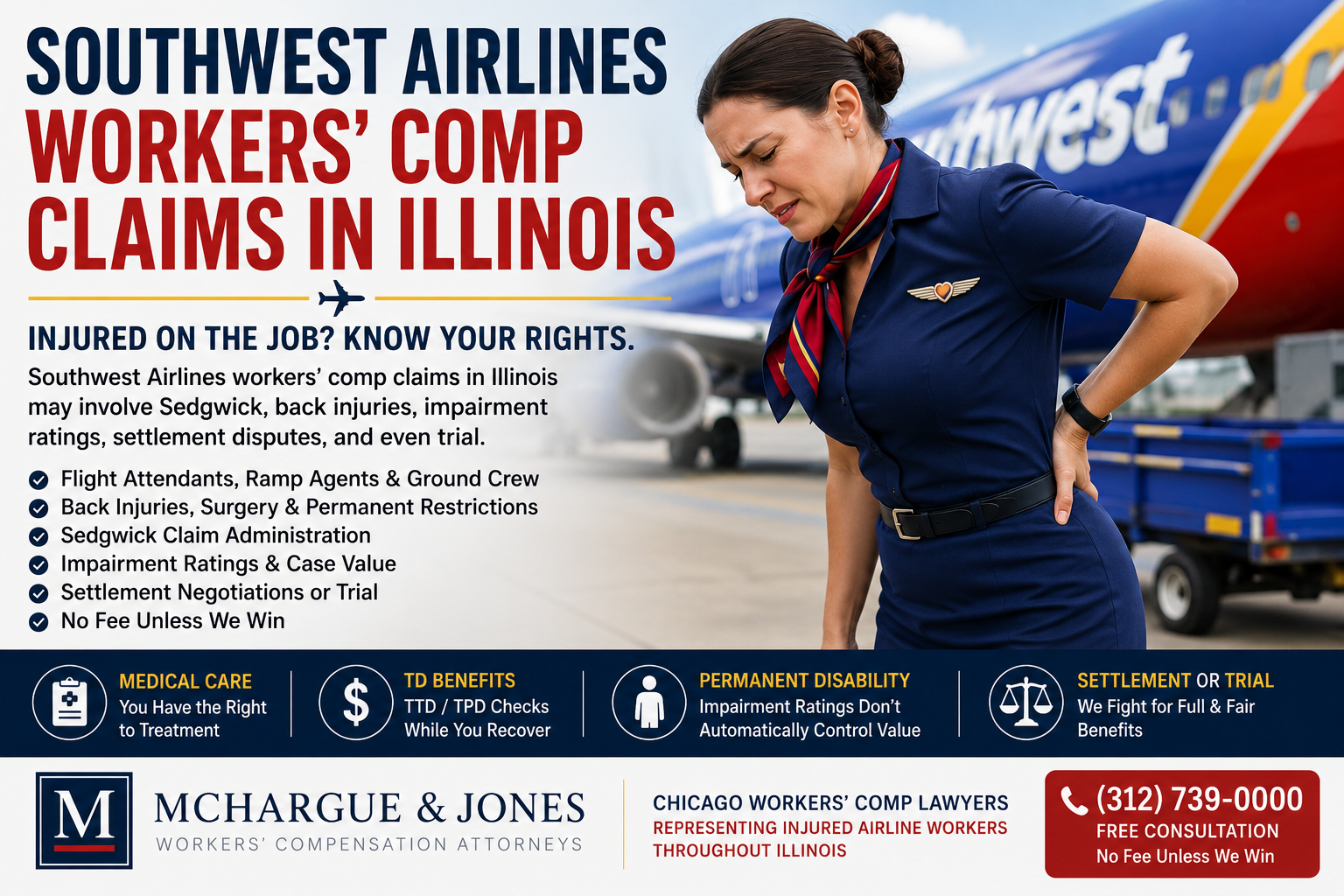


Southwest Airlines Workers’ Comp Claims in Illinois: Sedgwick, Flight Attendant Injuries, Impairment Ratings, and Settlements
For a broader overview, visit our main Illinois workers’ compensation page and our Chicago airline and airport workers’ compensation page.
Hurt While Working for Southwest Airlines?
If your Southwest workers’ comp claim involves Sedgwick, an IME, a back injury, surgery, an impairment rating, settlement pressure, or a resignation demand, McHargue & Jones can review your case and explain your options.
Or call (312) 739-0000 • No fee unless we win • Se habla español
Quick Answer: What Should Southwest Airlines Workers Know About Illinois Workers’ Comp?
Southwest Airlines workers may be entitled to Illinois workers’ compensation benefits if their injury is covered under Illinois law. Benefits may include medical treatment, TTD checks while off work, payment of medical bills, permanent disability benefits, and in some cases a settlement or trial award.
Southwest workers’ comp claims can involve issues such as:
- Whether Illinois has jurisdiction over the case
- Whether Sedgwick is approving medical care and paying benefits correctly
- Whether the worker can return to full duty or needs restrictions
- Whether a back injury, disc injury, or surgery affects future work
- Whether an impairment rating is being used to argue for a lower case value
- Whether the settlement offer reflects the true value of the injury
- Whether resignation is being required as part of settlement
- Whether the case should be tried if settlement is not fair or not available
A low offer, impairment rating, or resignation demand does not automatically mean the case is worth less or that the worker is out of options. Depending on the facts, the worker may have the right to proceed to hearing before the Illinois Workers’ Compensation Commission.
Southwest Workers’ Comp Claims Often Involve Sedgwick
Southwest Airlines workers’ compensation claims often involve Sedgwick as the claim administrator. Sedgwick may handle communications, medical authorizations, TTD checks, IME scheduling, benefit issues, and settlement discussions.
A claim administrator does not decide the final value of your case, and it does not have the final word on disputed Illinois workers’ comp issues. If there are problems with delayed medical care, stopped checks, an IME, an impairment rating, or settlement pressure, the claim may need legal action to move forward.
For more detail, read our guide to Sedgwick workers’ compensation claims in Illinois.
Southwest Flight Attendant Workers’ Comp Claims
Flight attendants face unique injury risks because they work in aircraft cabins, during boarding, in turbulence, on layovers, and across state lines. A Southwest flight attendant workers’ comp claim may involve both medical issues and Illinois jurisdiction issues.
Common Southwest flight attendant injuries include:
- Back injuries from turbulence, lifting bags, bending, twisting, carts, and assisting passengers
- L4-L5 and L5-S1 disc injuries, sciatica, radiculopathy, and lumbar fusion surgery
- Shoulder injuries from overhead luggage, service carts, and passenger assistance
- Knee injuries from twisting, falls, stairs, jet bridges, and narrow aircraft spaces
- Neck injuries and concussions from turbulence, falling luggage, or sudden movement
- Wrist, hand, and repetitive trauma injuries from carts, doors, bags, and cabin service
- Slip and fall injuries in aircraft, airports, jet bridges, hotels, shuttles, and layover locations
If the injury happened outside Illinois, the flight attendant should not assume the case cannot be filed in Illinois. Jurisdiction may depend on the worker’s base, route, contract, employment connection, and other facts. Read our full guide: Can flight attendants file workers’ comp in Illinois after an out-of-state injury?
Recent Southwest Flight Attendant Trial: Lumbar Fusion Injury, Illinois Jurisdiction, and About a $100,000 Award
Matthew Jones recently tried a Chicago workers’ compensation case for a Southwest Airlines flight attendant who lived in Wisconsin and suffered a serious lumbar spine injury while working in Washington, D.C.
The case proceeded in Chicago under Illinois workers’ compensation. The flight attendant had a serious back injury that required lumbar fusion surgery.
In that case, Southwest did not make a settlement offer unless resignation was part of the resolution. Instead of accepting those terms, the case was tried. Matthew Jones obtained an award of about $100,000 for the workers’ compensation case.
Prior results do not guarantee a similar outcome. Every workers’ compensation case depends on its own facts, medical records, testimony, jurisdiction, restrictions, impairment evidence, and legal issues. But the case shows why Southwest workers should not assume a low offer, impairment rating, or resignation demand is the final word.
If your injury involves a lower back condition, read our guides to L4-L5 and L5-S1 disc injuries in Illinois workers’ comp and how much a back injury may be worth in an Illinois workers’ comp case.
Southwest Ramp Agent, Baggage Handler, and Ground Crew Injuries
Southwest workers’ compensation claims are not limited to flight attendants. Ramp agents, baggage handlers, ground operations workers, and airport employees often perform physically demanding work around aircraft, luggage, cargo, equipment, vehicles, and weather conditions.
Common ramp and ground crew injuries include:
- Back injuries from lifting, twisting, pushing, and pulling luggage or cargo
- Shoulder tears from loading bags, working overhead, or forceful pulling
- Knee injuries from kneeling, twisting, stairs, and tarmac work
- Foot and ankle injuries from slips, falls, uneven surfaces, and equipment accidents
- Hand, wrist, and elbow injuries from repetitive gripping, scanners, tools, and baggage handling
- Vehicle and equipment injuries involving tugs, carts, belt loaders, and other airport equipment
- Weather-related injuries from ice, rain, heat, and winter tarmac conditions
Even if the airline says the injury is “just soreness,” “pre-existing,” or “part of the job,” the worker may still have a valid Illinois workers’ compensation claim if the job caused or aggravated the condition.
Impairment Ratings in Southwest Workers’ Comp Cases
In some Southwest workers’ comp cases, the defense may obtain an impairment rating to argue for a lower permanent disability value at trial. An impairment rating is one piece of evidence. It is not automatically the value of the case, and it does not necessarily control what an arbitrator will award.
In Illinois workers’ compensation, case value is usually broader than a single impairment number. The arbitrator may consider the medical records, surgery, restrictions, pain, job duties, occupation, age, wage loss, ability to return to work, and the overall impact of the injury. In our experience, an impairment rating may be used by the defense to try to reduce value, but it is weighed like other evidence in the case.
This can be especially important in serious Southwest cases involving back injuries, lumbar fusion surgery, permanent restrictions, or an inability to return to the same airline job. A low impairment rating does not automatically mean the case has low value.
For a full explanation, read our guide to Illinois workers’ comp impairment ratings.
Common Issues in Southwest Workers’ Comp Cases
Not every Southwest workers’ comp case involves a fight over every issue. Some cases involve accepted injuries and paid medical care, but still become difficult when the parties disagree about settlement value, permanent disability, impairment ratings, restrictions, future work, or resignation language.
Common issues include:
- Illinois jurisdiction questions for flight attendants or traveling airline workers injured outside Illinois
- Sedgwick claim administration issues involving medical approvals, benefit payments, paperwork, or communication
- IME opinions that may affect treatment, work status, restrictions, or settlement posture
- Impairment ratings used by the defense to argue for a lower permanent disability award
- Back injury valuation after disc injuries, injections, surgery, or lumbar fusion
- Permanent restrictions that affect whether the worker can return to the same Southwest job
- Settlement disputes where the offer does not reflect surgery, wage loss, restrictions, or future medical risk
- Resignation demands where settlement is conditioned on signing a release and resignation
If treatment has been denied, start with Workers’ comp denied my surgery in Illinois: what to do next. If checks stopped, read Workers’ comp stopped my checks in Illinois. If an IME is involved, see what injured workers need to know about IMEs.
What If Southwest Will Not Settle Unless You Resign?
You do not have to resign just because you filed a workers’ compensation claim. But an employer may refuse to settle a workers’ compensation case unless resignation is part of the agreement. We have seen this issue in Southwest Airlines workers’ compensation cases.
That does not mean you have to quit to pursue benefits. A workers’ compensation settlement is voluntary. If Southwest will not offer a fair settlement without resignation, the injured worker may still be able to proceed to hearing before the Illinois Workers’ Compensation Commission and seek a permanency award or other benefits supported by the evidence.
Whether a resignation demand creates a separate employment-law, union, retaliation, discrimination, or contract issue depends on the facts. From the workers’ compensation side, the key point is this: you should understand what you are being asked to give up before signing any settlement, release, or resignation paperwork.
For more on this issue, read Do I have to resign to settle my workers’ comp case in Illinois?. You can also review Do I need a lawyer to get a workers’ comp settlement?, the Illinois workers’ comp settlement chart, and our Illinois workers’ comp hearing and trial guide.
Can Southwest Workers Get Benefits If the Case Does Not Settle?
Yes. A settlement requires agreement, but a trial award is different. If the case does not settle, the injured worker may be able to proceed to hearing before an arbitrator at the Illinois Workers’ Compensation Commission.
At hearing, the arbitrator can decide disputed issues such as:
- Whether Illinois has jurisdiction
- Whether the injury is work-related
- Whether medical treatment is reasonable and necessary
- Whether TTD benefits are owed
- Whether medical bills should be paid
- Whether the worker has permanent disability
- How much weight to give an impairment rating
- How much permanency should be awarded
This is why a $0 offer, a resignation demand, or a low impairment rating does not necessarily end the case. If the evidence supports the claim, trial may be the way to force a decision.
What Benefits Are Available in a Southwest Airlines Workers’ Comp Case?
If the injury is covered under Illinois workers’ compensation, a Southwest worker may be entitled to benefits such as:
- Medical benefits for reasonable and necessary treatment, including doctor visits, imaging, therapy, injections, surgery, medication, and follow-up care
- Temporary Total Disability, or TTD checks, if the worker is off work because of the injury
- Temporary Partial Disability, or TPD, if the worker returns to lower-paying light duty while recovering
- Permanent Partial Disability, or PPD, for permanent impairment after maximum medical improvement
- Wage differential benefits in some cases where permanent restrictions prevent a return to the same airline job
- Vocational rehabilitation or maintenance in certain cases involving retraining or job search
- A settlement or trial award depending on the evidence and disputed issues
For a broader explanation, read our guide to types of Illinois workers’ compensation benefits.
How Much Is a Southwest Workers’ Comp Case Worth?
The value of a Southwest workers’ compensation case depends on the injury, treatment, time off work, surgery, permanent restrictions, wage loss, future medical risk, and whether the case is resolved by settlement or hearing.
Important value factors include:
- The body part injured
- The diagnosis
- Whether surgery was needed
- Whether the worker had injections, therapy, or extensive medical care
- Whether the worker returned to full duty or has permanent restrictions
- Whether the worker can return to the same Southwest job
- Average weekly wage
- Whether future medical care is likely
- Any impairment rating and how much weight the arbitrator gives it
- Whether resignation is being demanded as part of settlement
- Whether the case settles or goes to hearing
For more, review the Illinois workers’ comp settlement chart, our guide to Illinois workers’ comp impairment ratings, and our guide on whether you need a lawyer to get a workers’ comp settlement.
Why Trial Preparation Matters in Southwest Workers’ Comp Cases
Not every Southwest workers’ compensation case goes to trial. Many cases settle. But trial preparation can change the leverage in a serious case.
When a case involves a serious spine injury, lumbar fusion, permanent restrictions, an impairment rating dispute, a resignation demand, or a low settlement offer, the worker may need a lawyer who is prepared to move the case forward at the Illinois Workers’ Compensation Commission.
That can include:
- Developing medical evidence
- Obtaining and organizing treatment records
- Preparing testimony about how the injury happened
- Responding to impairment rating evidence
- Using treating doctor opinions
- Taking doctor depositions when needed
- Documenting restrictions and wage loss
- Trying the case when settlement is not fair or not available
For more detail, read our Illinois workers’ comp hearing and trial guide.
What Should You Do After a Southwest Airlines Work Injury?
If you were hurt while working for Southwest Airlines, take these steps:
- Report the injury as soon as possible.
- Get medical treatment and tell the doctor the injury happened at work.
- Keep copies of injury reports, texts, emails, schedules, work notes, and Sedgwick paperwork.
- Write down the flight, airport, gate, aircraft, tarmac area, or work assignment involved.
- Do not assume an impairment rating automatically controls the value of your case.
- Do not sign settlement, release, or resignation paperwork without understanding what rights you are giving up.
- Talk to a workers’ compensation lawyer if treatment is delayed, checks stop, an IME is scheduled, an impairment rating is being used against you, or settlement pressure begins.
Talk to a Chicago Southwest Workers’ Comp Lawyer
McHargue & Jones represents injured Southwest Airlines workers in Illinois workers’ compensation cases involving Sedgwick, flight attendant injuries, back injuries, lumbar fusion surgery, impairment ratings, IMEs, stopped checks, settlement disputes, resignation demands, jurisdiction issues, and cases that need to be tried.
Call (312) 739-0000 • No fee unless we win
Southwest Airlines Workers’ Comp FAQ
Can Southwest Airlines workers file workers’ comp in Illinois?
Yes, if Illinois workers’ compensation law applies to the injury. The answer may depend on where the worker is based, where the injury happened, the employment relationship, Illinois contacts, and other facts.
Does Sedgwick handle Southwest workers’ comp claims?
Southwest workers’ compensation claims often involve Sedgwick as the claim administrator. Sedgwick may handle communications, medical approvals, IMEs, benefit payments, and settlement discussions, but Sedgwick does not have the final word on disputed Illinois workers’ comp issues.
Can a Southwest flight attendant file in Illinois if hurt in another state?
Sometimes, yes. A flight attendant may be able to file in Illinois depending on the base, route, employment contract, union agreement, hiring or training facts, and other Illinois connections.
Can Southwest use an impairment rating to lower the value of my case?
The defense may use an impairment rating to argue for a lower permanent disability value, but an impairment rating does not automatically control the case. An arbitrator may consider it along with medical records, surgery, restrictions, job duties, age, occupation, wage loss, and the overall impact of the injury.
Can a Southwest worker get workers’ comp for a back injury or lumbar fusion?
Yes, if the medical evidence supports that the work injury caused, aggravated, or accelerated the condition. Back injury and lumbar fusion cases can involve significant medical care, time off work, permanent restrictions, impairment evidence, and case value issues.
What if Southwest will not settle unless I resign?
You do not have to resign just because you filed a workers’ compensation claim. But an employer may refuse to settle unless resignation is part of the agreement. If that happens, the worker may need to decide whether to negotiate, reject the terms, or proceed to hearing.
Can I still win benefits if Southwest offers $0?
Possibly. A settlement offer is not the same as a trial award. If the evidence supports the claim, the worker may be able to proceed to hearing and ask an arbitrator to award benefits or permanency.
How much is a Southwest workers’ comp case worth?
Value depends on the injury, treatment, surgery, time off work, permanent restrictions, wage loss, average weekly wage, future medical risk, impairment evidence, settlement terms, and whether the case settles or goes to hearing.