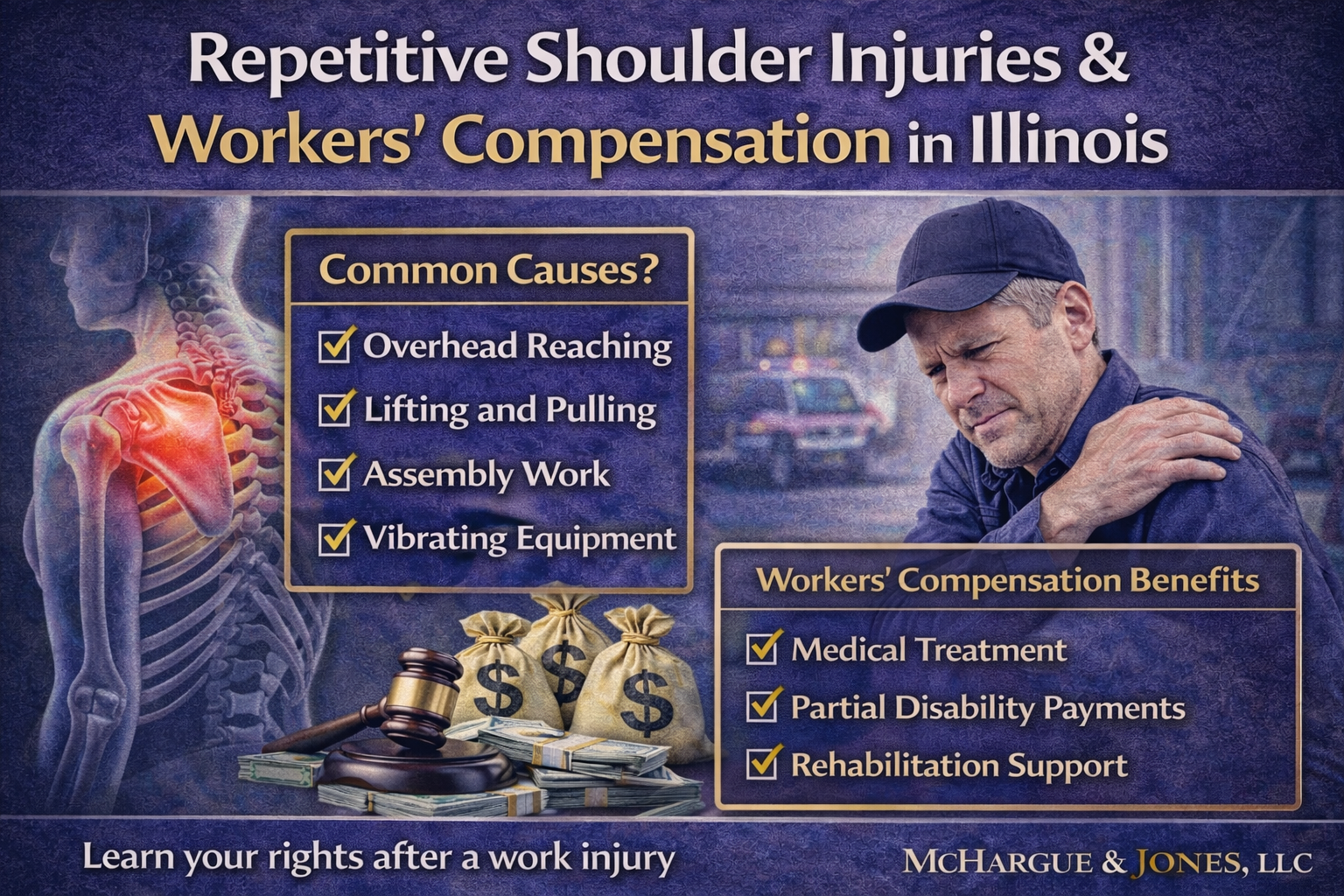


Repetitive Shoulder Injuries in Illinois Workers’ Compensation
Not every work injury happens in a single moment. Some of the most serious shoulder injuries we see in Illinois workers’ compensation cases develop slowly — from doing the same overhead work over and over again, day after day, for years.
These are repetitive trauma injuries, and they are especially common in warehouse, logistics, and industrial jobs. Workers at Amazon, Walmart, and FedEx facilities, along with painters, welders, and manufacturing employees, often spend entire shifts lifting, stacking, reaching, or working at or above shoulder height.
When that happens long enough, the shoulder eventually breaks down — leading to impingement syndrome, rotator cuff tears, or labral injuries. These are real injuries with real value under Illinois law. But they are also some of the most heavily disputed claims we handle.
By Matthew C. Jones, Illinois workers’ compensation attorney
Where We See These Injuries Most Often
The pattern is consistent across industries: repetitive overhead use of the arms, combined with time and frequency, leads to breakdown in the shoulder.
We commonly represent workers in:
- Warehouse and fulfillment operations, including Amazon facilities, Walmart distribution centers, and FedEx operations, where workers are constantly stacking, lifting, and wrapping pallets overhead
- Painters performing repetitive overhead rolling and finishing work
- Welders and fabricators doing repetitive shoulder-level or above-shoulder activity
- Manufacturing and assembly workers performing repetitive reaching and placement tasks
These jobs are not always “heavy” in the traditional sense. In fact, many of the strongest cases involve relatively light work performed at a high frequency over long periods of time.
What Repetitive Overhead Work Does to the Shoulder
The shoulder is built for motion, not repetition. When you repeatedly elevate your arm — especially above shoulder height — the structures in the joint begin to wear down.
Over time, this can lead to:
- Shoulder impingement syndrome
- Rotator cuff tears
- Labral tears
- Chronic inflammation and loss of function
These conditions often develop gradually, which is exactly why insurance companies argue they are “degenerative” rather than work-related.
Why These Cases Are Won or Lost on Detail
The biggest mistake in repetitive shoulder cases is thinking that general descriptions are enough.
Saying “I lift overhead” will not win your case. A doctor — and ultimately an arbitrator — needs to understand exactly what the job involves:
- How much weight is being lifted
- How often the activity is performed
- How long the worker has been doing it
- The height and positioning of the work
- Whether the motion is continuous or repetitive throughout the shift
This is the foundation of proving a repetitive trauma case in Illinois. Without that level of detail, even a supportive doctor may not be able to give a strong causation opinion.
Real Case Example: When Detail Changes the Outcome
We represented a welder who had been doing the same repetitive shoulder-level work for over 25 years. The job was not especially heavy — but it was constant.
We went to the job site, documented the work on video, and provided that to our medical expert. Once the actual job demands were understood, the insurance company’s IME doctor changed his opinion — and the case resolved successfully.
Trial Example: Beating the “Job Rotation” Defense
In a trial against Jel Sert, the employer argued that our client could not have developed a repetitive shoulder injury because her job duties rotated every few hours.
We addressed this by walking through each job in detail. Our client testified for nearly two hours about the specific tasks, the frequency of the work, and — critically — the height of the workstations.
She was shorter than many other workers, which meant tasks that were “shoulder level” for others were actually overhead for her.
Despite the work being relatively light, we proved that the long-term, repetitive nature of the job caused her shoulder tears — and we won her the right to surgery.
That is how these cases are won: by turning general job descriptions into specific, credible evidence.
These Cases Have Real Value
A repetitive shoulder injury is not a lesser claim. Under Illinois law, these cases carry the same benefits as any specific accident, including medical treatment, wage loss benefits, and permanent disability.
In fact, many significant outcomes come from cumulative trauma cases. You can review examples of results involving shoulder injuries here: shoulder injury settlements in Illinois workers’ compensation cases.
These cases often involve surgery and long-term impairment — which means they can be just as serious, and just as valuable, as any accident-based injury.
Putting It All Together
Repetitive shoulder injuries from overhead work are common in today’s workforce — especially in warehouse and logistics environments — but they are rarely straightforward. An experienced Chicago workers’ compensation lawyer can help get you the benefits you deserve.
Winning these cases requires more than just proving you worked hard. It requires proving exactly what you did, how often you did it, and how that work caused or aggravated your condition over time.
When that is done correctly, these cases are not only winnable — they are often among the strongest claims we see.
For a broader understanding of your rights, benefits, and how the system works, see our
Illinois workers’ compensation guide.
Frequently Asked Questions
Can you get workers’ compensation for a shoulder injury without a specific accident?
Yes. Illinois law allows recovery for injuries that develop over time from repetitive work activities, even without a single accident.
How do you prove a repetitive shoulder injury is work-related?
These cases are proven through detailed job descriptions and a medical opinion connecting the work activities to the condition.
Can repetitive overhead work cause a rotator cuff tear?
Yes. Repetitive overhead activity is a well-recognized cause of shoulder impingement, tendon damage, and rotator cuff tears.
Are warehouse workers covered for these types of injuries?
Yes. Workers in warehouse, fulfillment, and delivery roles — including Amazon, Walmart, and FedEx — frequently bring these claims.