

I Have Permanent Work Restrictions: What Happens Next in Illinois Workers’ Comp?
If you are released with permanent work restrictions after a job injury, the next question is usually simple: what happens now?
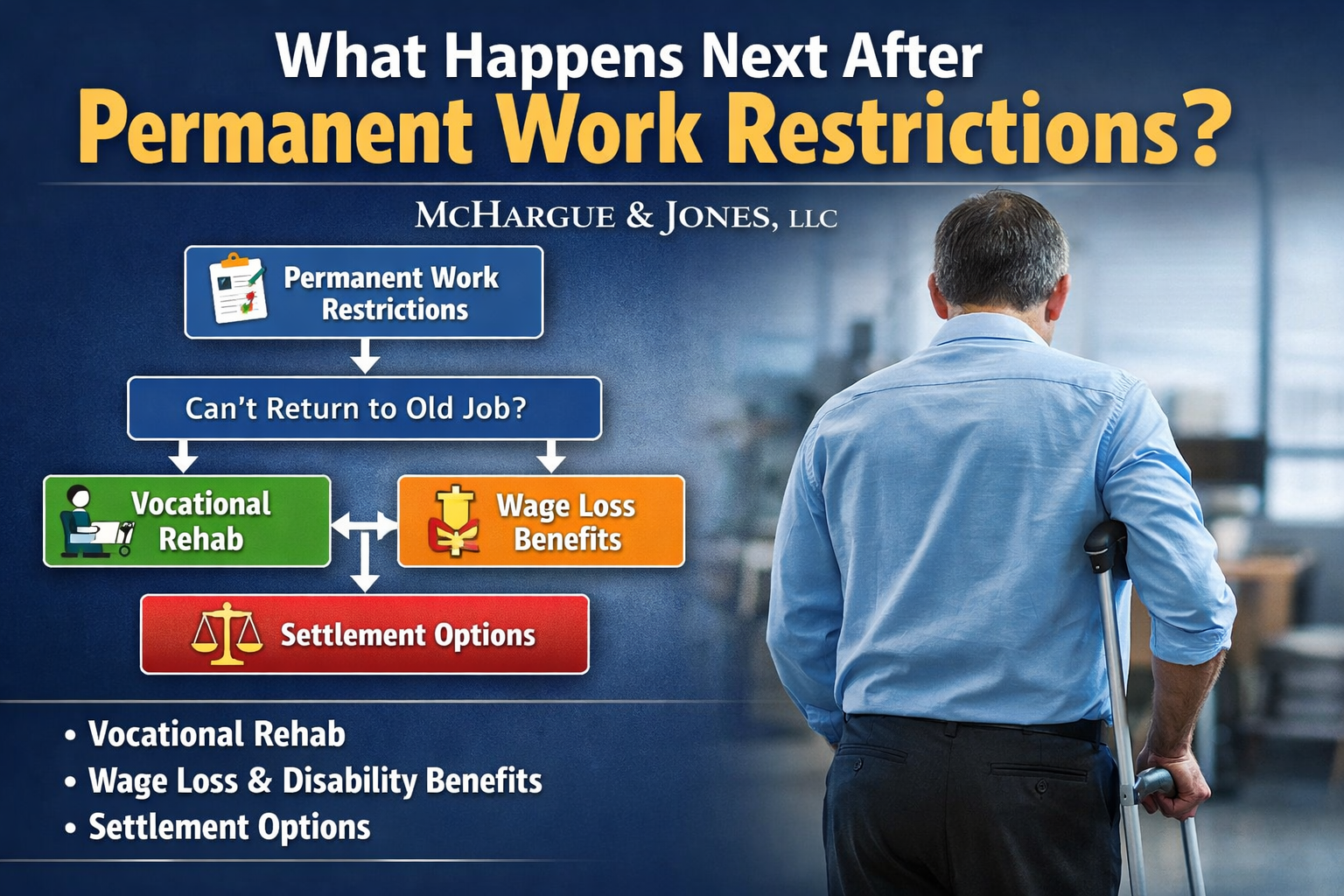
In most Illinois workers’ compensation cases, discharge with permanent restrictions is the start of a new phase of the claim. We need to figure out whether your employer can really accommodate those restrictions long term, whether a stable labor market exists for you if they cannot, whether you need a documented job search or vocational rehabilitation, and whether the case points toward wage differential, loss of trade / loss of occupation, man-as-a-whole PPD, or in the most serious cases permanent total disability.
This is also where a workers’ comp case often becomes much more about future earning power, employability, and settlement value than about treatment alone. If you want the big-picture value framework, also read my guides on what an Illinois workers’ compensation case may be worth, the Illinois workers’ compensation settlement chart, how FCEs and permanent restrictions affect settlement value, and the types of workers’ comp benefits available in Illinois.
Quick answer: what happens if I have permanent work restrictions?
If you are released with permanent work restrictions, your case usually turns on whether your employer can accommodate those restrictions in a real long-term job. If not, you may need to begin a documented job search, participate in vocational rehabilitation, seek maintenance benefits during that process, and evaluate whether the case supports a wage differential claim, a loss-of-trade or man-as-a-whole settlement, or in severe cases permanent total disability benefits.
The 5 questions that usually decide these cases
- What exactly are the permanent restrictions?
- Can the employer truly accommodate them on a permanent basis?
- If not, does a stable labor market exist for the worker?
- Will the worker need job search assistance, retraining, or vocational rehabilitation?
- Does the case fit best as wage differential, loss of trade, man-as-a-whole PPD, or PTD?
What permanent work restrictions really mean
In plain English, permanent restrictions mean your doctors do not expect you to return to unrestricted work. They believe the work injury has left lasting limits on what you can safely and consistently do.
That does not automatically mean:
- you can never work again;
- you automatically qualify for permanent total disability;
- your employer must create a permanent job for you;
- your case has one obvious settlement value; or
- the insurance company will fairly value the claim without a fight.
What it does mean is that your case shifts from being mostly a medical question to being a medical-plus-employment question. We are no longer just asking what treatment you need. We are asking what kind of work you can still do, whether that work actually exists in the real labor market, and how much the injury has changed your future earning power.
In many claims, the restrictions involve lifting, carrying, repetitive hand use, overhead reaching, standing, walking, climbing, kneeling, grip strength, or tolerance for sustained activity. Those details matter because a restriction that sounds moderate on paper may effectively take a union carpenter, nurse, warehouse worker, laborer, mechanic, driver, or machine operator out of the job they spent years doing.
Can your employer accommodate the restrictions?
Usually the first question after discharge with permanent restrictions is whether your employer can accommodate them and return you to work in a legitimate ongoing role.
Sometimes the answer is yes. A worker may return to the same employer in a modified role, a lighter assignment, a different department, or a supervisory position. But even then, the real questions are:
- Is the job real?
- Is it permanent?
- Does it genuinely fit the restrictions?
- Can you actually perform it day after day?
- Is the pay the same, lower, or uncertain?
Sometimes the answer is no. The employer may say it has no permanent work within restrictions, no open position, or no ability to commit to a long-term role.
And sometimes the employer gives the kind of vague answer that requires a much closer look. That happens all the time. A company may say it can “work with” restrictions, but when you dig into the actual duties, the position may not really exist in a meaningful long-term way.
Light duty is not always the same as permanent accommodation
This is one of the most important practical distinctions in these cases.
A worker may already be on light duty while still treating. Maybe the employer has been flexible. Maybe it found odd jobs or temporary tasks for the worker to perform while treatment was still ongoing. But that does not answer the permanent question.
There is a major difference between:
- temporary light duty during treatment, and
- a true permanent accommodation after discharge with permanent restrictions.
Employers are often willing to let someone do a make-work assignment for a while during treatment. Maybe they answer phones, do paperwork, monitor a gate, sort supplies, or do some other task that keeps them on payroll while the case is active. But that does not mean the employer has a legitimate permanent position it is willing to commit to after the worker reaches maximum medical improvement.
I often explain this to clients in very simple terms: an employer may be willing to let you “lick envelopes” for a few months while the case is open, but that does not make envelope-licking your long-term career. The real issue is whether there is an actual ongoing job with real duties, real hours, and a stable place in the company.
If the position would disappear the moment the workers’ comp pressure comes off, it may be temporary light duty, not a genuine permanent accommodation.
For background on temporary work issues, see my guide on light duty work in Illinois workers’ compensation.
What Our Clients Say
Real Google reviews from injured workers we’ve helped across Illinois.
Questions About Restrictions After a Work Injury? We Can Help.
Get your free Illinois workers’ comp case review. You don’t pay unless we win.
Or tap to call
(312) 739-0000
What happens if your employer cannot accommodate your permanent restrictions?
If your employer cannot accommodate your permanent restrictions, the case usually does not simply end. Instead, the claim often moves into one or more of these paths:
- a documented job search;
- vocational rehabilitation or retraining;
- maintenance benefits while participating in that process;
- a dispute over whether you are employable at all;
- a wage differential analysis if you can work but only at lower pay;
- a loss-of-trade or man-as-a-whole settlement analysis; or
- litigation over permanent total disability in the most severe cases.
Which path fits your case depends on the restrictions, your age, education, work history, transferable skills, wages, and what jobs actually exist for someone like you in the real world.
This is also where the case often gets more stressful for the injured worker. Treatment may be “over” on paper, but now the practical problem begins: no return to the old job, uncertainty about income, pressure from the insurer, and questions about whether you need to search for work to keep getting paid.
That is why this stage needs a real plan. It is often the point where a claim either gets developed properly or gets undervalued.
The real question is whether a stable labor market exists for you
One of the biggest mistakes in these cases is reducing the whole issue to: “Can this person do some job somewhere?”
That is not the real analysis.
The better question is whether a stable labor market exists for this worker considering the full picture:
- age;
- education;
- language ability;
- work history;
- licenses or certifications;
- transferable skills;
- physical restrictions;
- ability to sustain full-time work;
- local job availability; and
- whether the worker is actually competitive for the jobs that supposedly exist.
This is why I do not like simplistic arguments such as, “Maybe a family member can give you a desk job,” or, “Maybe you could be a file clerk somewhere.” That is not the real-world test.
If your uncle can bring you into his office for a while, that does not automatically prove employability in a stable labor market. The question is whether you could obtain and keep similar work elsewhere if that one opportunity dries up. Could you replicate it? Are employers generally hiring people with your background and restrictions for that kind of role? Are you actually competitive for those jobs?
That issue becomes especially important for older workers, workers with limited formal education, workers whose experience is tied to heavy labor, and workers whose restrictions remove the physical skills that used to drive their wages.
What to do right after you are released with permanent restrictions
The first few weeks after discharge with permanent restrictions are important. What you do here can affect both your benefits and the later value of the case.
- Get the restrictions in writing. Do not rely on a vague verbal summary. You want the actual written restrictions.
- Give the restrictions to your employer. Make sure there is a clear record that the employer received them.
- Find out exactly what the employer is offering. If they say they can accommodate you, ask what the job is, what the duties are, what the hours are, and whether the position is permanent.
- Do not assume make-work equals permanent employment. Temporary light duty and real accommodation are not the same thing.
- Keep records. Save emails, letters, job descriptions, pay information, and any employer statements about whether work is available.
- If no work is available, be ready for a job search. In many cases, keeping a good-faith, documented job search becomes important very quickly.
- Look closely at the restrictions themselves. If they are vague, incomplete, or inconsistent, the defense may exploit that.
- Talk to an experienced workers’ comp lawyer before accepting the defense narrative. A case that looks like a routine body-part claim may really be a wage differential or loss-of-trade case.
For related issues about wage checks and work status, see what to do if workers’ comp stopped your checks and how much workers’ comp pays in Illinois, including TTD, TPD, and maintenance.
Job search and vocational rehabilitation after permanent restrictions
If your employer cannot bring you back permanently, you may need to start a documented job search. In many cases, that means keeping a written record of applications, contacts, interviews, and job leads each week.
I often advise clients to expect a serious, organized search with something like 7 to 10 quality job leads per week, depending on the case. This is not busywork. It can become evidence. If later we need to prove that you made a good-faith effort to find work and the market did not respond, that job log may matter a great deal.
But a job search alone is not always enough. Many cases call for vocational rehabilitation. That may include:
- a vocational interview;
- review of your restrictions and medical records;
- transferable skills analysis;
- vocational testing;
- a labor market survey;
- job placement help;
- resume and interview assistance; or
- formal retraining or education.
I have had clients doing ESL classes, GED classes, and other retraining while workers’ comp paid benefits through the process. In the right case, that may be exactly what should happen. In other cases, the vocational process helps prove the opposite point: that even with training or placement assistance, the worker still does not have a realistic place in the labor market.
My own approach is usually aggressive here. I do not like waiting around for the insurance company to decide who they want to use, when they want to do the evaluation, and whether they feel like moving the case along. Sometimes it makes more sense to build the vocational proof early, even if that means advancing the expense and fighting later over reimbursement.
A strong vocational record can shape both trial posture and settlement value. It often clarifies whether the claim is really about reemployment, wage loss, loss of trade, or total disability.
Maintenance benefits while retraining or searching
If the case moves into vocational rehabilitation, maintenance benefits may become a major issue. Workers often confuse maintenance with temporary disability, but it comes up in a different context.
Maintenance benefits can come into play when the case has moved beyond basic treatment and the worker is participating in approved rehabilitation efforts, job placement, retraining, or other return-to-work services.
This is also where it is important to distinguish between:
- temporary restrictions during active treatment, and
- permanent restrictions after discharge.
If the issue is really that your employer cannot accommodate your temporary restrictions while you are still healing, that usually belongs in a separate discussion focused on light duty, TTD, TPD, and maintenance, and what happens when the employer will not provide work within temporary restrictions.
This post is about what happens after you are released with permanent restrictions, but readers often confuse those two situations, so the distinction matters.
When permanent restrictions may lead to permanent total disability benefits
The most serious outcome is a claim for permanent total disability. That generally means the worker is effectively removed from the labor market because no stable employment is realistically available, even after considering rehabilitation or placement efforts.
PTD is not common, and it is not easy to prove. A worker is not permanently and totally disabled just because they cannot return to the exact same job they had before the injury. The burden is much higher than that.
Usually, a PTD case requires strong proof on several fronts:
- clear permanent medical restrictions;
- credible evidence that the worker cannot sustain regular employment;
- vocational support showing there is no stable labor market; and
- often evidence that job search or rehabilitation efforts did not produce real options.
These are often sad cases. They involve workers whose injury has taken them not just out of one job, but out of meaningful work entirely. When that is truly the situation, we pursue it. But PTD is not something to claim casually. It requires a serious evidentiary record.
When permanent restrictions may lead to wage differential benefits
A very common outcome is that the worker can still work, but not at the same pay level. That is where a wage differential claim may become central.
These cases are especially important for union workers, skilled tradespeople, and other workers whose pre-injury wages were tied to physically demanding work they can no longer perform. A worker who used to earn strong trade wages may now be limited to lighter work paying much less. That difference can dramatically change the value of the case.
But not every restrictions case should automatically be pushed into a wage differential framework. The numbers matter. The worker’s age matters. The future work outlook matters. In some cases, especially with older workers, a pure wage differential theory may not be the best route compared with a strong loss-of-trade or man-as-a-whole argument.
That is why I do not like one-size-fits-all advice here. A smart analysis asks not just whether wage differential is available, but whether it is the best strategic outcome based on the facts of this particular case.
When the case is really about loss of trade or loss of occupation
Sometimes the worker is still employable and may even be able to earn respectable money after the injury, but the injury has permanently taken them out of the trade, occupation, or career path they spent years building.
That is a very different kind of harm than a simple scheduled-loss analysis captures.
Maybe you were a union carpenter, ironworker, electrician, mechanic, laborer, nurse, driver, or machine operator. Maybe you spent years developing a specialized skill set, wage scale, seniority, and career path in that role. If the injury permanently closes the door on that field, the case may belong in a more serious man-as-a-whole or loss-of-trade / loss-of-occupation framework.
In practice, these cases often end up in a range far above what the defense wants to offer when it is pretending the injury is “just” a hand case, shoulder case, back case, or other body-part case. Why? Because the injury did more than damage a body part. It damaged the worker’s place in the labor market.
This is also where many settlement fights happen. The insurance company may argue that your new work is “close enough” to your old trade, or that you still have similar skills, or that the new job is basically a continuation of what you did before. Sometimes that is true. Sometimes it is nonsense. The job descriptions, physical demands, tools used, independence level, required skills, and market value all matter.
When the facts support it, a loss-of-trade argument can significantly increase case value compared with a more mechanical scheduled-loss approach. For value background, see my Illinois workers’ compensation settlement chart.
How permanent restrictions affect settlement value
Permanent restrictions often have a major impact on case value, but not because there is some easy formula that says one restriction equals one number.
The value question usually depends on a chain of issues:
- How strong and specific are the medical restrictions?
- Can the pre-injury employer accommodate them long term?
- If not, what other work can the injured worker actually get?
- What will that work pay?
- Has the worker lost access to a trade or occupation?
- Do we have strong vocational evidence?
- Are we valuing the case as scheduled loss, man-as-a-whole, wage differential, or PTD?
This is why permanent restrictions are such a major pivot point. A case that looked like a normal body-part settlement while treatment was still ongoing can become something very different once the worker is discharged and the labor-market consequences come into focus.
In many cases, that is also when the defense begins trying to narrow the case and frame it as something smaller than it really is. That is often where aggressive lawyering matters most.
If you are trying to understand the bigger value picture, I would also read these questions to ask about a workers’ comp settlement offer and when an Illinois workers’ comp case may settle.
Why the details of the restrictions matter
A lot of the case turns on how well the restrictions are actually defined.
A vague opinion such as “sedentary work only” or “no heavy lifting” may sound useful, but those labels often leave too much room for argument. The more precise the restrictions are, the better we can analyze employability and value.
The details that often matter include:
- maximum lifting amount;
- occasional versus frequent use;
- floor-to-waist, waist-to-shoulder, or overhead tolerance;
- standing and walking endurance;
- repetitive hand use and grip strength;
- climbing, kneeling, squatting, or crawling tolerance;
- whether the worker can use tools safely; and
- whether the worker can sustain the activity full time on a reliable basis.
Sometimes we already have a strong FCE. Sometimes we need a better one. Sometimes we need to depose the doctor to clarify what the restrictions actually mean. Sometimes the treating doctor and the IME are not even speaking the same language about work capacity. Those details often drive the whole next phase of the case.
If you want a deeper dive into this issue, read how FCEs and permanent restrictions affect workers’ compensation settlements in Illinois.
A practical example
Suppose a 40-year-old union carpenter suffers a serious hand injury with bad fractures. Before the injury, he is making around $40 per hour. After treatment, he is released with permanent restrictions.
If he can still return to union carpentry, the case may remain a more conventional hand case. But if the restrictions prevent him from doing the actual physical demands of the trade, everything changes.
Now maybe he can only earn $17 to $25 per hour in lighter work. Or maybe he can use his construction knowledge in a different role, such as sales, estimating, installation supervision, or field coordination. That may still be good money, but it is not the same labor-market position he held before.
At that point, we have to run the real analysis:
- Is this primarily a wage differential case?
- Is it stronger as a loss-of-trade or loss-of-occupation case?
- Are the new job duties really comparable to the old trade, or is that just a defense talking point?
- What do the future earnings numbers look like?
- How would an arbitrator likely view the labor-market change?
I have handled cases like this where the defense tried to argue that the worker’s new job was close enough to the old line of work that the case should be valued much lower. We pushed back by comparing the positions in detail: duties, tools, skill overlap, physical demands, actual day-to-day work, and what the worker had really lost. That kind of detailed comparison can make a major difference. In one such case, forcing that issue materially changed the settlement posture.
That is why I tell clients that discharge with permanent restrictions is not a conclusion. It is the beginning of the serious proof and valuation process.
This process can take weeks, months, or even years
Workers often want to know how quickly this gets resolved. The honest answer is that it varies a lot.
Some cases resolve fairly quickly because the employer clearly cannot accommodate, the restrictions are well-defined, the vocational picture is obvious, and both sides see the value range.
Other cases take much longer because important questions remain disputed:
- Are the restrictions accurate?
- Does the employer really have a permanent job available?
- Is the worker making a sufficient job search?
- Should vocational rehabilitation be started?
- What jobs actually exist?
- Is this a wage differential case or a man-as-a-whole case?
- Does the defense need to be pushed into a realistic settlement posture through motion practice, pretrial, or trial preparation?
In more complex cases, it may take doctor depositions, vocational experts, labor market surveys, FCE disputes, and substantial negotiation before the real value becomes clear.
What I want injured workers to understand at this stage
The biggest mistake I see is workers assuming that discharge with permanent restrictions automatically tells them what their future looks like. It does not.
It is really the start of the next set of questions:
- Can the employer truly keep you?
- If not, what does the real labor market look like for you?
- Do you need to search for work to protect benefits?
- Do you need vocational help?
- Did the injury take you out of your trade?
- Are you facing lower future earnings?
- Do the restrictions need to be sharpened or defended?
- What is the best strategy to maximize the value of the case?
Those are the questions that decide outcomes.
Frequently asked questions about permanent work restrictions in Illinois workers’ comp
What happens if I am released with permanent work restrictions?
Your case moves into a new phase where the key questions are whether your employer can accommodate the restrictions, whether you need a job search or vocational rehabilitation, and whether the long-term effect of the injury supports wage differential, loss of trade, man-as-a-whole PPD, or permanent total disability.
Can my employer fire me if they cannot accommodate permanent restrictions?
Workers’ compensation does not guarantee that your employer must create a permanent job for you. The core issue is usually whether work exists within your restrictions and what benefits or settlement theories may apply if it does not.
Do permanent restrictions mean I cannot work anymore?
Not necessarily. Permanent restrictions mean you have lasting limits, but many injured workers can still work in some capacity. The harder question is whether a stable labor market exists for work you can actually perform and obtain.
What if my employer says they have work for me, but it seems made up?
That happens. A temporary or make-work assignment is not always a true permanent accommodation. The position should be examined closely to see whether it is real, stable, within restrictions, and likely to continue.
Will I have to look for jobs to keep getting paid?
In many cases, yes. If your employer cannot accommodate permanent restrictions, a documented job search may become important, especially if employability is disputed or vocational rehabilitation is being considered.
What is the difference between wage differential and loss of trade?
Wage differential focuses on reduced earnings after the injury. Loss of trade or loss of occupation focuses more broadly on the worker being forced out of a career path, trade, or earning position even if some alternative employment still exists.
Can permanent restrictions increase the value of my case?
Yes, sometimes substantially. Permanent restrictions can change a case from a more limited scheduled-loss analysis into a much larger wage differential, man-as-a-whole, or loss-of-trade evaluation.
Does an FCE matter if I already have restrictions from my doctor?
Often yes. In some cases an FCE helps define the restrictions more precisely. In other cases it creates disputes that need to be addressed. The details of your actual work capacity often matter a great deal.
Talk to an Illinois workers’ compensation lawyer about permanent restrictions
If you have been released with permanent work restrictions and your employer cannot bring you back, your case may involve much more than a routine settlement discussion. These cases often require careful medical review, real-world employability analysis, vocational evidence, and a strategy for maximizing value.
Start with our main Illinois workers’ compensation page, my guide on what workers’ comp pays in Illinois, my page on types of workers’ comp benefits, my guide on light duty work, and the Illinois workers’ compensation settlement chart. You can also learn more about me here: Matthew C. Jones.
If you need help analyzing permanent restrictions, job loss, vocational rehabilitation, wage differential, or loss-of-trade issues, contact us through McHargue & Jones.