

Do Permanent Work Restrictions Increase My Workers’ Comp Settlement Value in Illinois?
Quick answer: do permanent restrictions increase settlement value?
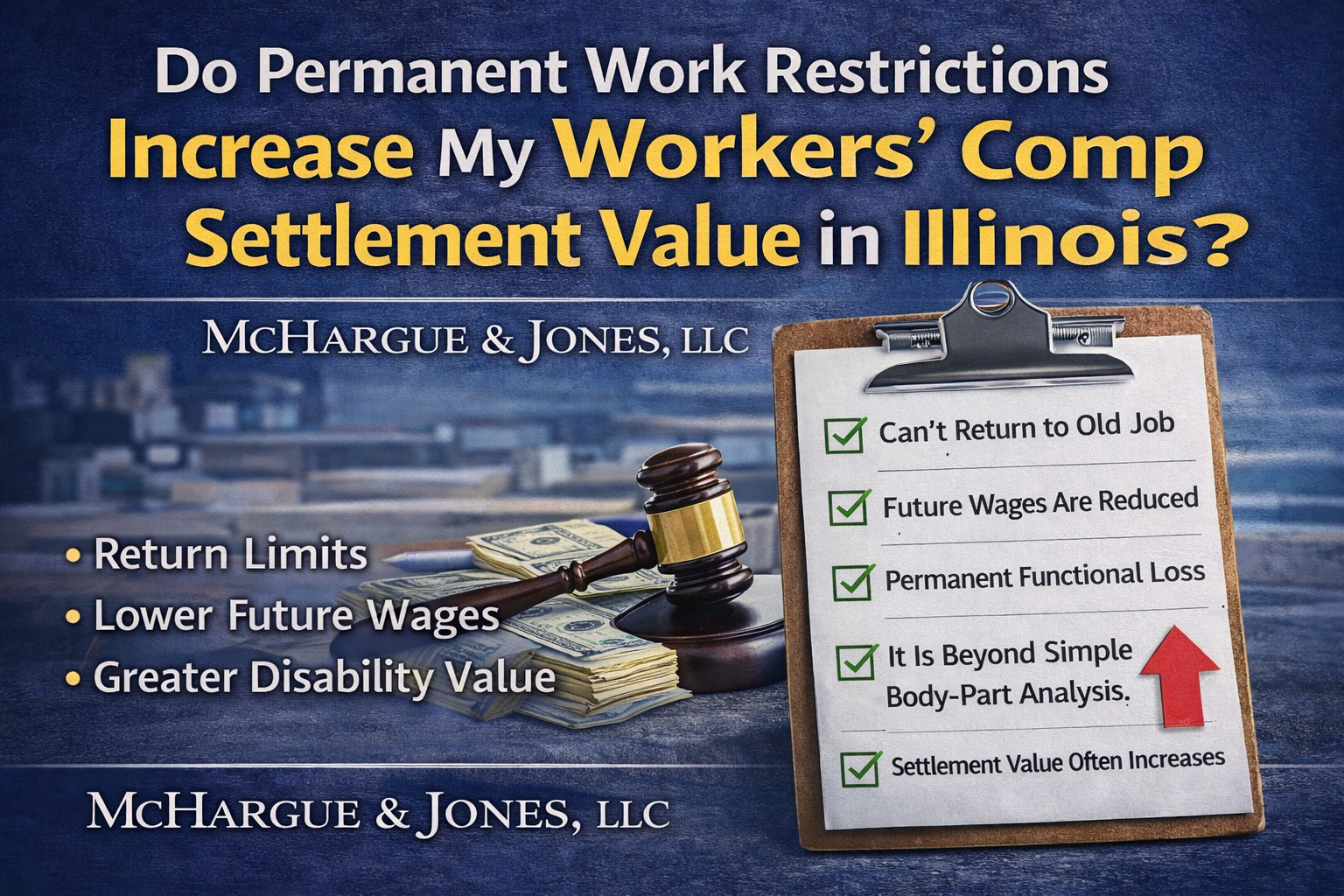
Yes, permanent work restrictions often increase workers’ comp settlement value because they may prove lasting disability, reduced earning capacity, and an inability to return to the same job. The increase is usually greatest when the restrictions prevent a return to the old employer or old trade, reduce wages, or support a more serious disability analysis than a simple body-part settlement.
The short answer
Permanent restrictions often increase settlement value, sometimes significantly. That is especially true when they affect one or more of these issues:
- your ability to return to your old job,
- your ability to return to your old trade or occupation,
- your future earnings,
- the seriousness of the permanent disability argument, or
- whether the case should be valued as more than a simple scheduled-loss claim.
That said, restrictions do not increase value in a vacuum. A mild permanent restriction that does not affect your real job or wages may not change the case nearly as much as a restriction that takes you out of heavy labor, union work, repetitive hand use, overhead work, or another physically demanding role.
Why permanent restrictions can raise case value
Permanent restrictions matter because they often prove that the injury did not simply heal and go away. They show a lasting change in what you can safely do at work.
That can increase settlement value by showing:
- lasting functional loss,
- a stronger permanent disability picture,
- reduced ability to perform your pre-injury job,
- reduced earning capacity, or
- a more serious long-term effect on your place in the labor market.
In many real cases, the restrictions matter more than the diagnosis label. Two workers can have the same body part injured, but if one returns full duty and the other ends up with permanent restrictions that change future work options, the settlement picture may be very different.
If you want the medical-and-proof side of this issue, read how FCEs and permanent restrictions affect workers’ compensation settlements in Illinois.
What Our Clients Say
Real Google reviews from injured workers we’ve helped across Illinois.
Worried About How Permanent Restrictions May Affect Your Case?
We help workers after career-altering injuries. Contact us today for a free consultation.
Or tap to call
(312) 739-0000
Permanent Restrictions After an Amputation Can Change the Value of the Case
Amputation cases show why permanent restrictions can matter more than the body-part chart alone. The insurance company may focus on the statutory value of the lost finger, hand, foot, arm, leg, or toe. But if the amputation prevents the worker from returning to the same job, using tools safely, standing or walking for long periods, operating equipment, or earning the same wages, the case may involve much more than a scheduled-loss payment.
In serious cases, an amputation may support vocational rehabilitation, wage differential benefits, loss-of-trade value, or permanent total disability. For more, read:
How Much Is an Amputation Worth in Illinois Workers’ Comp?
When restrictions matter most
- you cannot return to your pre-injury employer,
- you cannot return to your old trade or occupation,
- you can work, but only at lower wages,
- the restrictions move the case beyond a simple body-part settlement analysis, or
- the overall claim now points toward wage differential, loss of trade, or broader man-as-a-whole value.
That is why permanent restrictions often become a major turning point in a case. They can change the conversation from “what body part is involved?” to “what has this injury done to your long-term ability to earn a living?”
For the broader process after discharge with restrictions, read permanent work restrictions: what happens next in Illinois workers’ comp.
When they may not add much
Permanent restrictions do not always make a case worth dramatically more.
Sometimes the restrictions are real, but they do not meaningfully change the worker’s actual job duties, wages, or future work options. If a worker returns to the same employer, keeps the same pay, and the restrictions do not materially affect earning power, the increase in value may be more limited.
That is why the better question is not just, “Do I have permanent restrictions?” The better question is, “What do those restrictions actually change?”
Why MMI matters before valuing a case
Meaningful settlement analysis usually happens at or near maximum medical improvement (MMI). That is when the doctors are finally in a position to say whether you still need treatment, whether the restrictions are permanent, and how the injury affects your long-term work ability.
Before that, you may be guessing about future treatment, future restrictions, and future wage loss. That is one reason settling too early can be risky.
For more on timing, read when an Illinois workers’ comp case may settle.
Simple examples
Same injury, different outcome
Two workers may have the same shoulder, back, knee, or hand injury. One returns full duty with no restrictions. The other ends up with permanent lifting, repetitive-use, or overhead restrictions. The second case is often worth more because the long-term work impact is greater.
Same surgery, different wage picture
Two workers may both have surgery. One returns to the same job and same pay. The other cannot return to heavy labor and has to take lower-paying work. The second case may be worth more because the restrictions affect future earnings, not just the body part.
Same body part, different occupation
A hand or back restriction may affect an office worker differently than it affects a union carpenter, welder, mechanic, warehouse worker, or nurse. Restrictions often add more value when they interfere with the actual work that used to drive the worker’s wages.
Frequently asked questions about permanent restrictions and settlement value
Do permanent work restrictions increase workers’ comp settlement value?
Often, yes. Permanent restrictions can increase value when they show lasting functional loss, prevent a return to the old job, reduce earning capacity, or support a more serious disability analysis.
Do restrictions automatically mean my case is worth more?
No. The real question is whether the restrictions actually affect your work, wages, and long-term function.
Can permanent restrictions make my case worth more than the settlement chart suggests?
Yes. In some cases, permanent restrictions show that the chart is only a starting point and that the real issue is broader work loss or future earning-capacity damage.
Should I settle before I know whether I will have permanent restrictions?
Usually that is risky. Until you reach MMI and know your long-term outcome, it is often impossible to fairly value the case.
Talk to an Illinois workers’ compensation lawyer about how permanent restrictions affect value
If you have been released with permanent restrictions, your case may be worth more than a simple chart estimate suggests. The real question is how those restrictions affect your ability to return to work, earn wages, and compete in the labor market.
Start with my broader guides on what an Illinois workers’ compensation case may be worth, the Illinois workers’ compensation settlement chart, and what happens next after permanent work restrictions. You can also start on our main Illinois workers’ compensation page or learn more about me here: Matthew C. Jones.