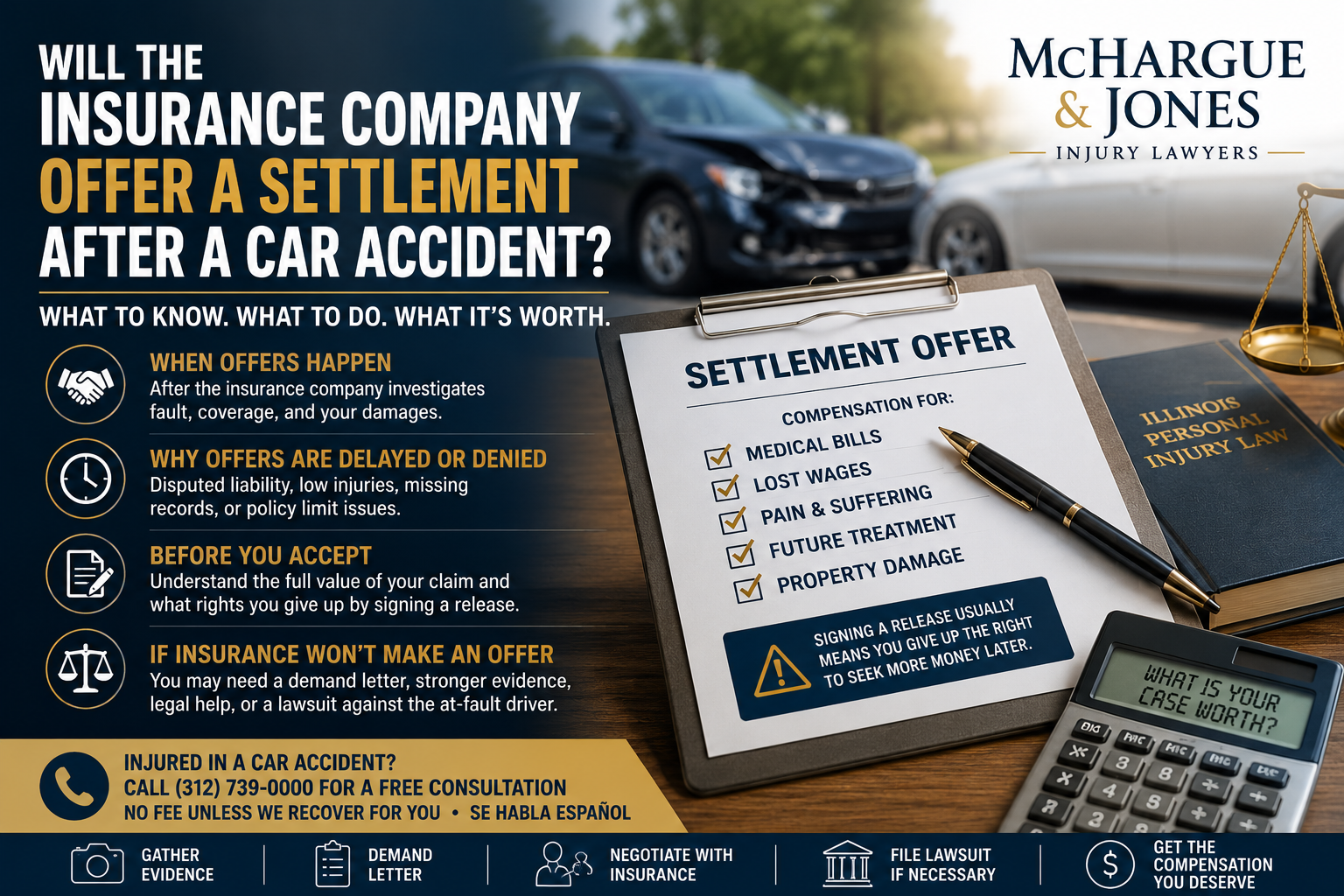


Will the Insurance Company Offer a Settlement After a Car Accident in Illinois?
Sometimes an offer comes quickly. Sometimes it comes only after a formal demand letter. Sometimes the insurance company makes a low offer. And sometimes it refuses to make any offer at all because it disputes fault, injury causation, medical treatment, policy coverage, or the value of the claim.
Before you accept any car accident settlement, understand this: the insurance company usually requires you to sign a release. A release typically ends your right to bring any further claim against the at-fault driver or insurance company for that crash. The Illinois Department of Insurance explains that a third-party claim is a claim against the other driver’s insurance company, and the Illinois State Bar Association explains that insurers generally require a release before compensation is paid.
If you were injured in a crash in Chicago or anywhere in Illinois, McHargue & Jones helps car accident victims deal with insurance companies, settlement offers, policy limits, medical bills, lost wages, and injury claims. Call (312) 739-0000 for a free consultation. You do not pay unless we recover for you. Se habla español.
Did the insurance company offer money after your crash?
Before you sign a release or accept a settlement, McHargue & Jones can review the offer, the injuries, the medical bills, the policy limits, and the value of your Illinois car accident claim.
Start Your Free Case Review
Or call (312) 739-0000
Will Insurance Automatically Offer a Settlement After a Car Accident?
No. Insurance companies do not automatically offer a fair settlement just because a crash happened. The adjuster’s job is to evaluate whether the insured driver is legally responsible and, if so, how much the claim is worth under the available insurance coverage.
In a simple property-damage claim, the insurance company may make a repair or total-loss offer relatively quickly. A bodily injury claim is different. If you have neck pain, back pain, a concussion, a shoulder injury, surgery, injections, lost wages, or ongoing treatment, the insurance company may wait until it has enough medical information to evaluate the claim.
That does not mean you should wait forever. It means the offer usually depends on the evidence. The stronger and more complete the evidence, the harder it is for the insurer to ignore the claim or make a meaningless offer.
What Has to Happen Before the Insurance Company Makes an Offer?
Most car accident settlement offers happen after the insurance company has investigated three big issues: fault, damages, and coverage.
Fault means who caused the crash. The adjuster may review the police report, photos, vehicle damage, witness statements, recorded statements, traffic citations, intersection facts, dashcam footage, and statements from both drivers. If the insurance company believes its driver was not responsible, or that you were mostly responsible, it may refuse to make an offer.
Damages means what the crash caused. In an injury claim, that usually includes medical treatment, pain and suffering, lost wages, future treatment risk, permanent symptoms, scarring, disability, and how the injury affected your daily life. If the insurance company does not have your records or does not believe the treatment is related to the crash, it may delay or undervalue the claim.
Coverage means how much insurance is available and whether the policy applies. A strong injury case can still be limited by the at-fault driver’s insurance policy. For a deeper explanation, read our guide on how insurance policy limits work in Illinois car accident cases.
When Will the Insurance Company Make a Settlement Offer?
There is no single timeline. Some offers happen quickly, especially if liability is clear and the injuries are minor. More serious injury claims usually take longer because the insurer wants to see the full medical picture.
In many Illinois car accident cases, the bodily injury settlement process looks like this:
You get medical treatment. Your condition either improves or becomes more clearly defined. Your medical bills and records are collected. Lost wage information is documented. A demand package is submitted to the insurance company. The adjuster reviews the demand, asks questions, and either makes an offer, denies liability, or requests more information.
That process is not always smooth. Insurance companies may delay because treatment is ongoing, records are missing, liability is disputed, there are questions about pre-existing conditions, or the adjuster is trying to see whether you will accept less than the claim is worth.
If you are still early after the crash, start with our step-by-step guide on what to do after a car accident in Chicago.
Why Would Insurance Refuse to Make a Settlement Offer?
If the insurance company will not make an offer, it usually has a reason. The reason may be fair, unfair, or simply a negotiating position. But you need to know what the obstacle is before you can respond intelligently.
Common reasons an insurer may refuse to make an offer include disputed fault, incomplete medical records, treatment gaps, low visible property damage, questions about whether the injuries came from the crash, pre-existing condition arguments, lack of a formal demand, policy coverage problems, or a belief that your claimed damages are not supported.
Illinois also uses modified comparative negligence. The Illinois Department of Insurance explains that an injured party may recover damages only if they are less than 50% at fault, and any recovery may be reduced by that person’s percentage of fault. If the insurance company believes you were mostly responsible for the crash, it may refuse to pay or make only a reduced offer.
That does not mean the insurance company is right. Adjusters sometimes overstate fault, minimize injuries, ignore important medical facts, or undervalue pain and suffering. But if the insurer will not make an offer, you usually need evidence and pressure—not just repeated phone calls.
What Should You Do If Insurance Will Not Make an Offer?
If the insurance company will not make an offer, the first step is to find out why. Ask the adjuster whether the issue is liability, missing records, medical causation, policy coverage, treatment value, lost wages, or something else. A vague “we are still reviewing” is not enough if the claim has been pending for a long time.
Next, make sure the claim is documented. A serious injury claim usually needs medical records, bills, photos, wage documentation, proof of lost time, a clear explanation of the crash, and a settlement demand that explains why the other driver is responsible.
If the insurance company still refuses to make a reasonable offer, the next step may be legal action. In Illinois, the claim is usually against the at-fault driver, not simply a direct lawsuit against the other driver’s insurance company. The insurance company then defends and indemnifies its insured under the policy, if coverage applies.
Do not let negotiations drag past the legal deadline. Under Illinois law, most personal injury lawsuits must be filed within two years of the injury. Waiting for an insurance adjuster to “get back to you” does not automatically protect the statute of limitations.
Should You Accept the First Insurance Settlement Offer?
Not without understanding what you are giving up. The first offer may be reasonable in some property-damage-only claims, but injury claims require more caution. Once you sign a release, you usually cannot come back later for more money if your pain gets worse, you need more treatment, you miss more work, or a doctor recommends surgery. Read more here about what to do with the first offer after a car accident in Illinois.
Before accepting a bodily injury settlement, you should know the full picture: your diagnosis, medical bills, future treatment needs, wage loss, pain and suffering, permanency, insurance policy limits, health insurance liens, medical provider balances, and attorney fees if you are represented.
If you are trying to evaluate the number, read our guide on what a car accident case may be worth in Illinois.
Why Are Some Settlement Offers So Low?
Low offers are common. The insurance company may argue that the crash was minor, your treatment was too long, your bills are too high, your injuries are pre-existing, your pain should have resolved sooner, or you were partly at fault.
Sometimes the offer is low because the adjuster does not have the full evidence. Sometimes it is low because the insurer is testing whether you will accept less. Sometimes it is low because the available insurance limits are small. And sometimes the insurer is simply undervaluing the case.
This is where documentation matters. Medical records, consistent treatment, imaging, therapy notes, specialist opinions, lost wage records, photographs, and witness statements can all affect whether the insurer increases the offer.
How Policy Limits Affect Settlement Offers
A settlement offer is not based only on how badly you were hurt. It is also affected by how much insurance is available. If the at-fault driver has a small policy, there may be a gap between the full value of the injury and the available liability coverage.
That is why policy limits matter so much in serious injury cases. A $25,000 liability policy can become a major problem if the injured person has an ambulance bill, emergency room visit, MRI, injections, surgery recommendation, or months of lost wages. In those cases, your own uninsured or underinsured motorist coverage may also become important, depending on the facts and your policy.
For more, read our guide on Illinois car accident policy limits.
How Much Do You Keep From a Settlement?
The gross settlement amount is not always the amount you take home. Medical bills, health insurance liens, Medicare or Medicaid issues, unpaid provider balances, case expenses, and attorney fees can all affect the net recovery.
This is why a settlement can look better on paper than it feels in real life. A $25,000 settlement, $50,000 settlement, or $100,000 settlement may produce very different net results depending on the medical bills, liens, and fee structure.
If you are comparing numbers, see our detailed guide: How Much of a $25K, $50K, or $100K Car Accident Settlement Do You Keep in Illinois?
Do You Need a Lawyer Before the Insurance Company Makes an Offer?
Not every minor property-damage claim requires a lawyer. If no one was hurt and the issue is only a repair estimate, rental car, or total-loss value, you may be able to handle the claim yourself.
But if you were injured, the claim is different. You should strongly consider speaking with a lawyer if the insurance company blames you, delays the claim, refuses to make an offer, offers too little, asks for a recorded statement, disputes your medical treatment, says your injury is pre-existing, or wants you to sign a release before you know the full extent of your injury.
Many people wait too long because they are worried about cost. In most Illinois car accident injury cases, personal injury lawyers work on a contingency fee, meaning there is no upfront attorney fee and the lawyer is paid only if money is recovered. For more detail, read: How Much Does a Car Accident Lawyer Cost in Illinois?
What If the Insurance Company Offers the Policy Limits?
A policy-limits offer can be a good sign, but it does not automatically mean the case is over. You still need to understand whether there are medical liens, underinsured motorist issues, multiple injured people, coverage problems, or other available sources of recovery.
You also need to be careful with the release. A release may affect claims against the at-fault driver, the insurance company, or potentially other parties depending on the language. Do not assume every release is standard or harmless.
Before accepting policy limits, it is often wise to have a lawyer review the available coverage, the release, the lien situation, and whether any underinsured motorist claim may exist.
Bottom Line: Will Insurance Offer a Settlement After a Car Accident?
Insurance may offer a settlement after a car accident, but only when the insurer believes there is enough information to evaluate liability, damages, coverage, and risk. The offer may come quickly in a simple claim, but serious injury cases often require medical documentation, a demand package, negotiation, and sometimes litigation pressure.
If the insurance company will not make an offer, makes a low offer, or asks you to sign a release before you understand your injuries, do not assume that is the best you can do. The next step may be gathering stronger evidence, making a formal demand, identifying policy limits, protecting the statute of limitations, or filing a lawsuit if settlement negotiations fail.
McHargue & Jones represents car accident victims in Chicago and throughout Illinois. We help clients evaluate settlement offers, deal with insurance adjusters, identify policy limits, resolve medical bills and liens, and pursue fair compensation for injuries caused by negligent drivers.
Call (312) 739-0000 or start your free case review online. No fee unless we recover for you. Se habla español.
FAQ: Insurance Settlement Offers After a Car Accident
Will the insurance company automatically offer a settlement after a car accident?
No. The insurance company usually makes a settlement offer only after it investigates fault, damages, coverage, medical treatment, and the value of the claim. If liability or injury causation is disputed, the insurer may delay or refuse to make an offer.
How long does it take to get a settlement offer after a car accident?
It depends on the case. Property-damage offers may come quickly. Bodily injury offers often take longer because the insurance company wants to review medical records, bills, treatment history, lost wages, and whether the injuries have resolved or become permanent.
What should I do if insurance will not make an offer?
Ask the adjuster to explain the reason. The issue may be liability, missing records, medical causation, policy coverage, or claim value. If the insurer still refuses to make a reasonable offer, you may need a formal demand, stronger evidence, legal representation, or a lawsuit against the at-fault driver before the statute of limitations expires.
Should I accept the first settlement offer?
Not before you understand the full value of your claim and what rights you are giving up. The first offer may not account for future treatment, pain and suffering, lost wages, liens, or the long-term impact of your injury.
Can an insurance company make an offer before I finish treatment?
Yes, but accepting an early offer can be risky. If you settle before you know the full extent of your injury, you may be giving up the right to recover more money later if your condition worsens or you need additional treatment.
Why is the insurance settlement offer so low?
Low offers may happen because the insurer disputes fault, questions your injuries, argues your treatment was excessive, points to pre-existing conditions, relies on low property damage, or believes the claim can be settled cheaply. A low offer is not always the final offer.
Does the insurance company have to pay my medical bills after a crash?
The at-fault driver’s insurance company does not usually pay medical bills as they come in. Instead, medical bills are typically part of the bodily injury settlement. Health insurance, MedPay, or other coverage may affect how bills are handled while the injury claim is pending.
What happens when I sign a release?
A release usually means you accept the settlement money in exchange for giving up any further claim against the at-fault driver or insurance company for that crash. You should understand the release before signing it.
How do policy limits affect a car accident settlement offer?
Policy limits can cap how much the at-fault driver’s insurer will pay. If your damages are greater than the available liability coverage, underinsured motorist coverage or other sources of recovery may become important depending on the facts.
Do I need a lawyer if insurance already made an offer?
You may not need a lawyer for a minor property-damage-only claim. But if you were injured, the offer is low, policy limits are involved, medical bills or liens exist, or you are being asked to sign a release, it is wise to get legal advice before accepting.
Disclaimer: This article is for general information only and is not legal advice. Reading this article does not create an attorney-client relationship. Every Illinois car accident case depends on its own facts, injuries, medical records, insurance coverage, deadlines, liability evidence, and applicable law. Prior results do not guarantee a similar outcome.