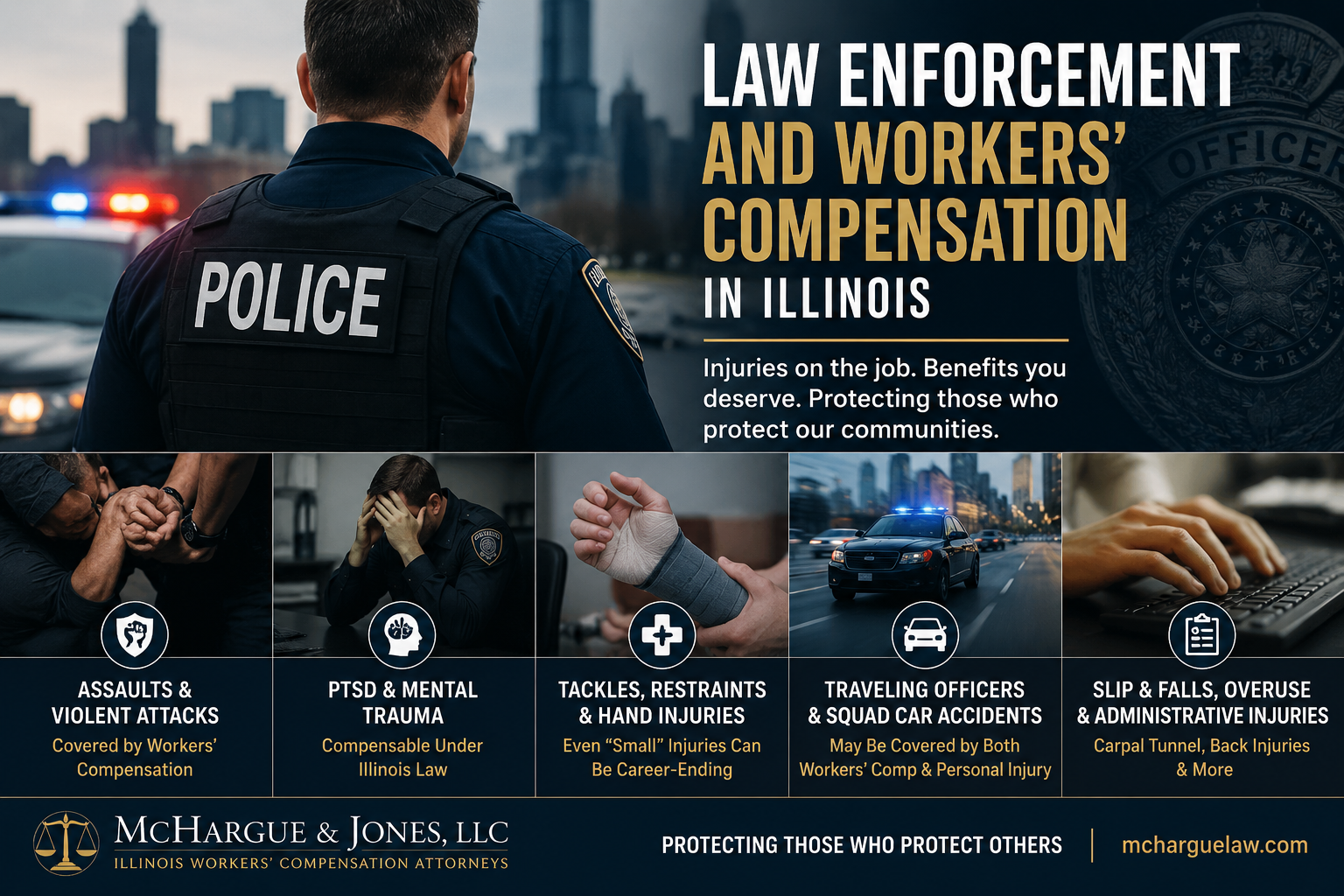


Illinois Workers’ Compensation for Police Officers, Sheriffs, and Law Enforcement Injuries
Many Illinois police officers, sheriff’s deputies, correctional officers, jail staff, state troopers, and other law enforcement employees may be entitled to workers’ compensation benefits when they are injured in the line of duty. These claims can involve obvious traumatic events, such as shootings, inmate attacks, violent arrests, and squad car crashes, but they can also involve smaller forceful moments that cause serious injuries, such as a shoulder being jerked during an arrest or a wrist twisting while trying to apply handcuffs.
Law enforcement work is physically and psychologically demanding. A compensable injury does not have to come from a dramatic brawl. It may come from a sudden pull, push, fall, foot chase, takedown, training exercise, squad car crash, slip and fall, repetitive administrative work, or traumatic incident that causes PTSD.
One important exception: Chicago police officers are treated differently under Illinois workers’ compensation law. The Illinois Workers’ Compensation Act excludes duly appointed members of a police department in a city with a population over 500,000. That is why Chicago police injury claims may involve different benefit systems, pension issues, contracts, ordinances, or other remedies. This page focuses mainly on Illinois law enforcement workers who are covered by the Illinois Workers’ Compensation Act, including many municipal officers outside Chicago, sheriff’s deputies, correctional officers, jail staff, state police, and other public law enforcement employees.
At McHargue & Jones, we represent injured workers throughout Illinois in serious workers’ compensation cases involving law enforcement injuries, PTSD, assaults, permanent restrictions, denied benefits, disputed surgery, and workers who cannot safely return to their prior jobs. Call (312) 739-0000 for a free consultation. You do not pay unless we recover for you. Se habla español.
Injured in law enforcement work?
If you were hurt restraining someone, responding to a call, working in a jail, driving a squad car, or dealing with PTSD after a traumatic incident, McHargue & Jones can review your Illinois workers’ comp case for free.
Start Your Free Case Review
Or call (312) 739-0000
Are Police Officers and Law Enforcement Workers Covered by Illinois Workers’ Compensation?
Many are, depending on the employer and the worker’s status. The Illinois Workers’ Compensation Act includes people in the service of the State, counties, cities, towns, villages, school districts, municipal corporations, and other public bodies, including deputy sheriffs. That means many Illinois law enforcement employees may have workers’ compensation rights when they are injured in the course of their duties.
Covered law enforcement workers may include municipal police officers outside Chicago, sheriff’s deputies, county correctional officers, jail staff, state troopers, state correctional officers, detention officers, and certain other public safety employees. The exact analysis depends on the employer, job title, statute, contract, and facts of the injury.
For a broader overview of the Illinois workers’ compensation system, see our Illinois Workers’ Compensation Guide.
Important Exception: Chicago Police Officers Are Treated Differently
Chicago police officers are a major exception. The Illinois Workers’ Compensation Act excludes duly appointed police department members in cities with a population over 500,000. In practice, that means Chicago police officers are not treated the same way as most other Illinois police officers under the Act.
This does not mean a Chicago police officer has no potential benefits or remedies after a line-of-duty injury. It means the case may involve different systems, such as pension, disability, contract, city-specific procedures, or other legal remedies. A Chicago police injury claim should be reviewed separately and carefully.
For police officers outside Chicago, sheriff’s deputies, state troopers, correctional officers, and many other law enforcement employees, Illinois workers’ compensation may still apply if the injury arose out of and in the course of employment.
Common Law Enforcement Injuries Covered by Workers’ Comp
Law enforcement injuries are not limited to shootings, high-speed chases, or major fights. Many serious cases begin with a short, forceful moment that looks ordinary on paper but is not ordinary in the real world.
Common law enforcement workers’ compensation injuries include:
- shoulder injuries while restraining, cuffing, grabbing, or being pulled by a suspect or inmate;
- hand, thumb, wrist, and finger injuries from handcuffing, grappling, weapon retention, restraints, or falls;
- back and neck injuries from takedowns, lifting, carrying, pulling, or sudden twisting;
- knee and ankle injuries from foot pursuits, stairs, uneven ground, or sudden direction changes;
- concussions and head injuries from assaults, falls, collisions, or vehicle crashes;
- PTSD after shootings, violent calls, inmate attacks, traumatic crash scenes, or other severe events;
- carpal tunnel and repetitive trauma from report writing, computer work, typing, dispatch-related work, or administrative duties;
- slip-and-fall injuries at stations, courthouses, jails, parking lots, scenes, and training areas;
- squad car crash injuries while responding to calls, transporting detainees, patrolling, or traveling for duty.
The fact that physical force is “part of the job” does not mean the injury is not covered. Law enforcement workers are still workers. If job duties cause or aggravate an injury, workers’ compensation may apply.
Injuries While Restraining Suspects, Inmates, or Detainees
Some of the most disputed law enforcement injury claims come from restraints, arrests, jail incidents, and inmate control. These injuries may not look dramatic in a report. There may be no long fight, no weapon, and no major headline. But a sudden pull, hard twist, awkward grip, or forceful takedown can cause a serious injury.
Examples include a shoulder torn while an officer tries to control someone’s arm, a wrist injury while applying handcuffs, a thumb ligament injury during a struggle, a back injury while taking someone to the ground, or a knee injury during a sudden shift in body weight.
These cases should be documented carefully. The report should explain the mechanics of injury, not just say “injured during arrest” or “injured restraining inmate.” The more clearly the records describe the force, position, body movement, resistance, and immediate symptoms, the stronger the claim tends to be.
For related issues, see our guide on whether workers’ compensation covers workplace assaults in Illinois.
Permanent Restrictions Can Be Complicated for Law Enforcement Workers
Permanent restrictions can be one of the biggest issues in law enforcement workers’ compensation cases. A restriction that seems workable for a normal job may be career-ending for a police officer, sheriff’s deputy, correctional officer, or jail worker.
A generic lifting restriction may not answer the real question. A doctor may release someone to lift 40 pounds, 50 pounds, or even medium-duty work, but that does not necessarily mean the worker can safely chase, tackle, restrain, cuff, fight, carry gear, respond to a riot, control an inmate, defend themselves, or protect someone else.
This is especially important with hand, wrist, thumb, and finger injuries. A functional capacity evaluation may test lifting, carrying, pushing, pulling, grip strength, and range of motion. But an FCE usually does not have a meaningful “can this officer squeeze a trigger, aim a firearm, retain a weapon, manipulate handcuffs, control a suspect’s wrist, or safely restrain an inmate?” section.
That matters. A hand injury with loss of dexterity, grip strength, trigger control, firearm accuracy, sensation, or fine motor function can be career-changing in law enforcement even if the worker could perform many ordinary civilian jobs.
The same is true with shoulder, back, neck, and knee injuries. A doctor may understand lifting boxes but not understand what it means to physically control a resisting person. In law enforcement cases, the treating doctor often needs a clear description of the real job duties, not just a generic job title.
Why the Doctor Needs to Understand the Actual Job
Good facts make good cases. A strong law enforcement workers’ comp case often requires a doctor to understand what the worker actually does. That may include patrol, arrests, weapon use, physical restraints, inmate transport, jail response, tactical equipment, stairs, body armor, emergency driving, long shifts, unpredictable physical encounters, and the need to react instantly.
If the doctor only sees “police officer” or “correctional officer” and thinks mainly about lifting, the restrictions may miss the most important parts of the job. The better approach is to make sure the medical records describe the real physical demands and why a restriction matters in the field, in the jail, in transport, or on patrol.
For more on how work restrictions affect settlement and case strategy, read our guide to permanent restrictions in Illinois workers’ compensation.
PTSD and Psychological Trauma in Law Enforcement Workers’ Comp Claims
PTSD can be a serious work injury for law enforcement workers. Police officers, sheriff’s deputies, correctional officers, and jail staff may be exposed to shootings, deaths, assaults, severe crash scenes, child injury cases, domestic violence, threats, inmate violence, and other traumatic events.
PTSD claims can involve a physical injury, such as a concussion or assault injury, or a traumatic incident without a separate physical injury. They often require careful medical proof, consistent treatment, and a clear explanation of how the traumatic work event affected the worker’s ability to return to duty.
In our experience, these cases can be life-changing. We have handled a case involving a police officer who developed severe PTSD after shooting and killing a suspect in the line of duty and could not return to that profession. Every case depends on its own facts, and prior results do not guarantee a similar outcome, but the example shows why PTSD after law enforcement trauma should not be dismissed as ordinary job stress.
For more on these claims, see our guide to PTSD and Illinois workers’ compensation. If you are trying to understand potential value, read how much a PTSD workers’ compensation case may be worth in Illinois.
Concussions and Brain Injuries From Assaults, Falls, and Forceful Encounters
Law enforcement workers can suffer concussions and traumatic brain injuries during assaults, takedowns, falls, vehicle crashes, training exercises, and jail incidents. A concussion does not require a loss of consciousness. Symptoms may include headaches, dizziness, nausea, light sensitivity, memory issues, sleep problems, mood changes, irritability, balance problems, or difficulty concentrating.
These symptoms can be especially dangerous in law enforcement work. An officer, deputy, or correctional worker may need rapid judgment, situational awareness, balance, reaction time, and emotional control. Even mild cognitive or vestibular symptoms can affect safety if the job involves weapons, driving, restraints, or emergency response.
For more on head injury claims, read our guide to concussions and brain injuries at work in Illinois. If the concussion happened during an assault or restraint incident, see attacks at work causing concussions and brain injuries.
Squad Car Accidents, Traveling Employees, and Third-Party Claims
Law enforcement workers spend significant time traveling for work. Squad car crashes, transport crashes, emergency-response collisions, training travel, courthouse travel, prisoner transport, and patrol-related vehicle crashes may all raise workers’ compensation issues.
If a covered law enforcement worker is injured while driving for duty, workers’ compensation may cover medical treatment and wage-loss benefits. If another driver caused the crash, there may also be a separate personal injury claim against that driver.
This matters because workers’ compensation and personal injury claims do different things. Workers’ compensation may pay medical bills and wage benefits, but it generally does not pay pain and suffering. A third-party car accident claim may allow recovery for pain and suffering, full lost wages, loss of normal life, and other damages not available through workers’ comp.
For related vehicle-injury issues, read our guide to work vehicle accident workers’ compensation claims. For more on overlapping claims, see workers’ compensation and car accident claims in Illinois.
Correctional Officers, Sheriff’s Deputies, and Jail Injuries
Correctional officers, jail staff, and sheriff’s deputies face some of the most physically demanding public safety work. Injuries may happen during inmate restraints, cell extractions, fights, transports, searches, stairwells, falls, training, emergency responses, and routine movement inside a jail or correctional setting.
These cases often involve disputed facts. The employer or insurer may argue that the injury was minor, that the officer had a pre-existing condition, that the restrictions are too severe, or that the worker can return to modified duty. In jail and correctional work, modified duty may not solve the problem if the worker still faces unpredictable physical risk.
These claims should focus on the real job demands. Can the worker restrain someone? Respond to a fight? Protect themselves? Carry required gear? Move quickly in an emergency? Work around inmates safely? Those questions may be more important than a generic lifting number.
Slip-and-Fall, Training, Administrative, and Repetitive Trauma Claims
Law enforcement workers can also have ordinary workers’ compensation claims that do not involve violence. A deputy can slip in a parking lot. A correctional officer can fall on stairs. A police officer can hurt a knee during training. A dispatcher or administrative officer can develop carpal tunnel from repetitive computer use.
These claims should not be minimized just because they are not dramatic. Workers’ compensation looks at whether the injury arose out of and in the course of employment. A routine fall, repetitive trauma injury, or administrative-work injury may still be compensable.
For more on repetitive and administrative work injuries, see our guide to workers’ compensation for office and administrative employees.
What Benefits May Apply After a Law Enforcement Work Injury?
If the claim is covered under Illinois workers’ compensation, benefits may include medical treatment, temporary disability benefits, permanent disability benefits, vocational issues, and settlement value depending on the facts.
Common benefits include:
- Medical care for reasonable and necessary treatment related to the work injury;
- Temporary total disability if the worker is medically unable to work;
- Temporary partial disability if the worker returns to lower-paying modified duty;
- Permanent partial disability for lasting impairment;
- Wage differential if the injury prevents return to the prior job and causes long-term wage loss;
- Permanent total disability in severe cases where the worker cannot return to suitable work.
For a broader explanation, read our guide to Illinois workers’ compensation benefits.
PEDA, PSEBA, Duty Disability, and Other Public Employee Benefits
Law enforcement injury cases may involve benefits beyond workers’ compensation. Depending on the employer, job title, injury facts, and applicable law, injured officers and public safety workers may have issues involving the Public Employee Disability Act, pension benefits, duty disability, collective bargaining agreements, or the Public Safety Employee Benefits Act.
The Public Employee Disability Act may provide certain eligible public employees, including qualifying law enforcement officers and correctional employees, continued pay on the same basis as before the injury for up to one year when a line-of-duty injury prevents the employee from performing duties. The statute has important conditions and exceptions, including specific language for certain correctional and institutional employees and a population carveout.
The Public Safety Employee Benefits Act may also matter in catastrophic injury or death cases involving full-time law enforcement, correctional, correctional probation, or firefighter employees. That law can involve health insurance premium issues for qualifying catastrophic line-of-duty injuries or deaths.
These benefit systems can be complicated and may interact with workers’ compensation, disability, pension, and third-party claims. The key point is that a serious law enforcement injury should not be evaluated through workers’ comp alone without checking whether other public safety benefits may apply.
Can an Injured Law Enforcement Worker Sue Someone Outside Workers’ Comp?
Sometimes, yes. Workers’ compensation may cover the job-related injury, but if a third party caused the injury, there may also be a separate personal injury claim.
Examples may include a squad car crash caused by another driver, a defective product or equipment injury, a premises liability claim at a location outside the employer’s control, or another situation where someone other than the employer may be legally responsible.
For example, if a sheriff’s deputy is hit by a negligent driver while traveling for work, workers’ compensation may cover medical care and wage benefits, but there may also be a third-party injury claim against the at-fault driver. That third-party claim may allow recovery for damages workers’ comp does not pay, including pain and suffering.
For more on when a separate lawsuit may be possible, read our guide on whether you can sue if you are hurt at work in Illinois. For a deeper explanation of overlapping claims, see workers’ compensation vs. third-party claims in Illinois.
Why Law Enforcement Workers’ Comp Claims Get Denied or Undervalued
Insurance companies and employers may dispute law enforcement injury claims for many reasons. They may argue that the condition is pre-existing, the worker can return to duty, the restriction is too vague, the incident was not the real cause, the PTSD is unrelated to work, or the worker can perform a civilian-style job even if they cannot safely perform law enforcement work.
One common mistake is treating the job like a generic physical job. A normal worker with a lifting restriction may be able to continue working. A law enforcement worker with the same restriction may not be able to restrain a person, respond to a violent scene, wear gear, safely handle a firearm, or protect themselves in an emergency.
Another mistake is relying too heavily on a generic FCE. Functional capacity evaluations can be useful, but they may not test the actual tasks that determine whether someone can safely return to patrol, corrections, jail duty, tactical response, or detainee transport.
If your claim has been denied, read our guide on why Illinois workers’ comp claims get denied.
How to Strengthen a Law Enforcement Workers’ Comp Case
Good careful facts make good cases. In law enforcement claims, the records should explain both the medical injury and the real job demands.
Important details may include how the injury happened, whether force was involved, what body position the worker was in, whether there was resistance, what gear was worn, whether the worker was restraining someone, whether a weapon or handcuffs were involved, whether the worker had immediate symptoms, and what specific job duties are now unsafe or impossible.
For permanent restrictions, the doctor may need to understand more than lifting limits. The medical opinion should address the actual job: firearm use, grip and trigger control, handcuffing, running, kneeling, grappling, restraining, emergency driving, body armor, shift demands, inmate control, and unpredictable physical encounters.
The better the medical records connect the injury to the real job, the harder it is for the insurance company to treat the case like a routine strain or ordinary restriction.
Talk to an Illinois Workers’ Comp Lawyer for Law Enforcement Injuries
Law enforcement workers’ compensation claims can become serious quickly, especially when the injury affects duty status, firearm use, restraint ability, PTSD symptoms, permanent restrictions, or the ability to return to the same profession.
McHargue & Jones helps injured workers throughout Illinois with denied claims, IME disputes, stopped checks, denied surgery, permanent restrictions, PTSD claims, assault injuries, work vehicle accidents, and workers’ compensation settlements. We understand that law enforcement work involves real physical demands that generic job descriptions and FCEs may miss.
Call (312) 739-0000 or start your free case review online. No fee unless we recover for you. Se habla español.
Law enforcement injury with permanent restrictions?
If your doctor released you with generic restrictions that do not account for firearms, handcuffing, restraining people, jail duty, patrol, or emergency response, we can review your options.
Free consultation: (312) 739-0000 | Start your free case review
FAQ: Illinois Workers’ Compensation for Law Enforcement Injuries
Do police officers get workers’ compensation in Illinois?
Many Illinois police officers outside Chicago may be covered by Illinois workers’ compensation if they are injured in the course of employment. Chicago police officers are treated differently because the Illinois Workers’ Compensation Act excludes duly appointed police department members in cities with a population over 500,000.
Are sheriff’s deputies covered by Illinois workers’ compensation?
Many sheriff’s deputies may be covered by Illinois workers’ compensation when injured in the line of duty. The Illinois Workers’ Compensation Act includes deputy sheriffs within its public-employee coverage language.
Are correctional officers and jail staff covered?
Many correctional officers, jail staff, and detention workers may have workers’ compensation rights for injuries caused by restraints, inmate attacks, falls, training, transports, repetitive trauma, or other job duties. Other public employee benefits may also apply depending on the employer and facts.
Can a law enforcement worker get workers’ comp for PTSD?
Yes, depending on the facts. PTSD may be compensable when connected to a traumatic line-of-duty event, physical injury, assault, shooting, inmate attack, severe crash scene, or other qualifying workplace trauma. These claims often require strong medical documentation and a clear causation opinion.
Can a police officer or deputy get workers’ comp after a squad car crash?
Yes, if the worker is covered and the crash occurred in the course of employment. If another driver caused the crash, there may also be a third-party personal injury claim in addition to workers’ compensation.
What if the injury happened while restraining a suspect or inmate?
Injuries during restraints, arrests, jail incidents, inmate control, or handcuffing may be covered if the injury arose out of and in the course of employment. These cases should clearly document the force, resistance, body movement, and immediate symptoms.
Why are hand injuries especially serious for law enforcement workers?
Hand, thumb, wrist, and finger injuries can affect firearm control, trigger pull, grip strength, handcuffing, weapon retention, restraint ability, and fine motor function. A hand injury that might not end a civilian job can be career-changing in law enforcement.
Can an FCE miss important law enforcement job duties?
Yes. A functional capacity evaluation may test lifting, carrying, grip, pushing, and pulling, but may not fully address firearm use, handcuffing, restraint ability, emergency response, tactical movement, or inmate control. The treating doctor should understand the actual job duties.
What benefits may apply after a law enforcement work injury?
Workers’ compensation benefits may include medical care, temporary disability benefits, permanent disability benefits, wage differential, or permanent total disability depending on the injury. Public employee benefits such as PEDA, pension benefits, or PSEBA may also need to be evaluated in serious cases.
Can an injured law enforcement worker sue someone outside workers’ comp?
Sometimes. If a third party caused the injury, such as another driver in a squad car crash, the injured worker may have both a workers’ compensation claim and a separate personal injury claim. Workers’ comp and third-party claims must be coordinated carefully.
Disclaimer: This article is for general information only and is not legal advice. Reading this article does not create an attorney-client relationship. Every Illinois workers’ compensation case depends on its own facts, employer, job duties, medical evidence, deadlines, insurance defenses, and applicable law. Chicago police officers and other public safety workers may have different benefit systems or special rules. Prior results do not guarantee a similar outcome.
By Matthew C. Jones
Matthew C. Jones is an Illinois workers’ compensation attorney representing injured workers in complex cases involving law enforcement injuries, PTSD, workplace violence, permanent restrictions, denied benefits, and disputed return-to-work issues.