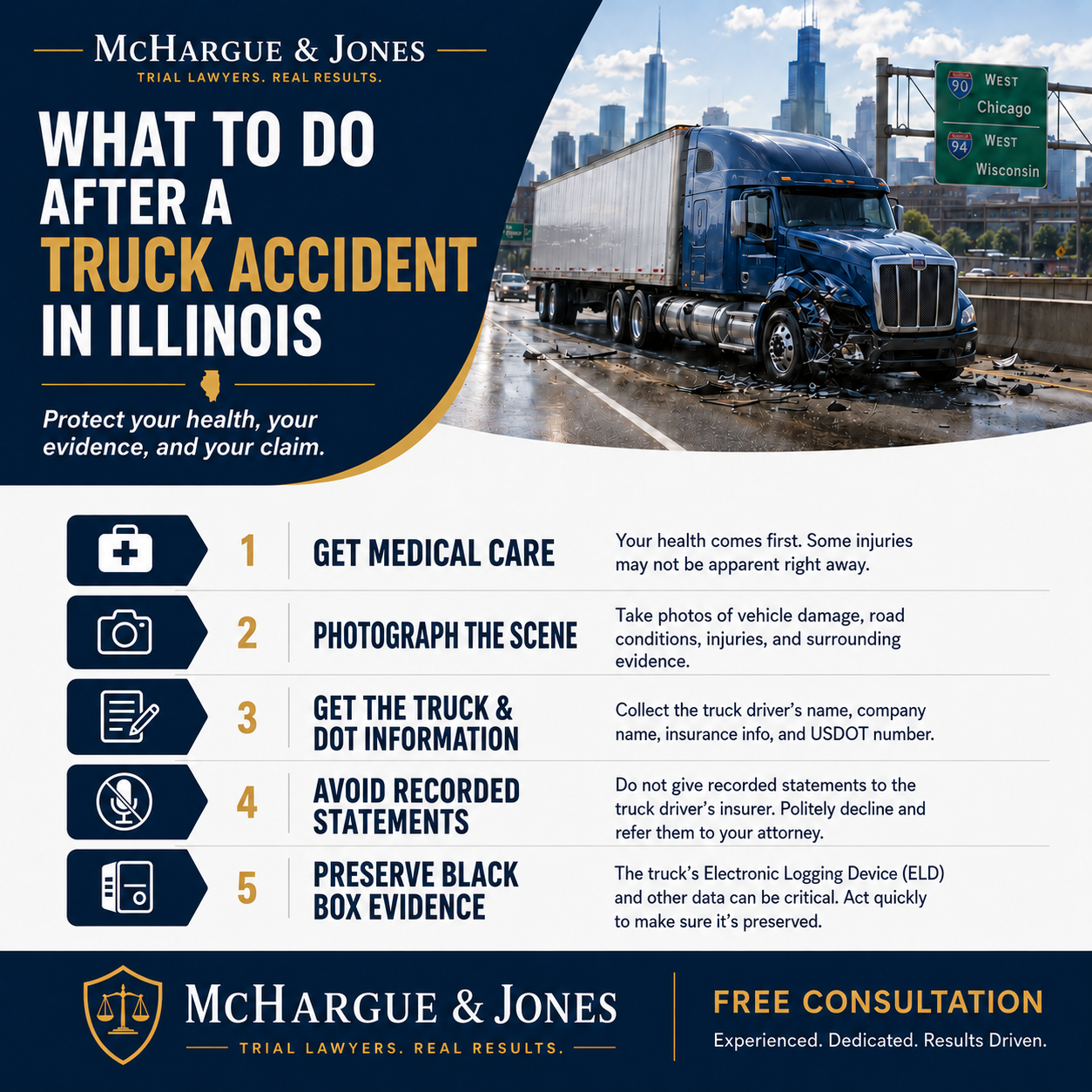


What To Do After a Truck Accident in Illinois
If you were hit by a semi-truck, box truck, delivery truck, dump truck, or other commercial vehicle in Illinois, the first steps you take can affect your health, your evidence, and the value of your case.
Truck accidents are different from ordinary car accident cases. The injuries are often more serious, the insurance policies are usually larger, and the trucking company may begin protecting itself almost immediately. Important evidence like black box data, driver logs, dashcam footage, maintenance records, and cargo records can disappear if no one acts quickly.
The short answer: after a truck accident, call 911, get medical care, photograph everything, identify the truck and trucking company, avoid recorded statements, and contact a truck accident lawyer quickly so critical evidence can be preserved.
At McHargue & Jones, LLC, we help injured people pursue serious truck accident claims in Illinois, including cases involving black box evidence, driver fatigue, brake failure, unsafe cargo, maintenance violations, and commercial insurance disputes.
[/vc_column_text][/vc_column][/vc_row]
Injured in an Illinois truck accident? Call (312) 739-0000 or contact us online for a free consultation before speaking with the trucking company’s insurer.
Quick Answer: What Should You Do After a Truck Accident?
If you are physically able, take these steps after a truck accident:
- Call 911 immediately and make sure a police report is created.
- Get medical care right away, even if pain seems manageable at first.
- Photograph the crash scene, vehicle damage, road conditions, debris, skid marks, and injuries.
- Identify the truck by photographing the license plate, trailer plate, company name, and DOT or USDOT number.
- Get witness information before people leave the scene.
- Do not admit fault or guess about what happened.
- Do not give a recorded statement to the trucking company’s insurer before getting legal advice.
- Save every document, including medical records, bills, repair estimates, and insurance letters.
- Contact a truck accident lawyer quickly so black box data, driver logs, and other truck-specific evidence can be preserved.
A general crash checklist can help, but truck cases require more. You can review our broader step-by-step guide on what to do after a car accident, but if a commercial truck was involved, the evidence preservation issues are more urgent.
Why Truck Accidents Are Different From Regular Car Accidents
Truck accident claims are more complex because they often involve commercial defendants, larger insurance policies, federal and state safety rules, and evidence controlled by the trucking company.
A truck accident case may involve:
- The truck driver
- The trucking company
- The trailer owner
- A maintenance company
- A cargo loading company
- A broker or shipper
- A parts manufacturer
- Another negligent driver
That is why truck accident claims need to be investigated differently. It is not enough to exchange insurance information and wait. Important evidence may include black box data, driver qualification files, inspection reports, maintenance records, cargo records, hours-of-service records, and dispatch communications.
For a deeper overview of these cases, visit our main page on Chicago truck accident claims.
Step 1: Call 911 and Get an Official Police Report
After a truck accident, call 911 right away. The police report can become one of the first important records in the case. It may identify the truck driver, trucking company, vehicle information, witnesses, insurance information, and initial crash details.
Do not rely on the truck driver, trucking company, or insurance carrier to “take care of it.” You need an official crash record.
When speaking with police, stick to the facts. Do not guess, speculate, apologize, or say you are fine if you are hurt. If you feel pain, dizziness, confusion, numbness, or any other symptom, say so clearly.
Step 2: Get Medical Care Immediately
Truck accidents often cause serious injuries because of the size and weight difference between commercial vehicles and passenger cars. Even if you do not feel the full pain immediately, you should get evaluated as soon as possible.
Same-day medical care protects your health and creates a record connecting your injuries to the crash. Delays in treatment give the insurance company room to argue that your injuries were not caused by the truck accident or were not as serious as you claim.
This is especially important for concussions, neck injuries, back injuries, internal injuries, fractures, shoulder injuries, knee injuries, nerve symptoms, and delayed pain. For more detail, read our guide on why seeing a doctor after a crash matters.
Step 3: Photograph the Scene Before Evidence Changes
Truck accident scenes change quickly. Vehicles get towed, debris gets cleared, skid marks fade, and road conditions may look different later.
If you can safely do so, take photos and videos of:
- All vehicles involved
- Damage to your vehicle
- Damage to the truck and trailer
- The truck’s license plate
- The trailer license plate
- Company names and logos on the cab or trailer
- DOT or USDOT numbers
- Skid marks, debris, fluid spills, and roadway conditions
- Traffic signs, signals, construction zones, and lane markings
- Your visible injuries
These photos can help prove how the crash happened and who may be responsible.
Step 4: Identify the Trucking Company and DOT Number
In a regular car crash, the claim often focuses on one negligent driver. In a truck accident, the truck driver may only be one part of the case.
Try to identify:
- The truck driver’s name and contact information
- The driver’s employer
- The trucking company name on the cab
- The DOT or USDOT number
- The tractor license plate
- The trailer license plate
- The company listed on insurance paperwork
- Any cargo, shipping, or broker information visible at the scene
This matters because a truck accident claim may involve more than one company. The truck may be owned by one entity, driven by another, maintained by another, and loaded by another. Identifying the right parties early can make a major difference.
Step 5: Get Witness Information Before People Leave
Witnesses can disappear quickly after a crash. If someone saw what happened, get their name, phone number, and email address if possible.
Witnesses may help prove that:
- The truck driver was speeding
- The truck changed lanes unsafely
- The truck driver ran a red light or failed to stop
- The truck appeared overloaded or unstable
- The truck driver was distracted or fatigued
- The truck’s brakes or equipment appeared to fail
The police report may not include every witness. Getting this information early can help preserve testimony before memories fade.
Step 6: Do Not Give a Recorded Statement to the Trucking Company’s Insurer
The trucking company’s insurance carrier may contact you quickly. They may sound polite and say they only need your version of events. They may ask for a recorded statement.
Be careful.
You may need to report the crash to your own insurer if your policy requires it, but you should not give a recorded statement to the trucking company’s insurance carrier before understanding your rights. Recorded statements can be used to minimize your injuries, shift blame, or lock you into incomplete answers before the medical picture is clear.
This is one reason it is important to understand when to hire a lawyer after a serious accident. In truck cases, earlier is often better because trucking companies and their insurers move quickly.
Step 7: Preserve Black Box Data, Driver Logs, and Truck Records
Truck accident cases often turn on evidence that does not exist in ordinary car crashes. Important evidence may include:
- Black box or ECM data
- Electronic logging device records
- Driver hours-of-service records
- Dispatch records
- Maintenance and inspection records
- Brake inspection records
- Dashcam or in-cab video
- Cargo loading records
- Weight tickets or hazardous cargo records
- Driver qualification and training files
This evidence may not be preserved forever. Some data can be overwritten, deleted, or lost if action is not taken quickly. A lawyer can send preservation letters to the trucking company, insurer, and other evidence holders.
For more on this issue, read our page on how black box data can help in a truck accident case.
Step 8: Save Every Document Related to the Truck Crash
Keep a file with everything related to the crash, including:
- Police report information
- Medical records and discharge papers
- Medical bills
- Prescription receipts
- Physical therapy records
- Vehicle damage photos
- Repair estimates
- Lost wage records
- Insurance letters and emails
- Photos of injuries as they heal
You should also write down what happened while your memory is fresh. Include the date, time, location, weather, traffic, what you saw, what you felt, and what hurt afterward.
Step 9: Watch for Truck-Specific Causes of the Crash
Truck accidents may be caused by more than simple driver error. Common truck-specific issues include:
- Driver fatigue
- Speeding or unsafe lane changes
- Distracted driving
- Brake failure
- Poor maintenance
- Overloaded cargo
- Improperly secured cargo
- Hazardous cargo problems
- Violation of trucking safety rules
These issues can affect liability and case value. For related truck-specific topics, see our pages on common causes of large truck accidents, truck brake failure liability, overweight and hazardous cargo truck accidents, and Illinois truck driving safety regulations.
Step 10: Contact a Truck Accident Lawyer Before Evidence Disappears
You do not need to know every legal issue before calling a lawyer. That is the lawyer’s job.
A truck accident lawyer can help:
- Identify the trucking company and insurance coverage
- Send preservation letters for black box data and records
- Investigate driver logs, dispatch records, and maintenance records
- Review brake, inspection, and cargo evidence
- Deal with the trucking company’s insurance carrier
- Document your injuries, wage loss, and future damages
- Evaluate whether more than one party is responsible
If cost is part of your concern, read our page on how much a car accident lawyer costs in Illinois. Truck accident injury cases are also commonly handled on a contingency fee, meaning no upfront attorney fee in many cases.
What If the Truck Accident Happened While You Were Working?
If you were working when the truck accident happened, there may be more than one claim.
You may have:
- A workers’ compensation claim through your employer
- A personal injury claim against the truck driver or trucking company
- A third-party claim against a maintenance company, cargo loader, or another negligent party
This can apply to delivery drivers, commercial drivers, warehouse workers, construction workers, utility workers, field service workers, and others injured while working.
For more on the work-injury overlap, see our article about how an Amazon semi crash on the Kennedy Expressway highlights workers’ compensation issues for Chicago delivery drivers. You may also find our post on holiday trucking accident causes helpful if the crash involved delivery pressure, seasonal volume, or commercial driving conditions.
What Not To Do After a Truck Accident
Avoid these mistakes after a truck accident:
- Do not leave the scene before police arrive unless emergency medical care requires it.
- Do not admit fault.
- Do not guess about your injuries.
- Do not give a recorded statement to the trucking company’s insurer.
- Do not post about the crash on social media.
- Do not repair or dispose of your vehicle too quickly if it may be evidence.
- Do not accept a fast settlement before knowing the full medical picture.
Fast settlement offers can be especially dangerous in truck accident cases because the injuries, future care, and available insurance coverage may be much larger than they first appear. If you are trying to understand value, see our page on what a car accident case may be worth in Illinois.
How Much Is a Truck Accident Case Worth?
Truck accident cases are often worth more than ordinary car accident cases because they frequently involve severe injuries, commercial insurance policies, and multiple responsible parties.
Case value may depend on:
- The severity of the injuries
- Whether surgery is required
- Whether the injury is permanent
- Whether you missed work or cannot return to your job
- The amount of available insurance coverage
- Whether the truck driver or company violated safety rules
- Whether black box, maintenance, brake, or cargo evidence supports liability
Truck cases deserve careful review before any settlement is accepted. Commercial insurers know these cases can be high-value, and they often investigate early to protect themselves.
Frequently Asked Questions About What To Do After a Truck Accident
What is the first thing I should do after a truck accident?
Call 911, get to safety if possible, and request medical help. Then document the scene if you are physically able.
What information should I get after a truck accident?
Try to get the truck driver’s name, trucking company name, insurance information, license plate numbers, trailer plate number, DOT or USDOT number, witness information, and the police report number.
Should I talk to the trucking company’s insurance adjuster?
You should be very careful. Do not give a recorded statement to the trucking company’s insurer before understanding your rights and speaking with a lawyer.
Why is black box data important in a truck accident case?
Black box or ECM data may show speed, braking, throttle use, sudden deceleration, and other information about how the truck was operated before the crash.
How quickly should I contact a lawyer after a truck accident?
As soon as possible. Truck accident evidence can disappear quickly, and preservation letters may be needed to protect black box data, driver logs, dashcam footage, maintenance records, and other key proof.
What if I was working when the truck accident happened?
You may have both a workers’ compensation claim and a personal injury claim, depending on the facts. This is common when delivery drivers, commercial drivers, or other workers are injured in roadway crashes.
Are truck accident cases different from car accident cases?
Yes. Truck accident cases often involve commercial insurance, multiple liable parties, federal and state trucking regulations, black box data, driver logs, maintenance records, and more severe injuries.
Hurt in an Illinois Truck Accident? Get Help Before Evidence Disappears.
After a truck accident, time matters. The trucking company and its insurer may already be investigating. You should have someone protecting your side too.
McHargue & Jones, LLC helps injured people pursue serious truck accident claims throughout Chicago and Illinois. We investigate liability, preserve evidence, deal with the insurance companies, and fight for the compensation available under the law.
Call (312) 739-0000 or contact us online for a free consultation.
You do not pay unless we win.