

How Insurance Policy Limits Work in Illinois Car Accident and Truck Accident Cases
Short answer: insurance policy limits are the most an insurance company has to pay on a claim. In a typical Illinois car accident case, that may mean only $25,000 for one injured person. In a commercial truck accident case, the available insurance can be much higher, but the coverage analysis is also more complicated because there may be multiple companies, multiple policies, and multiple liable parties involved.
What are insurance policy limits in an Illinois accident case?
Policy limits are the ceiling on available insurance coverage. That matters because what your Illinois car accident case is worth is not always the same as what insurance is available. A strong injury case can still be capped by low coverage. A harder-fought case may be worth pursuing because there is more coverage on the table.
What does 25/50/20 mean in an Illinois car accident case?
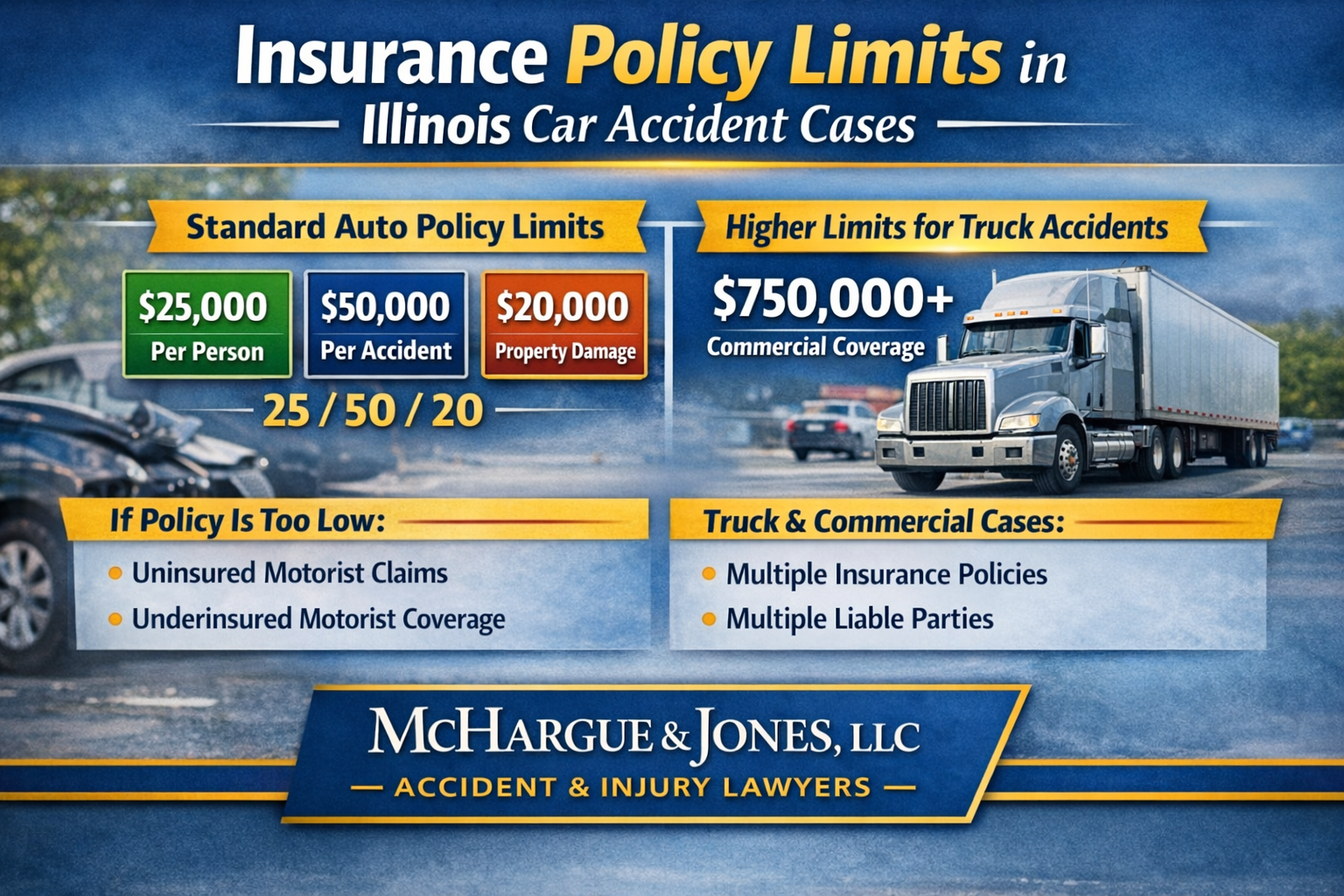
For many personal auto policies in Illinois, the minimum liability coverage is:
- $25,000 per person for bodily injury
- $50,000 per accident for bodily injury total
- $20,000 for property damage
So if the at-fault driver carries minimum coverage and you are the only injured person, the most that driver’s liability insurer may pay for your bodily injury claim is often $25,000, even if your damages are much higher.
Why policy limits matter so much in smaller Illinois car accident claims
If your medical bills, lost wages, and pain and suffering push the case higher than $25,000, the claim can still stop at the available policy. That is why policy limits often control the practical settlement value of a case, especially when the other driver has only minimum coverage.
Policy limits matter because even a serious injury may be limited by the available insurance. That includes claims involving medical bills, lost wages, future care, and pain and suffering damages after an Illinois car accident.
What happens if your case is worth more than the at-fault driver’s policy?
That is where coverage strategy matters. If the at-fault driver has no insurance, you may need an uninsured motorist claim in Illinois. If the driver has some insurance but not enough, you may need an underinsured motorist claim in Illinois. In other words, the first policy is not always the end of the case.
How commercial insurance policy limits work in truck accident cases
Truck accident cases are different from ordinary car wrecks because the at-fault vehicle may be covered by a commercial policy instead of a basic personal auto policy. In many interstate trucking cases, the minimum required coverage is higher than the Illinois personal-auto minimum. That does not automatically mean the case is easy or that the insurer will pay fairly. It does mean the insurance analysis can be more important, and sometimes more valuable, in a serious injury case.
Why truck accident policy limits can be higher than regular car insurance
Commercial trucks are larger, heavier, and capable of causing catastrophic harm. Because of that, commercial carriers may be required to carry much more insurance than a regular driver. In many interstate trucking cases involving non-hazardous property, the minimum can be far above a standard $25,000 Illinois auto policy. Some hazardous-material cases carry even higher required limits.
Does a truck accident always mean there is a big insurance policy?
No. Bigger truck cases often involve larger policies, but not every crash produces an easy high-limit recovery. Coverage depends on the type of carrier, the cargo, whether the trip was interstate, who owned the truck, and which companies were involved. The important point is that truck crash coverage should be investigated, not assumed.
Why truck accidents may involve more than one insurance policy
In a regular two-car crash, the coverage question may start and end with the at-fault driver’s auto policy. In a truck accident case, there may be multiple entities involved, including the driver, the trucking company, the truck owner, a maintenance company, a cargo-loading company, or even a manufacturer. That can mean more than one insurance policy may be relevant, depending on who caused or contributed to the wreck.
Why liability matters just as much as the policy limits
A high-limit policy does not help unless you can connect the injuries to a legally responsible party. In truck cases, that often means looking beyond the driver and examining company practices, maintenance failures, loading problems, fatigue, scheduling pressure, and other systemic issues. That is one reason commercial truck accident claims are usually more complex than standard car accident claims.
Can you recover more than one policy limit after an Illinois crash?
Sometimes, yes. If more than one party is legally responsible, or if your own UM/UIM coverage applies, there may be more than one source of recovery. This is especially important in severe injury cases, fatal crashes, and truck wrecks where the damages can quickly exceed a single low-limit policy.
How a lawyer evaluates policy limits before talking settlement value
Before anyone can give a meaningful answer about settlement value, they need to know the injuries, the fault picture, and the available insurance. That includes whether the case is limited by a small personal auto policy, whether there is additional UM or UIM coverage, and whether a truck or commercial vehicle opens the door to larger policies and multiple defendants.
Even when a policy limit is paid, that does not mean the full amount goes to the injured person. See how much of a $25K, $50K, or $100K settlement you keep after fees, costs, and medical liens.
FAQ: Insurance policy limits in Illinois car and truck accident cases
What is the most the insurance company has to pay after an Illinois car accident?
Usually no more than the available policy limit. In many Illinois car accident cases involving minimum coverage, that means $25,000 for one injured person.
Are truck accident insurance policies usually bigger than regular car insurance policies?
Often yes, especially in interstate commercial trucking. But the actual available coverage depends on the carrier, the cargo, the route, and the companies involved.
Can my case be worth more than the insurance policy?
Yes. Your injury claim can be worth more than the available insurance. The problem is collecting the full value if the policy is too small.
What if the at-fault driver only has minimum coverage?
You may need to look at underinsured motorist coverage or uninsured motorist coverage, depending on the facts.
Why are truck accident insurance issues more complicated?
Because truck crashes may involve commercial policies, multiple liable parties, multiple insurers, and federal regulations that do not apply in a normal passenger-car accident case.